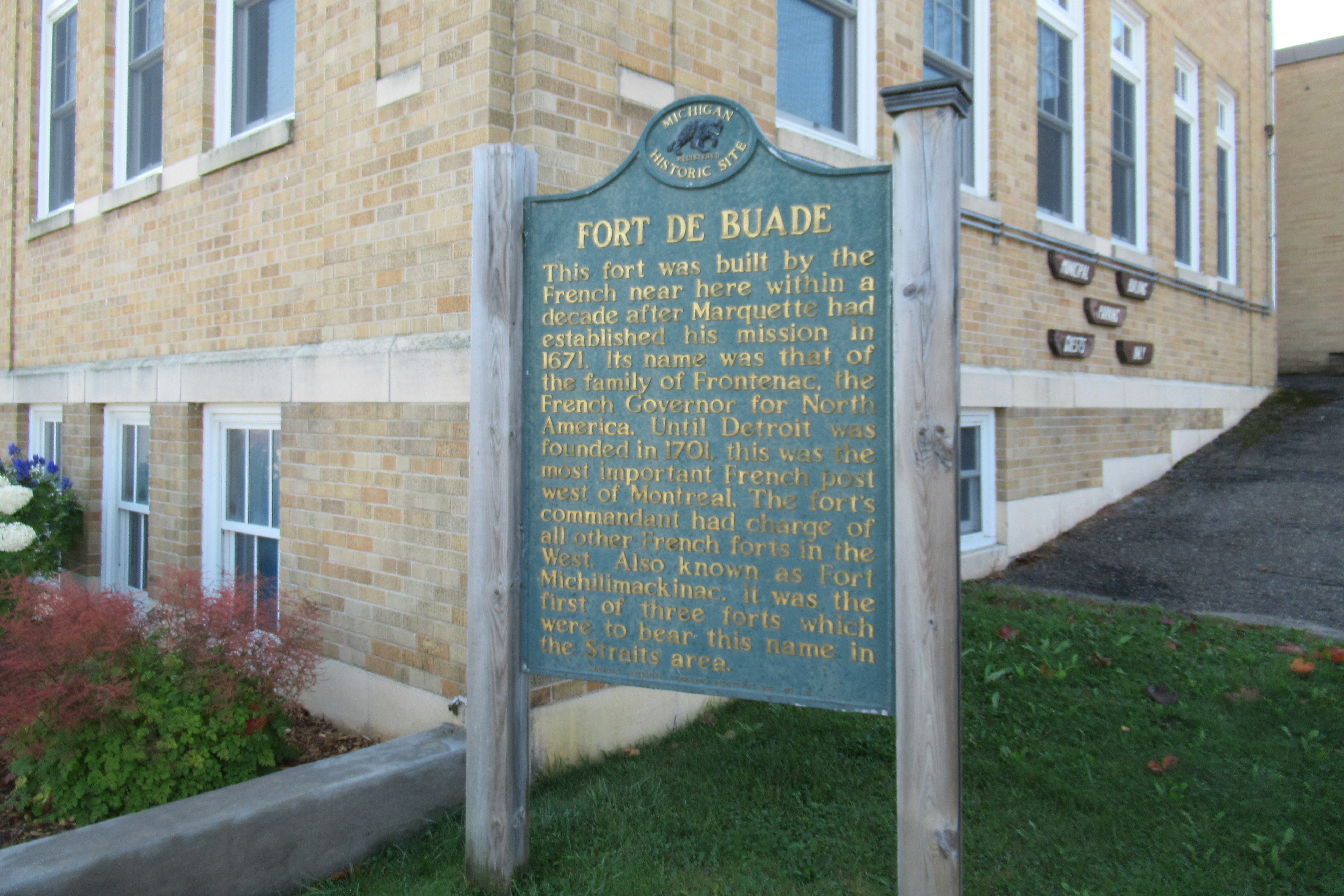
Fort de Buade
Somewhere beneath modern St. Ignace -- perhaps under a hill the locals call "Fort Hill," perhaps along the waterfront of East Moran Bay -- lie the vanished remains of Fort de Buade. No one has found them. The wooden stockade, garrisoned from 1683 to 1701, was one of New France's most important outposts, commanding the Straits of Mackinac where Lake Michigan meets Lake Huron. From this remote post, French commanders launched raids against the Seneca, brokered alliances with the Huron and Ottawa, and ran a fur trade empire that stretched from Thunder Bay to the Illinois River. The fort's most famous commandant, Antoine de la Mothe Cadillac, grew so wealthy and caused so much trouble that he was effectively reassigned -- to found a new post on the Detroit River. The city of Detroit exists, in part, because Fort de Buade's commander needed somewhere else to go.
A Mission Becomes a Fortress
The French presence at the Straits began not with soldiers but with a priest. Father Jacques Marquette established the Mission of Saint Ignace in 1671, and within a decade the settlement had grown into a considerable community: the mission itself, a French village of a dozen cabins, a Wyandot village enclosed by a wooden palisade, and an adjacent Odawa village similarly fortified. Tensions ran high. In 1681, the Huron and Illiniwek at St. Ignace killed the Seneca chief Annanhac, who had been leading raids against western peoples. The Seneca were part of the Iroquois Confederacy, and the killing drew New France deeper into the Beaver Wars -- the sprawling conflict over who would control the continental fur trade. In 1683, Governor La Barre ordered Daniel Greysolon, Sieur du Lhut, and Olivier Morel de La Durantaye to fortify the mission. La Durantaye became overall commander of French forts in the northwest, responsible for outposts as far-flung as Fort Kaministigoya on Thunder Bay and Fort Saint Louis in present-day Illinois.
Cadillac's Profitable Command
The fort that gave St. Ignace its military character was built in 1690 by commandant Louis de La Porte de Louvigne, constructed as a wooden stockade overlooking the Straits. During the 1690s it served as a staging ground for French and allied Indigenous raids against the Seneca, who had allied with the English. In 1694, Governor Frontenac -- for whom the fort was named -- sent his aggressive young protege Antoine de la Mothe Cadillac to run the post. Cadillac made a fortune, possibly through bribes. The Jesuit missionaries, led by Father Etienne de Carheil, accused him of encouraging the brandy trade with Native Americans. Cadillac may have seen alcohol sales as a necessary tactic to compete with English traders offering their own goods. La Durantaye, his honest predecessor, had controlled the brandy trade and policed the fur merchants with a firm hand. He died in poverty. Cadillac did not share his scruples.
The Peace That Emptied the Fort
While Cadillac enriched himself, the Huron chief Kondiaronk was shaping history. In 1697, Kondiaronk led an attack on the Seneca at Lake Erie and won a crushing victory. Four years later, he played a leading role in forging the Great Peace of Montreal in 1701, which ended decades of warfare between New France and the Iroquois Confederacy. That same year, Cadillac received permission from Paris to establish a new post on the Detroit River to block British trade goods from reaching Lake Huron. He took the Fort de Buade garrison south and founded Fort Pontchartrain du Detroit -- the seed of modern Detroit. The Huron followed Cadillac south; the Ottawa eventually relocated to the new Fort Michilimackinac built on the Straits' south shore in 1715. St. Ignace was largely abandoned.
A Fort That Vanished
After the garrison departed in 1701, Fort de Buade's fate becomes murky. Unlicensed coureurs de bois continued trading at Michilimackinac, and Governor Vaudreuil used them to smuggle goods to northern nations during the War of the Spanish Succession. The fort may have served as a storehouse until Fort Michilimackinac was completed on the south shore in 1715. After that, few French remained at East Moran Bay. The wooden stockade either was deliberately destroyed or simply rotted away. Archaeological searches have not located its remains. The fort that helped launch Detroit, shaped the Beaver Wars, and commanded one of North America's most strategic waterways has returned entirely to the earth -- somewhere beneath the streets and lawns of modern St. Ignace.
From the Air
Fort de Buade's site lies at 45.87N, 84.73W in St. Ignace, Michigan, on the north shore of the Straits of Mackinac. From altitude, the Straits are unmistakable -- the narrow passage between Lake Michigan and Lake Huron, spanned by the Mackinac Bridge. St. Ignace sits on the Upper Peninsula side. East Moran Bay is visible along the town's eastern shore, where the fort likely stood. Mackinac Island lies just to the east. Pellston Regional Airport (PLN) is 18 miles south across the Straits. The nearest airport on the UP side is Chippewa County International (CIU) at Sault Ste. Marie, 55 miles east.