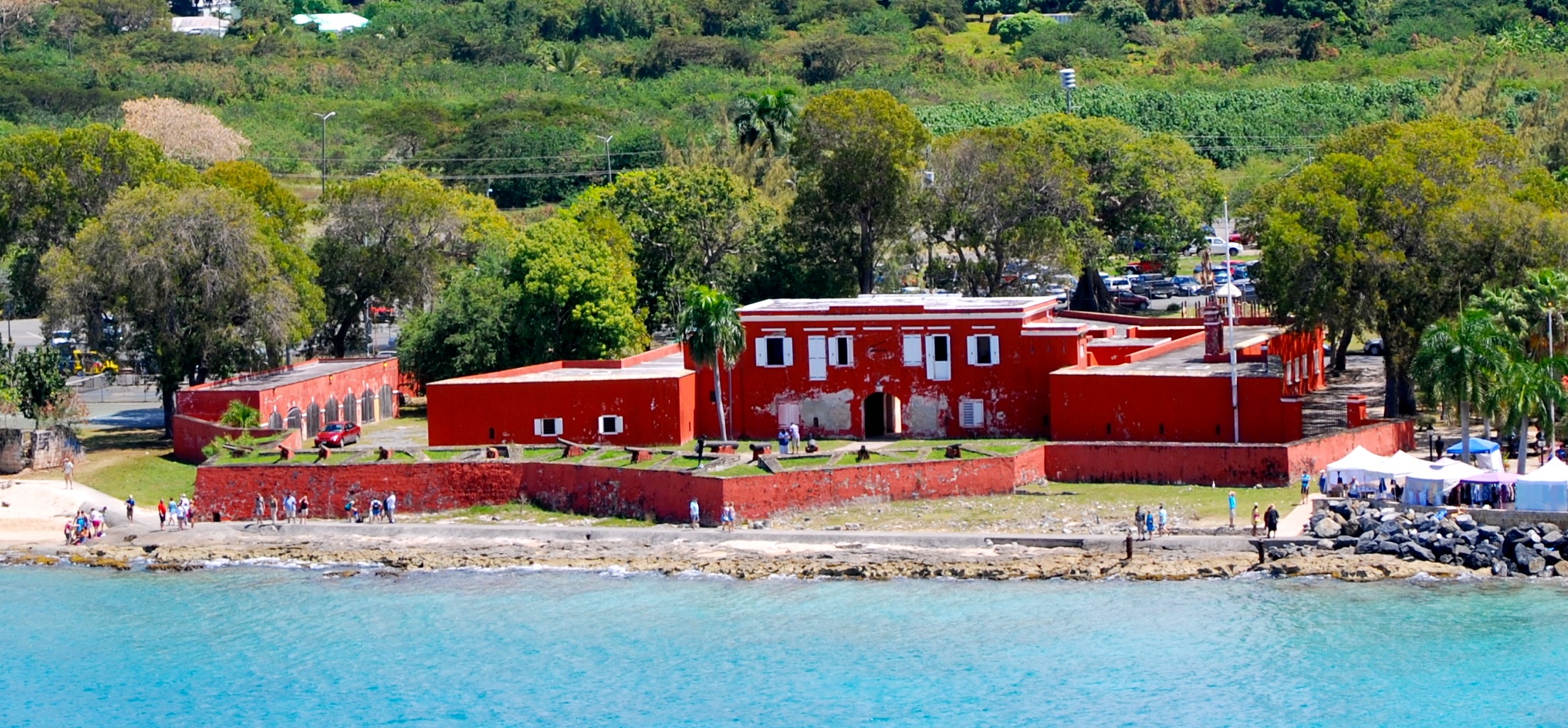
Fort Frederik
On July 3, 1848, roughly 8,000 enslaved people marched on the town of Frederiksted, St. Croix. They had not come to petition. They had not come to negotiate. They came in numbers that could not be ignored, led by a man known as General Buddhoe -- born John Gottliff, also called Moses Gotlieb -- and they came to the red-walled Danish fort at the edge of the harbor to demand their freedom. Governor-General Peter von Scholten, faced with a force that would not disperse and a garrison that could not contain it, stood in the fort and proclaimed emancipation for all enslaved people in the Danish West Indies. It was not a gift. It was a capitulation. And it happened here, at Fort Frederik, where the walls still carry the color of that confrontation.
Cannons Against the Night Tide
Denmark-Norway built Fort Frederik between 1752 and 1760 to defend the deep-water port at Frederiksted from pirates and to prevent merchant ships from slipping away at night without paying customs duties. As one colonial administrator noted, without a "water battery" commanding the anchorage, ships were "accustomed to slip away in the night-time without securing papers or paying their dues." The fort's walls were painted red and white -- deliberately different from the yellow and white of Fort Christiansvaern on the island's opposite coast, so that approaching sailors could tell at a glance which port they were entering.
The fort sits at the north end of Frederiksted, where Mahogany Road meets the coast. Its position commands a clear view of the harbor and the Caribbean beyond. Thick masonry walls, musket windows, and a battery of cannons facing the sea announce its purpose plainly. For decades, that purpose was commercial enforcement dressed in military architecture -- a customs house with firepower.
A Salute Across the Water
In 1776, an American brigantine flying the new flag of the rebellious colonies entered Frederiksted harbor. Fort Frederik's garrison fired a salute in recognition -- one of the earliest acknowledgments of the American flag by a foreign power. The gesture violated Denmark-Norway's official neutrality in the conflict between Britain and her colonies, but the Danish West Indies had long-standing commercial ties with the American settlements, and the salute reflected a practical friendliness between the two colonial economies.
Historians have debated the precise sequence of early flag salutes. Fort Oranje on the Dutch island of Sint Eustatius also fired a salute to an American vessel on November 16, 1776, and is more widely cited as the first formal recognition. What is not in dispute is that Fort Frederik's salute was among the very first, fired at a moment when the outcome of the American Revolution was entirely uncertain and the gesture carried real diplomatic risk.
The Day Freedom Was Taken
By 1848, St. Croix held roughly 17,000 enslaved people and 5,000 free Black residents. Denmark had abolished the slave trade in 1792 -- the law took effect in 1802 -- but the institution of slavery itself continued for another forty-six years. The end, when it came, was not the work of enlightened legislation or gradual reform. It was the work of the enslaved themselves.
General Buddhoe organized the march on Frederiksted with a discipline that left the colonial authorities no room to maneuver. Eight thousand people advancing on a small Caribbean town is not a crowd. It is an ultimatum. Governor-General von Scholten understood what refusal would mean -- a full-scale revolt that the garrison could not suppress -- and he proclaimed emancipation from Fort Frederik that same day, July 3, 1848. The decision ended his career; Danish authorities later charged him with exceeding his authority. But the freedom was proclaimed, and it could not be retracted. The people who forced that proclamation did what no legislative body had been willing to do.
The Park That Remembers
Today Fort Frederik houses a museum and art gallery within its red walls. Below the fort, Emancipation Park spreads along the Frederiksted waterfront, shaded by dozens of large mahogany trees and scented with tropical flowers. The Eliza James-McBean Clock Tower rises at one end. Statues of historically important Virgin Islanders stand among the paths, and the park explicitly honors General Buddhoe and the 1848 emancipation he forced.
The fort was listed as a contributing property in the Frederiksted Historic District in 1976 and individually placed on the National Register of Historic Places in 1996. On the third Friday of each month, Jazz in the Park fills the space below the fort with music. The mahogany trees have grown tall. Children play in the gazebo. It is a quiet place now, this ground where 8,000 people came to claim what was theirs. The red walls remain -- the same color that sailors used to identify Frederiksted from the sea, the same color that the marchers saw when they arrived to demand the end of slavery in the Danish Caribbean.
From the Air
Located at 17.72N, 64.88W on the western coast of St. Croix, at the north end of Frederiksted. The fort's distinctive red-and-white walls are visible at lower altitudes along the island's west coast. Frederiksted's cruise ship pier extends into the Caribbean nearby. Henry E. Rohlsen International Airport (TISX/STX) is approximately 5 nm to the southeast. Fort Christiansvaern at Christiansted is on the opposite end of the island, approximately 10 nm to the east-northeast.