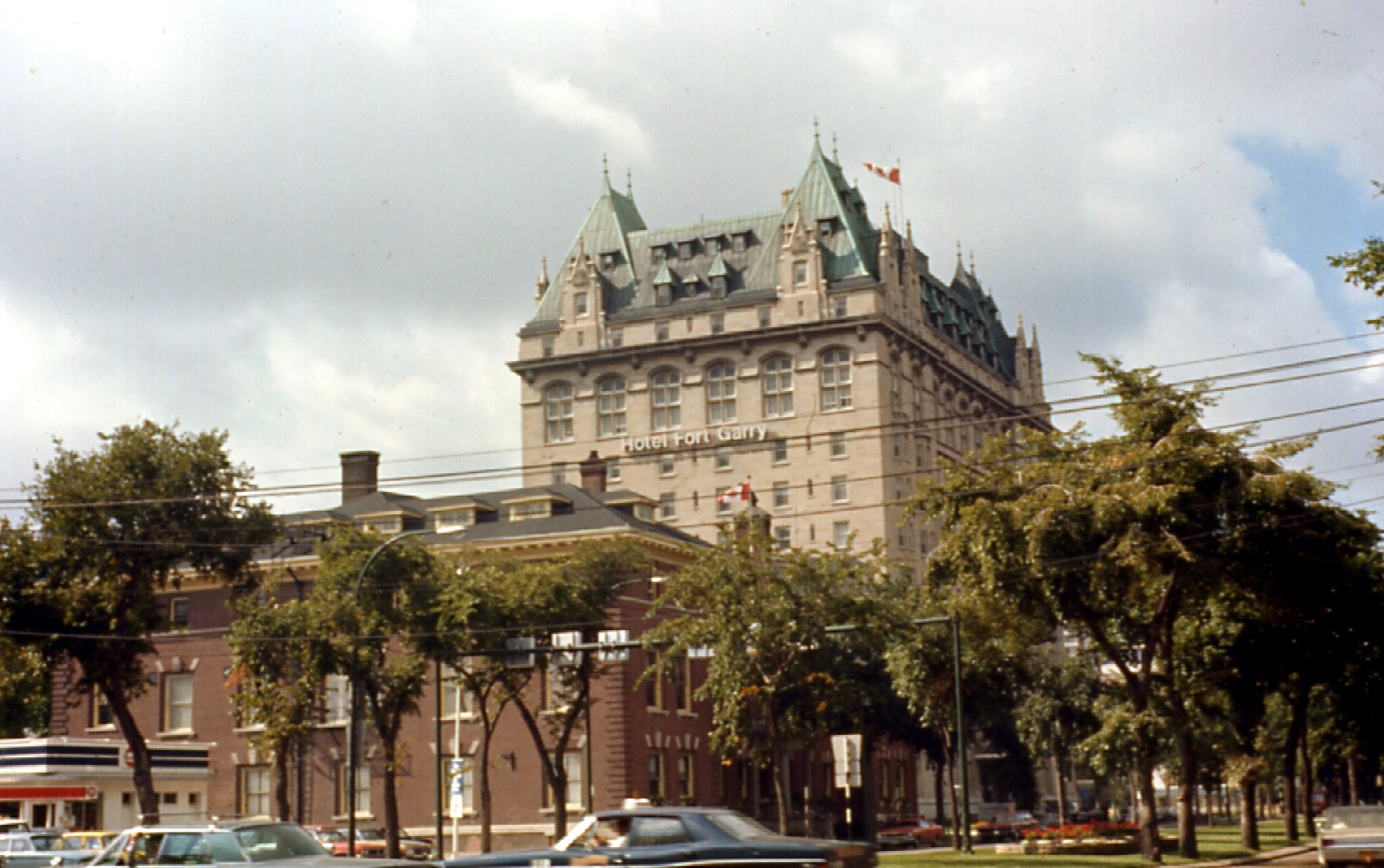
Fort Garry Hotel
When the Fort Garry Hotel opened its doors on December 10, 1913, with a grand ball that drew Winnipeg's social elite, it was the tallest building in the city -- thirteen storeys of Indiana limestone and grey granite crowned by steeply pitched copper roofs that gave the prairie skyline its first taste of French chateau grandeur. The Grand Trunk Pacific Railway had spent two years constructing what was meant to be an irresistible inducement: sleep here, ride our trains. One block away stood the railway's own Union Station, and the message was clear. Winnipeg was no longer a frontier outpost. It was a destination.
A Castle on the Prairie
Montreal architects George Ross and David MacFarlane designed the Fort Garry after the model of Ottawa's Chateau Laurier, making it Manitoba's only example of the chateauesque architectural style that defined Canada's grand railway hotels. The exterior combines the romantic silhouette of a Loire Valley chateau -- truncated hip roof, multiple peaks, progressively smaller dormer windows, pinnacles, and ornate chimneys -- with the monolithic form of a twentieth-century skyscraper. Smooth-cut Indiana limestone rises over a grey granite base. The copper roofs, now aged to a green patina, cap the structure with a profile that remains unmistakable against the flat horizon. Inside, the hotel offered luxury that matched its exterior promise, catering to the wealthy travellers who crossed the continent on the Grand Trunk Pacific and expected to find civilization waiting at every stop.
Fire, Taxes, and a One-Dollar Sale
The Fort Garry's first century was not kind. On December 7, 1971, at 1:30 in the morning, fire broke out on the seventh floor and damaged the top ten storeys. Fifty firefighters battled the blaze for two hours while 95 guests were evacuated; remarkably, only one man was hospitalized. The first three floors remained open even as smoke cleared above. By 1987, the hotel owed a staggering sum in back taxes and was described as being in 'urgent need of renovations to bring it up to modern-day standards.' The City of Winnipeg briefly owned the building before selling it in early 1988 to a company controlled by Quebec hotelier Raymond Malenfant -- for just one million dollars, with a promise of twelve million more in renovations. The deal signaled how far the once-grand hotel had fallen, and how uncertain its future remained.
The Ghost of Room 202
No account of the Fort Garry is complete without Room 202, the hotel's most famous -- and most fictional -- resident. The story goes that a woman, upon hearing of her husband's death in a car accident, hanged herself in the closet of the room many years ago. The tale has made the Fort Garry a staple of Canadian haunted-hotel lists. There is, however, no documentation to support it. No newspaper articles report a woman's death in the hotel, and the story itself has shifted over the decades, originally involving a man found dead before transforming into the more dramatic suicide narrative. The ghost may be pure invention, but the legend has proven remarkably durable -- and remarkably good for business.
Voices from the Seventh Floor
Before the fire and the ghost stories, the Fort Garry played a quieter but historically significant role in Canadian broadcasting. Between 1923 and 1932, the hotel housed the Winnipeg studio of CNR Radio, the precursor to CBC Radio. Using the original CKY transmitter on 665 kHz -- later moving to 780 kHz in 1925 -- the Canadian National Railway purchased airtime on stations it did not own, so-called 'phantom' stations, broadcasting from a hotel room to listeners across the prairies. It was an early experiment in national public broadcasting, born in the same building that had been built to move people by rail. Designated a National Historic Site in 1981 and a Manitoba Provincial Heritage Site in 1990, the Fort Garry stands today as the only surviving grand railway hotel in Winnipeg -- a copper-roofed reminder that this prairie city once sat at the crossroads of a continent.
From the Air
Located at 49.888N, 97.137W on Broadway in downtown Winnipeg, Manitoba. The hotel's distinctive chateauesque copper-green roofline makes it identifiable from the air among the surrounding modern buildings, one block north of the Assiniboine River and Union Station. Nearest major airport: Winnipeg James Armstrong Richardson International (CYWG), approximately 7 km west-northwest. Recommended viewing altitude: 3,000-5,000 ft AGL for downtown context. The Fort Garry sits roughly 500 metres southwest of The Forks, another major Winnipeg landmark.