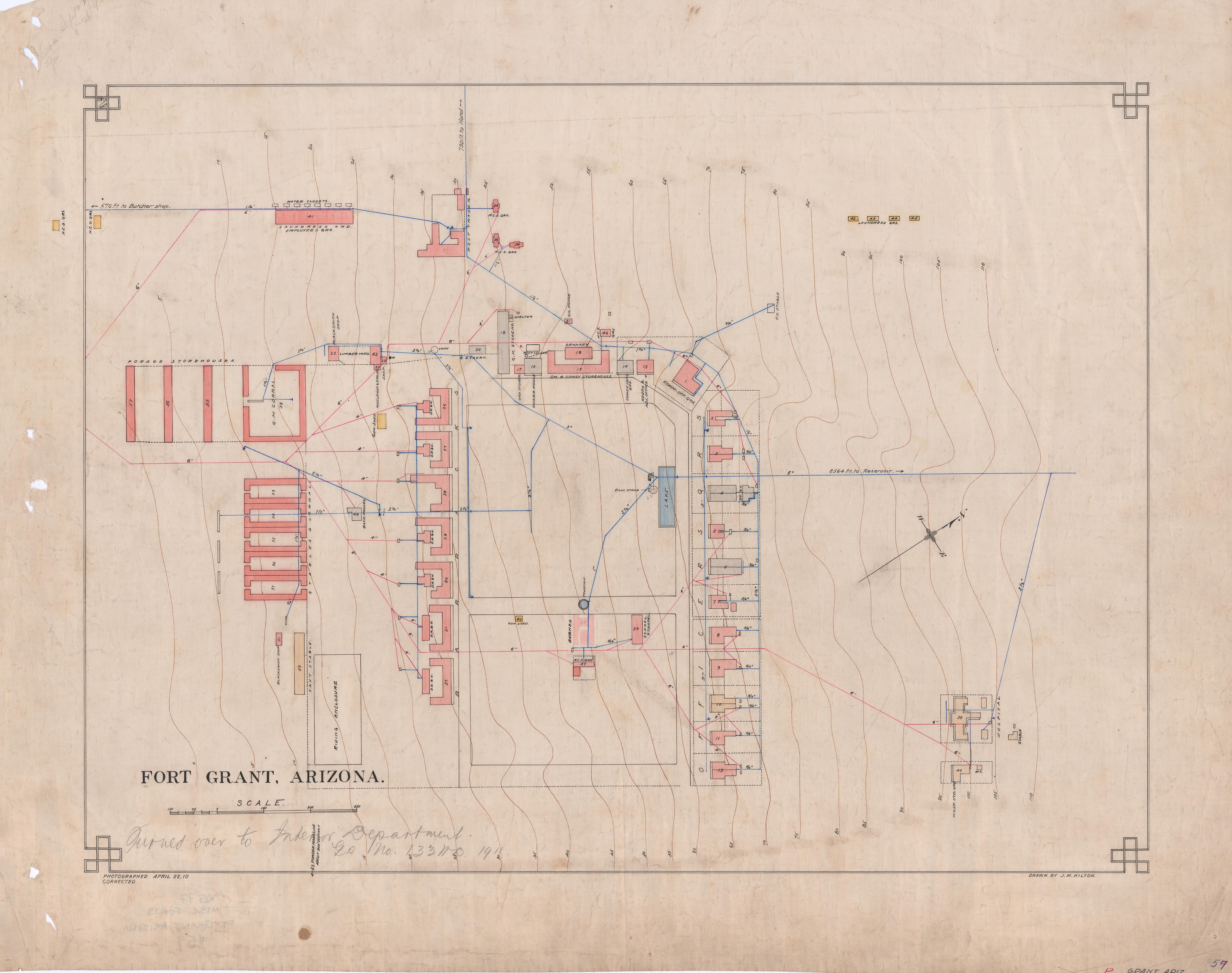
Fort Grant, Arizona
In 1877, a teenage ranch hand named Henry McCarty killed a blacksmith at a saloon near Fort Grant and was locked in the fort's stockade. He escaped to New Mexico Territory before he could be tried. The world would come to know him as Billy the Kid. Two decades later, a young man named Edgar Rice Burroughs arrived at the same fort after failing the entrance exam for West Point. He was discharged within a year, diagnosed with a heart condition. He went on to create Tarzan. Fort Grant has a way of launching people into legend, even as the fort itself transforms from frontier outpost to reformatory to state prison.
Four Names, One Location
Fort Grant was born in August 1860 as Fort Breckinridge, an Old West outpost at the junction of Aravaipa Creek and the San Pedro River. When Union troops evacuated at the start of the Civil War, the fort was destroyed and abandoned. It returned as Fort Stanford from 1862 to 1865 under the California Column, then became Camp Grant when the regular Army reoccupied the site. After the Camp Grant Massacre of 1871, when vigilantes slaughtered 144 Apaches who had surrendered to the Army, military planners decided a new location was needed. In 1872, they moved the post to the southwestern slope of Mount Graham, naming it Fort Grant after President Ulysses S. Grant. This final incarnation would stand watch over some of the bloodiest years of the Apache Wars.
Outlaws and Authors
The fort's most famous residents never intended to stay long. Billy the Kid worked as a ranch hand and sheep tender in the area in 1876, when he was still just Henry McCarty, a teenager drifting through the Arizona Territory. His first killing, at a saloon called the Bonita Store a few miles from the fort, set him on the path to infamy. He broke out of the Fort Grant stockade and fled to New Mexico, where his legend would grow with each subsequent gunfight. Edgar Rice Burroughs arrived in 1896 as an enlisted man, his dreams of becoming an officer dashed by his failure at West Point. A heart condition ended even that modest military career within a year. But the Arizona landscape, with its harsh terrain and ancient mysteries, would echo through the adventure fiction he later created.
Wars Foreign and Domestic
Throughout the 1880s, Fort Grant served as a key installation in the Apache Wars, protecting settlers from warriors who refused to accept confinement on reservations. The fort's strategic position on Mount Graham's slopes gave it commanding views of the approaches from Apache country. In 1889, it served as the departure point for the pay wagons targeted in the Wham Paymaster robbery, one of the Old West's most notorious heists. By 1900, with the Apache Wars long concluded, the fort was repurposed as a staging point for soldiers heading to the Philippines to fight in the Philippine-American War. The frontier had moved an ocean away.
From Barracks to Cellblocks
The Army abandoned Fort Grant in 1905, transferring all troops to Fort Huachuca and leaving only a caretaker behind. When Arizona achieved statehood in 1912, the state government saw potential in the empty buildings. The fort became the State Industrial School for Wayward Boys and Girls, its barracks and officers' quarters converted for a different kind of confinement. The transformation continued in 1968, when Arizona assigned the site to the Department of Corrections. By 1973, Fort Grant had become a state prison for male convicts, eventually incorporated into the Arizona State Prison Complex headquartered in Safford.
What Remains
The Fort Grant Historical Museum once occupied the lobby of the administration building, displaying artifacts from the fort's military history through its years as a reformatory and prison. That museum is now closed, the administration building shuttered with no known plans to reopen. Visitors are not allowed on prison property unless visiting an incarcerated inmate. An abandoned general aviation airport, Angel Field, sits immediately south of the prison, its runway as empty as the museum. Arizona State Route 266 winds through the mountains to reach this isolated spot, where the ghosts of Billy the Kid and Edgar Rice Burroughs share space with the living ghosts of the incarcerated. Mount Graham still rises above it all, indifferent to the purposes humans have found for its southwestern slopes.
From the Air
Located at 32.62N, 109.94W on the southwestern slope of Mount Graham in Graham County. The prison complex is visible from the air, with the abandoned Angel Field airport immediately to the south. Best viewed at 5,000-7,000 feet AGL due to the mountainous terrain. Mount Graham rises to 10,720 feet, so maintain safe altitude. Safford Regional Airport (KSAD) lies 15nm to the northeast. Tucson International Airport (KTUS) is 75nm to the west. Arizona State Route 266 can be traced winding up to the site. The Gila Valley stretches to the north, with the Pinaleno Mountains dominating the eastern horizon.