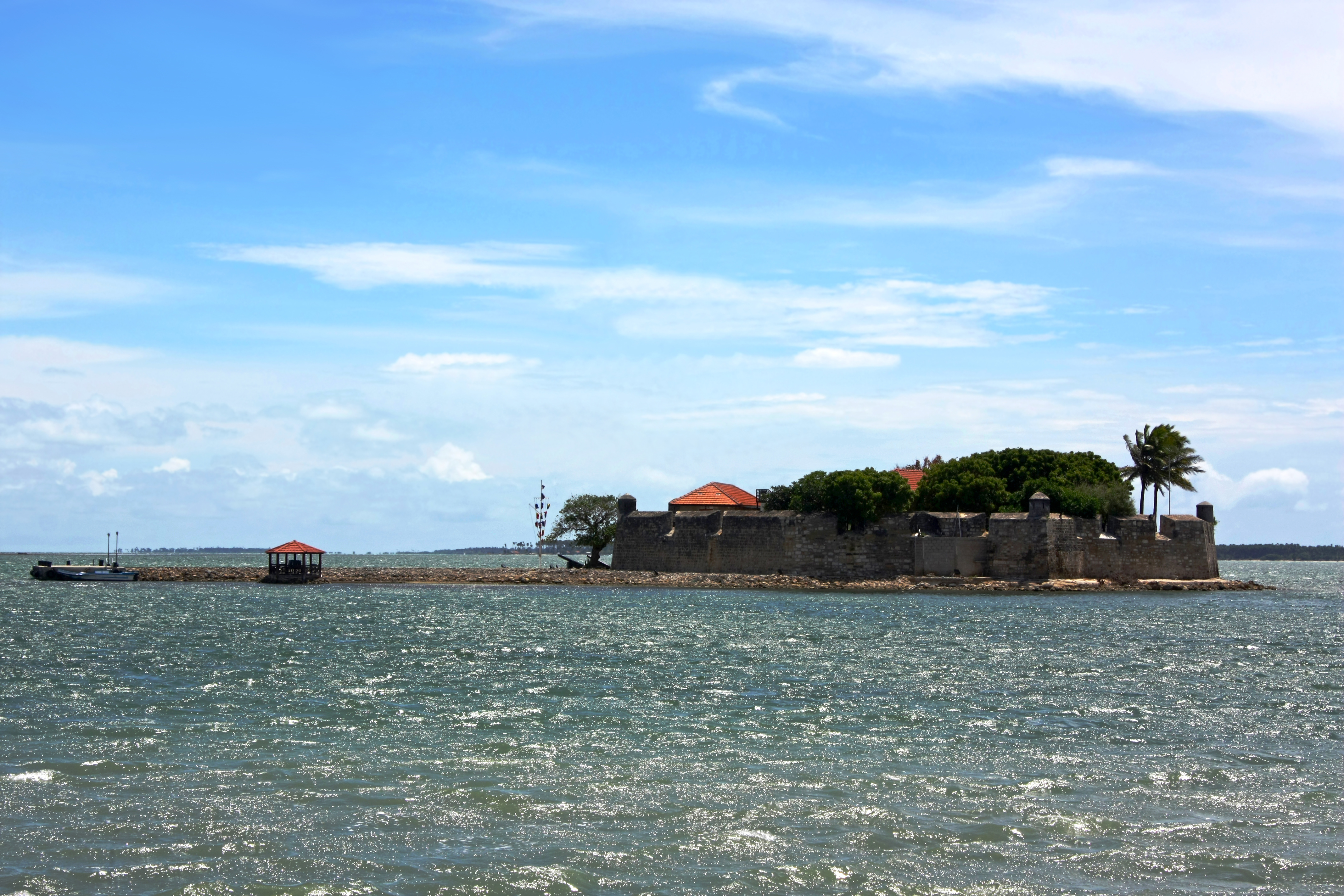
Fort Hammenhiel
The Dutch thought Ceylon looked like a smoked ham. Fort Hammenhiel - 'Heel of the Ham' - sits at the point where, in this peculiar cartographic metaphor, the shank bone would jut out. Built on a rocky islet barely larger than the fort itself, wedged between the islands of Kayts and Karaitivu at the entrance to the Jaffna lagoon, this coral-stone fortification has spent four centuries being useful to whoever controlled it. The Portuguese built it to guard a sea lane. The Dutch rebuilt it to project power. The British locked people inside it. The Sri Lankan state did the same. Now it is a hotel, and guests sleep in rooms that were once cells. The walls are thick enough to hold almost any story, and they have held quite a few.
Quarried Coral and Colonial Ambition
The Portuguese constructed the original fort in the mid-seventeenth century from quarried coral, naming it Fortaleza do Caes - Fort Royal. Its purpose was straightforward: control passage into the Jaffna Peninsula from the sea. In March 1658, Dutch forces under Captains Cornelies Reb, Piester Waset, and N. van der Reede captured the fort and gave it its lasting name. The Dutch were practical occupiers. They rebuilt Hammenhiel in 1680, constructing a stone breakwater around the islet, filling in the hollow ramparts with solid masonry, replacing the upper floor with a stone vault, and building a brick-lined reservoir to the north to catch rainwater. On an island with no freshwater source, that reservoir was as strategic as the cannons.
From Prison to Plague Ward
The British found a different use for Hammenhiel's isolation. Surrounded by water, with walls thick enough to discourage escape and currents strong enough to punish anyone who tried, the fort became a maximum-security prison. Later, when confinement of a different kind was needed, it served as an infectious diseases hospital - the logic being identical. An island fort keeps things in as effectively as it keeps things out. During the Second World War, the fort took on yet another identity. In late 1944, on orders from Admiral Lord Mountbatten, Camp Hammenhiel was established as a base for a Special Operations Group under Colonel Humphry Tollemache. Mountbatten visited the camp personally in November 1944. The fort's strategic position at the tip of the Jaffna Peninsula, overlooking the sea routes between Sri Lanka and India, made it valuable to every power that held it.
The Walls Remember
After independence, the fort continued to hold prisoners. In 1971, Rohana Wijeweera, the founder of the Janatha Vimukthi Peramuna (JVP), was detained at Hammenhiel following his arrest during the failed insurrection. Other political prisoners from the 1971 uprising followed - figures like Upatissa Gamanayake and the academic Jayadeva Uyangoda, who would go on to become one of Sri Lanka's most prominent political scientists. During the long civil war, Tamil political prisoners were held at the fort as well. T. Kumar, a Tamil student leader arrested for organizing a peaceful protest, was imprisoned without charge at Hammenhiel until Amnesty International named him a prisoner of conscience and secured his release after six months. The Sri Lanka Navy also used the fort to detain its own sailors accused of misconduct. Hammenhiel's purpose never really changed across centuries - only the names of the authorities and the prisoners rotated.
Checking Into History
After the civil war ended in 2009, the Sri Lanka Navy restored the fort extensively, and in 2015 it reopened as a hotel. The transformation is deliberate and slightly surreal. Guests arrive by boat, as prisoners once did. The rooms occupy spaces that were cells, and the fort's architecture - low ceilings, thick walls, narrow passages - reminds visitors at every turn that this building was designed to contain people, not comfort them. The coral walls that the Portuguese quarried from the seabed in the 1600s still stand, weathered by salt air and centuries of monsoons. From the ramparts, the view across the Jaffna lagoon is beautiful and indifferent - the same water that isolated prisoners now draws tourists. Whether this conversion from prison to hotel constitutes preservation or erasure depends on who you ask, and what they remember about the people who were held here.
From the Air
Located at 9.71N, 79.85E on a small rocky islet between Kayts Island and Karaitivu Island, at the western entrance to the Jaffna lagoon. The fort is clearly visible from the air as a rectangular stone structure occupying nearly the entire islet, surrounded by shallow turquoise water. The nearest airport is Jaffna International Airport (VCCJ), approximately 15 km to the east. Palaly Air Force Base is also nearby. Best viewed at 1,500-3,000 feet. Look for the narrow channel between Kayts and Karaitivu - the fort guards this passage. The Jaffna Peninsula stretches to the north and east, with Jaffna Fort (another Dutch colonial structure) visible on the coastline.