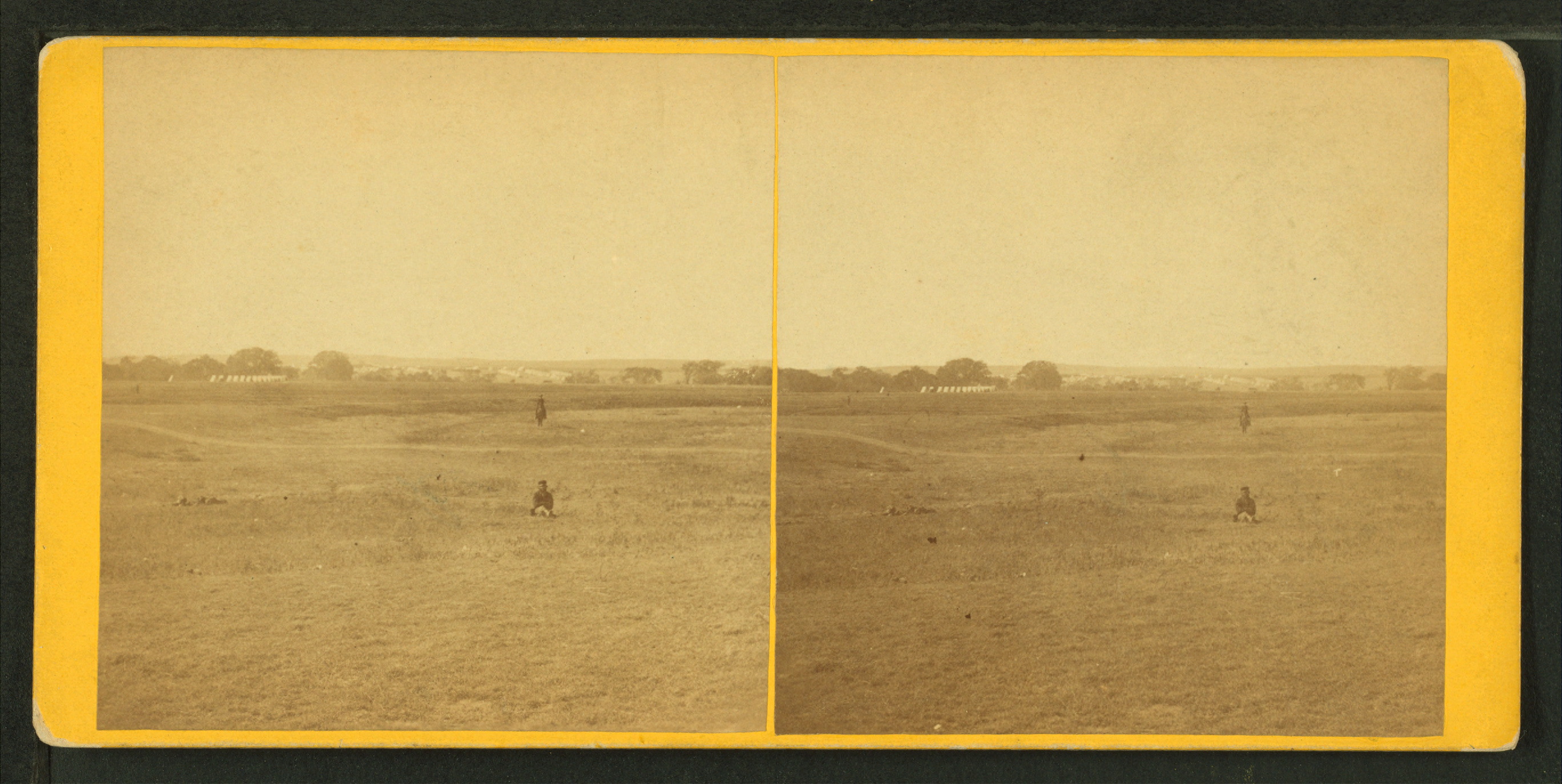
Fort Hays
They say Elizabeth Polly still walks the grounds. She died in 1867, a hospital matron who had spent her final days tending to cholera victims at a frontier Army post in western Kansas. Buried at the base of a nearby hill, she became local folklore: the Blue Light Lady, a spectral figure reportedly seen drifting through the area around the old fort. Ghost stories aside, Fort Hays needs no supernatural embellishment. Established on October 11, 1865, as Fort Fletcher -- named for Missouri governor Thomas C. Fletcher -- it was reborn as Fort Hays in November 1866 and operated until 1889 as one of the most important military installations on the Great Plains. Its roster of residents and visitors reads like a who's who of the American frontier: Buffalo Bill Cody, Wild Bill Hickok, George Armstrong Custer, Philip Sheridan, and even a Russian grand duke.
Three Forts in Four Years
Fort Hays had to be built three times. The original Fort Fletcher, established in October 1865 to protect Butterfield Overland Despatch stagecoaches from Cheyenne and Arapaho attacks along the Smoky Hill Trail, stood on Big Creek one-quarter mile south of its confluence with the North Fork. Despite the military presence, raids continued, the stage line went bankrupt, and Fort Fletcher closed on May 5, 1866. A second version opened in October 1866 at the creek confluence, was renamed Fort Hays in November, and served until June 1867. The final Fort Hays, the one that mattered, was established at a third location -- the site where the historic buildings stand today, immediately southwest of modern Hays, Kansas. Unlike stockaded frontier posts from earlier eras, Fort Hays had no walls. It looked more like a settlement than a fortification, its only defensive structure a single blockhouse. At its peak, it encompassed approximately forty-five buildings.
Legends on the Payroll
The fort's personnel files read like casting notes for a Western epic. Buffalo Bill Cody served as an Army scout, honing the frontier persona he would later transform into the world's most famous Wild West show. Wild Bill Hickok scouted from Fort Hays as well, his reputation for marksmanship and trouble already established. George Armstrong Custer used the fort as a base for his Plains campaigns -- campaigns that would culminate in his destruction at Little Bighorn eight years after leaving Kansas. Philip Sheridan, who would become General of the Army, planned his winter campaigns against the Cheyenne, Kiowa, and Comanche from Fort Hays. Even photographer Alexander Gardner visited in October 1867, documenting a frontier post that was already becoming legend. Grand Duke Alexei Alexandrovich of Russia stopped by to experience the American West firsthand.
Buffalo Soldiers on the Smoky Hill
Elements of the 10th Cavalry Regiment -- the Buffalo Soldiers -- were stationed at Fort Hays alongside the 38th Infantry Regiment. These Black soldiers served in some of the most demanding conditions on the frontier, earning their nickname from Plains peoples who saw in their courage and curly hair a resemblance to the buffalo they revered. The 10th Cavalry patrolled the Smoky Hill Trail and surrounding territory, protecting railroad construction crews and settlers while receiving minimal recognition and inadequate supplies. Their service at Fort Hays was part of a broader pattern of Black military achievement on the frontier, a chapter of American history that was long marginalized but is now recognized as essential to understanding how the West was secured and settled.
Auction Block and Second Life
The Army closed Fort Hays on June 1, 1889, and formally abandoned it on November 8. Samuel Mellison, who had served as post trader and sutler for nine years, was presented with the fort's flag at closing -- a personal memento of an era's end. The Kansas Legislature petitioned for the site to become a soldiers' home, but the Department of the Interior claimed custody instead. Kansas State University eventually took over part of the former reservation for an agricultural research station it operates to this day. In 1902, most of the fort's buildings were auctioned off or sold for scrap. What survived reopened as Frontier Historical Park in 1929. The Kansas Historical Society acquired the property in 1967, designating it the Fort Hays State Historic Site. The visitor center contains exhibits on the conflict between the U.S. and the Plains tribes, including artifacts from the period.
The University Across the Creek
Fort Hays State University, whose main campus lies north of the historic site across Big Creek and the US Route 183 bypass, draws its name directly from the old military post. The relationship between fort and university campus is a common one in the American West, where military reservations frequently became educational institutions once the frontier moved on. The film set used for Fort Hays scenes in Dances with Wolves was built near Rapid City, South Dakota, and now operates as a tourist attraction. But the real fort needs no Hollywood version. Its stone guardhouse, built in 1867, and the officers' quarters from 1867-1870 still stand on Kansas soil, their thick walls a tangible connection to the years when the Smoky Hill Trail was the most dangerous road in America.
From the Air
Located at 38.862°N, 99.342°W at approximately 2,000 feet MSL immediately southwest of Hays, Kansas. The Fort Hays State Historic Site is identifiable from the air by its cluster of stone buildings on the south side of the US 183 bypass. Big Creek runs between the historic site and the Fort Hays State University campus to the north. Hays Regional Airport (KHYS) lies northwest of the city. The site sits in the broad Smoky Hill River drainage area of western Kansas. The stone buildings and surrounding grounds are most clearly visible from 2,000-4,000 feet, with the university campus providing a useful reference for locating the smaller historic site across the creek.