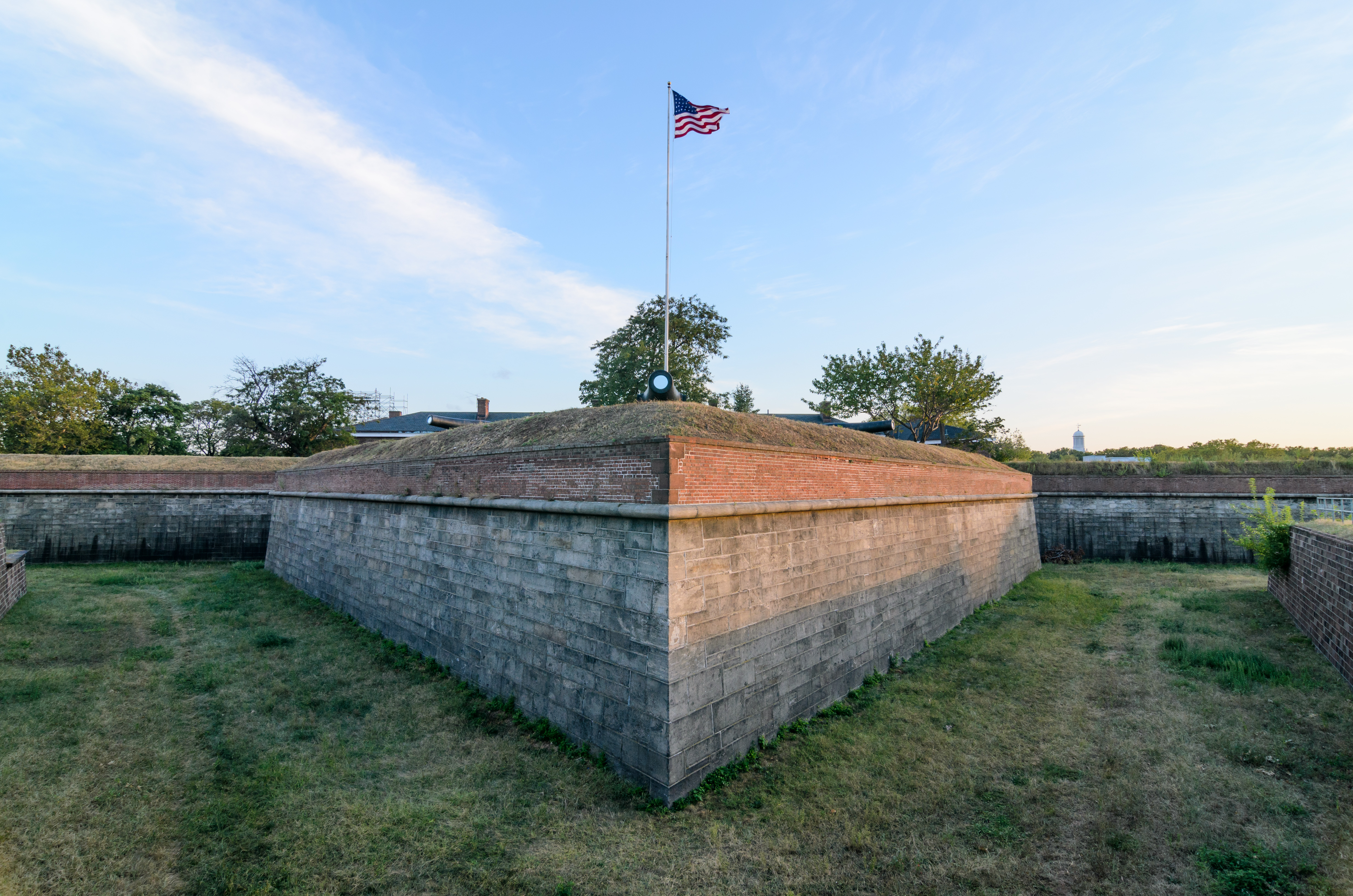
Fort Jay
New York State sold Governors Island to the federal government in February 1800 for one dollar. That single-dollar transaction secured a fortification that would shape two and a half centuries of American military history. Fort Jay, a star-shaped bastion of granite and sandstone perched on the highest point of the island, was built to guard the narrows of Upper New York Bay. It was named for Founding Father John Jay, then renamed Fort Columbus when Jay fell out of political favor, then rechristened Fort Jay again nearly a century later. Through revolutions, civil wars, and world wars, it remained the Army's anchor in New York Harbor -- and a place where future generals on both sides of the bloodiest American conflict once served together as young lieutenants.
Earthworks and Escape
The fortification's origins predate Fort Jay itself. In April 1776, General Israel Putnam began constructing earthen defenses on what was then called Nutten Island, a name derived from the Dutch Noten Eylandt, meaning "Nut Island." Armed with eight cannons, the batteries engaged British warships on July 12, 1776, inflicting enough damage to make the Royal Navy cautious about entering the East River. That caution proved decisive: it helped General George Washington execute his August 29-30 retreat from Brooklyn to Manhattan after the devastating Battle of Brooklyn. When the Americans abandoned the island that September, the British took over, improved the earthworks, and operated a Royal Navy hospital on the site until Evacuation Day on November 25, 1783. The island then passed to New York State, and the earthworks slowly crumbled through a decade of neglect.
A Fort Named Twice
New York State rebuilt the ruins as a square bastion with four corner bastions in 1794, naming it for John Jay -- governor, Chief Justice, Secretary of State, and negotiator of the controversial Jay Treaty with Britain. Congress appropriated $30,117 for further construction by 1797. But when Thomas Jefferson's Democratic-Republicans displaced the Federalists in 1800, Jay's treaty became a political liability. After Major Jonathan Williams redesigned the fort in 1806, replacing earthworks with granite and sandstone walls, a dry moat, and an arrow-shaped ravelin, the newly Jeffersonian administration quietly renamed it Fort Columbus. No documentation for the change has ever been found. The name stuck for 98 years, until Secretary of War Elihu Root restored the original in one of his final acts in February 1904.
Where Future Enemies Served Side by Side
As the closest major army post to West Point, Fort Columbus became the first posting for newly commissioned officers shipping to assignments along the Atlantic and Pacific coasts. The roster reads like a who's who of the Civil War, from both sides. Ulysses S. Grant and Robert E. Lee passed through as junior officers. So did Stonewall Jackson, Joseph Johnston, John Bell Hood, Abner Doubleday, and James McPherson. The fort that trained them together would later hold their captured comrades: during the Civil War, the north barracks served as a prisoner-of-war camp for Confederate officers awaiting transfer to facilities like Fort Delaware and Fort Warren. Major General William H.C. Whiting, the highest-ranking Confederate officer to die in captivity, succumbed to dysentery in the post hospital in February 1865 after his capture at Fort Fisher.
Guardian That Never Fought
Fort Jay's greatest military achievement may be the battles it prevented. Working in concert with Fort Wood on Liberty Island, Castle Clinton at the Battery, and Castle Williams on Governors Island itself, the fortification formed a defensive ring around Upper New York Bay that deterred the British Royal Navy during the War of 1812. Unable to breach the harbor defenses, the British chose softer targets -- the Great Lakes, the Chesapeake Bay, and the Gulf Coast. By the 1830s, advancing weapons technology had diminished the fort's protective value, but new purposes emerged. The Army established a recruiting center, an arsenal, and a music school on the island. After the Civil War, Fort Columbus became headquarters for the Division of the Atlantic and later the Department of the East, overseeing nearly all army activities east of the Mississippi. Its commanders included Winfield Scott Hancock, Nelson Miles, and Arthur MacArthur.
A Dollar Well Spent
Secretary of War Elihu Root expanded Governors Island from 60 to 172 acres using landfill from the newly constructed New York City Subway. He commissioned McKim, Mead and White to develop a master plan and personally ensured the three original fortifications were preserved. During World War II, Fort Jay housed the headquarters of First Army and later the Eastern Defense Command, coordinating defenses from Maine to Florida. The Army finally closed the post in 1964. The Coast Guard took over until 1996, using the fort's barracks -- converted to family housing by a 1930s WPA project -- as officers' quarters. In 2001, Fort Jay and Castle Williams were proclaimed part of the Governors Island National Monument. Today, visitors take a short ferry ride from Lower Manhattan to walk the glacis, peer into the dry moat, and stand on the spot where the cannons of Nutten Island once held the British fleet at bay.
From the Air
Coordinates: 40.6911°N, 74.0164°W. Located on Governors Island in New York Harbor, approximately 800 yards south of the southern tip of Manhattan. The star-shaped fort is visible from altitude on the highest point of the island. Nearest airports: KJFK (JFK International, 20 km SE), KLGA (LaGuardia, 16 km NE), KEWR (Newark Liberty, 8 km W). Best viewed at 1,500-3,000 ft AGL approaching from the south over Upper New York Bay, with the Statue of Liberty and Ellis Island visible to the west.