Fort Lancaster
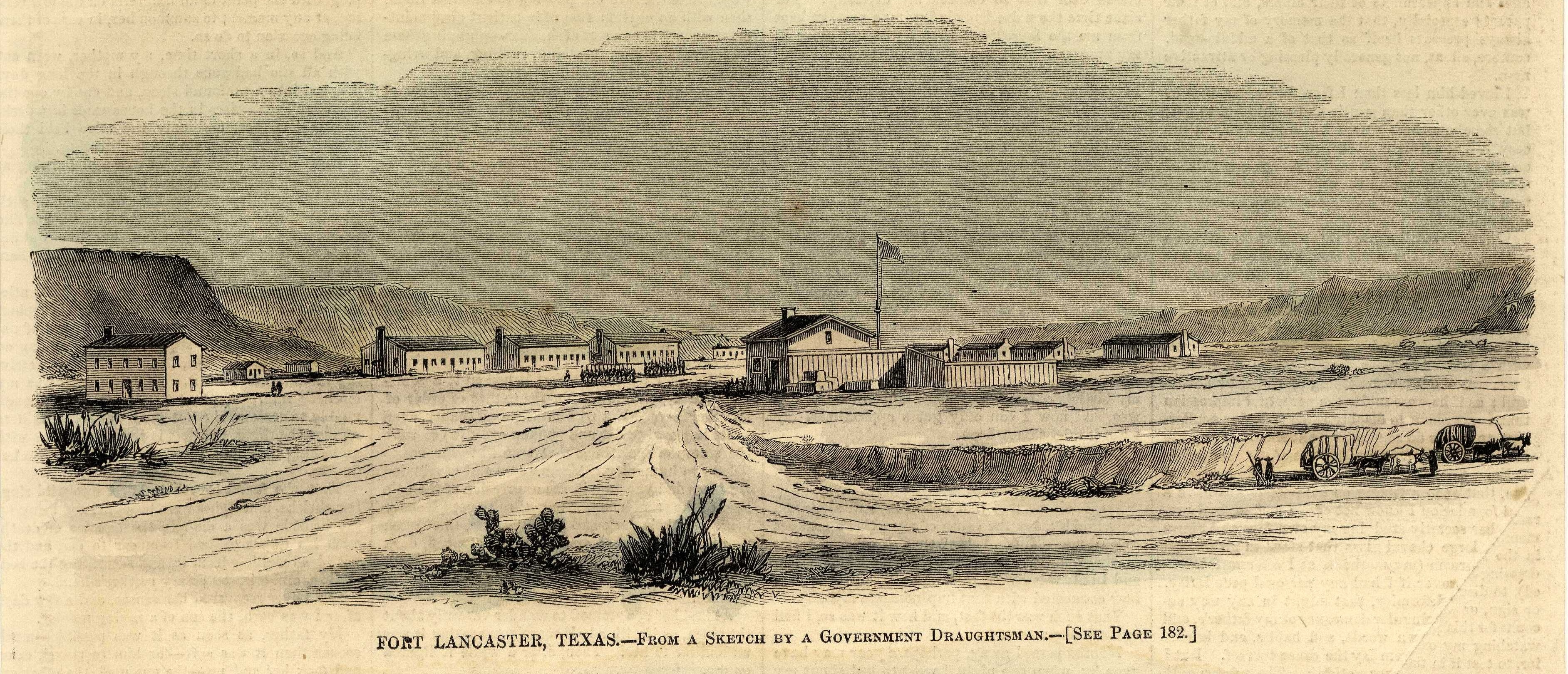
In the summer of 1855, General Persifor Frazer Smith faced a problem: between Fort Clark and Fort Davis lay 150 miles of wilderness along the San Antonio-El Paso Road, with no military presence to protect the wagon trains, mail coaches, and gold-seekers streaming toward California. On July 20, he ordered an outpost established where the Military Road crossed the Pecos River. Within weeks, Captain Stephen Decatur Carpenter and two companies of the 1st Infantry arrived at Live Oak Creek and began construction of Camp Lancaster, later made permanent as Fort Lancaster. For the next eighteen years, this isolated post would witness some of the strangest episodes of the American frontier: camel caravans, Confederate occupation, destruction by fire, and the heroic stand of African American cavalry against Comanchero raiders.
Building a Fort From Nothing
The soldiers who built Fort Lancaster faced extraordinary challenges. The nearest lumber was miles away, and the trans-Pecos desert offered little in the way of traditional construction materials. They began with jacales -- huts with wood or earth walls topped by canvas roofs -- and prefabricated buildings shipped by wagon and assembled on-site. Colonel Joseph K. Mansfield, inspecting the post in June 1856, found it composed mostly of these temporary structures. Gradually, the garrison built more permanent quarters of stone and adobe bricks: five officers' residences, two kitchens with attached mess halls, and barracks for enlisted men. Construction continued until 1860, when the fort finally lost what one quartermaster had described as its 'half-finished appearance.'
When Camels Came to Texas
On July 9, 1857, a caravan unlike any other arrived at Fort Lancaster: 40 men, 25 camels, and over a hundred sheep led by Edward Fitzgerald Beale, a former Navy lieutenant. The camels were part of the United States Camel Corps, an experimental Army unit testing whether these desert animals could serve as pack animals on the American frontier. The officers at Fort Lancaster invited Beale's caravan to stay the night, and the soldiers got their first look at the strange beasts that would become frontier legend. A second camel caravan passed through in June 1860. The experiment was actually promising -- camels could carry heavier loads and go longer without water than mules -- but the Civil War ended the program before it could be fully evaluated.
Civil War and Destruction
When Texas seceded in March 1861, General David E. Twiggs surrendered all federal installations in the state to Confederate authorities. Fort Lancaster's garrison departed on March 19, 1861, replaced by Confederate troops. That November, General Henry Hopkins Sibley passed through on his campaign to capture New Mexico for the Confederacy. The campaign ended in disaster at the Battle of Glorieta Pass, and Sibley's retreating forces abandoned Fort Lancaster on April 2, 1862. Around this time, the fort was destroyed by fire -- whether by retreating Confederates burning what they could not hold, or by Comanche or Apache warriors reclaiming territory, no one knows for certain.
The Battle of Fort Lancaster
After the Civil War, the US Army returned to Texas and began rebuilding the frontier defenses. In December 1867, Company K of the 9th Cavalry was stationed at Fort Lancaster -- African American cavalrymen, part of the regiments that would become known as Buffalo Soldiers. These troops faced discrimination even from fellow soldiers: they received inferior horses, sometimes riding mules instead, and were issued outdated weapons. Their motto captured their reality: 'forty miles a day on beans and hay.' On December 26, 1867, a large band of Kickapoo and Comanchero raiders attacked the fort, hoping to steal horses. Company K repelled the attack but lost 38 horses and mules. When some raiders returned two days later, the soldiers drove them off again. The Battle of Fort Lancaster was one of many small but fierce engagements fought by Buffalo Soldiers across the Texas frontier.
Ruins in the Desert
Fort Lancaster was abandoned for the final time by 1873, and within forty years, fire had destroyed the wooden superstructures of most buildings. Only stone walls, a few chimneys, and foundation outlines remained when archaeologists first surveyed the site in 1966. Today, the 82-acre Fort Lancaster State Historic Site preserves the ruins of 29 buildings arranged around the original parade ground. Archaeological excavations in the 1970s revealed carbonized wood-plank floors, iron door pintles, and other details of daily life at this remote outpost. The Texas Historical Commission now manages the site, where visitors can walk among the same stone walls that once sheltered soldiers waiting for camels, watching for Confederates, or standing guard against Comanchero raids in the bitter West Texas winter.
From the Air
Fort Lancaster State Historic Site lies at approximately 2,400 feet MSL in Crockett County, Texas (30.67N, 101.70W), near where the historic San Antonio-El Paso Road crossed the Pecos River. From the air, the site appears as a collection of stone ruins and foundation outlines arranged around a rectangular parade ground, surrounded by typical Chihuahuan Desert terrain. The site is located approximately 9 miles east of Sheffield, Texas, along US Highway 290. Nearest airports: Fort Stockton-Pecos County Airport (KFST) approximately 40 nm northwest; Ozona Municipal Airport (KOZA) approximately 35 nm northeast. The Pecos River is visible to the southwest of the site.