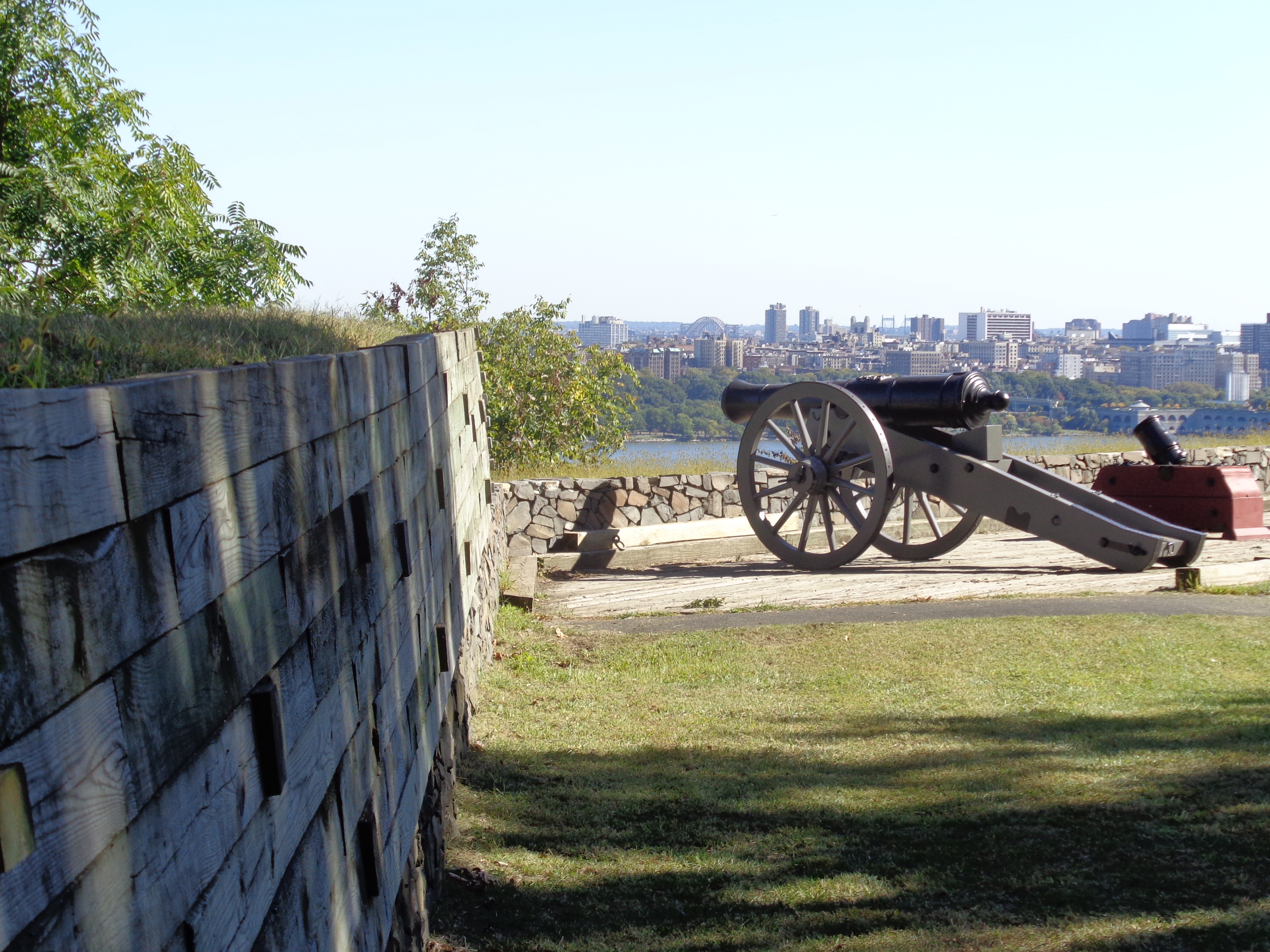
Fort Lee Historic Park
The night before everything fell apart, George Washington was rowed to the middle of the Hudson River in darkness. From a small boat somewhere between the New Jersey cliffs and the Manhattan shore, he met with his senior officers to plan the defense of New York - a defense he privately believed was impossible. The bluff he had departed from, high atop the Palisades in what is now Fort Lee, New Jersey, would within days become the site of one of the Revolution's most desperate retreats.
Twin Fortresses on a Doomed River
In the summer of 1776, Washington ordered General Hugh Mercer to build a fort on the western bank of the Hudson River. The position, initially called Fort Constitution and later renamed for General Charles Lee, sat atop the sheer cliffs of the Palisades, directly opposite Fort Washington on the northern tip of Manhattan. Together, these twin fortifications were meant to block British warships from sailing upriver and splitting the colonies in two. Chevaux-de-frise - underwater obstacles of iron-tipped wooden spikes - were sunk between the forts to snag enemy hulls. Local patriot Peter Bourdette gave up his house near the waterline and offered the labor of his enslaved workers to the construction effort. Over 2,600 Continental Army troops garrisoned the bluffs, building gun batteries, a blockhouse, and barracks along the cliff edge overlooking the river.
The View from the Bluff
On November 16, 1776, Washington stood on the Palisades above Burdett's Landing and watched the Battle of Fort Washington unfold across the river. It was a disaster. British General William Howe, commanding roughly 8,000 troops including Hessian soldiers under Lieutenant General Wilhelm von Knyphausen, overwhelmed the American garrison. The fort's commander, Colonel Robert Magaw, had vowed to fight 'to the last extremity,' but the British had been handed detailed plans of the American defenses by a deserting officer named William Demont. Nearly 2,838 American soldiers were captured. Washington, watching from across the water, could do nothing. Four days later, 5,000 British troops under Lord Cornwallis crossed the Hudson on barges and scaled the Palisades, aiming to trap Washington and end the rebellion entirely.
The Retreat That Saved a Revolution
Washington and General Nathanael Greene ordered an immediate evacuation on the morning of November 20, 1776. The retreat was chaotic - soldiers abandoned tents, cannons, and supplies as they fled west along what is now Main Street in Fort Lee, crossing the Hackensack River at New Bridge Landing and the Passaic River at Acquackanonk Bridge. Cornwallis pursued but could not close the trap. The retreating army stumbled south through New Jersey, demoralized and diminishing by the day. It was during this desperate march that Thomas Paine began writing 'The American Crisis,' opening with the words that would define the darkest hour of the Revolution: 'These are the times that try men's souls.' Washington's decision to retreat rather than stand and be destroyed preserved the Continental Army for the counterattack at Trenton six weeks later - the turning point of the war.
Cannons and Bridges
Today, Fort Lee Historic Park sits atop the same Palisades bluff where Washington's troops once trained their guns on the Hudson. The site, part of the Palisades Interstate Park system, includes a reconstructed blockhouse, gun battery, and soldiers' quarters that evoke the cramped, anxious months of 1776. Monument Park nearby, created by the Daughters of the American Revolution and dedicated in 1908 at a ceremony attended by General John 'Black Jack' Pershing, is one of only two parks in the United States dedicated specifically to the soldiers of the American Revolution. But the most striking feature of the park requires no historical imagination at all: from the northern overlooks, the George Washington Bridge arcs across the same river the Continental Army tried and failed to control, its massive steel cables spanning the gap between the same two shores that once defined the boundary between liberty and defeat.
From the Air
Located at 40.8503N, 73.963W on the New Jersey Palisades, directly west of the George Washington Bridge. The park sits atop dramatic cliffs overlooking the Hudson River, with clear sightlines to Upper Manhattan. The GW Bridge is the dominant visual landmark. Closest airports: KTEB (Teterboro, 5 nm NW), KLGA (LaGuardia, 8 nm E), KEWR (Newark Liberty, 14 nm SW). Best viewed at 1,000-2,000 ft AGL for the cliff-face perspective along the Palisades.