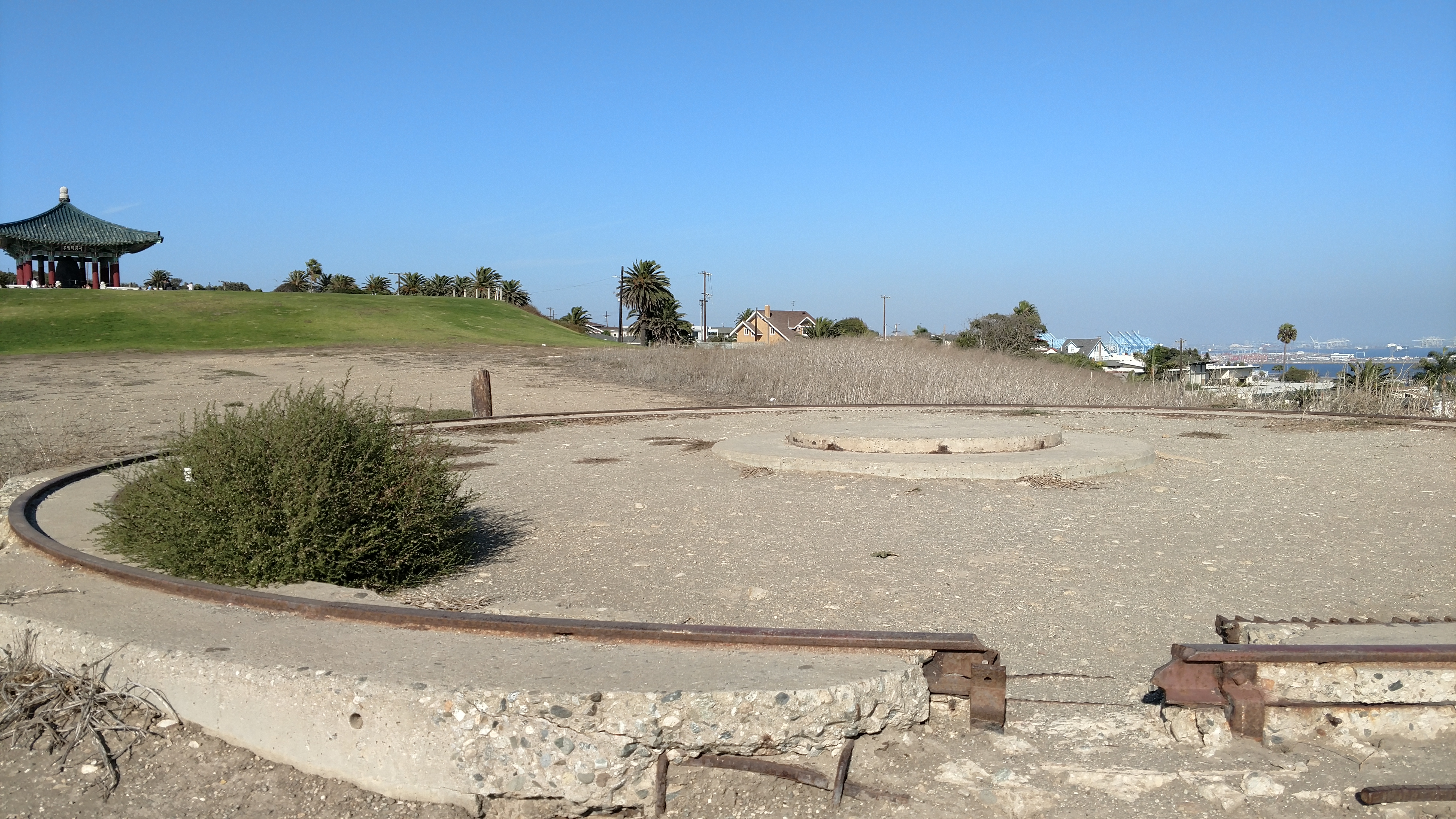
Fort MacArthur
When the big guns fired, windows shattered for miles. The test firings at Fort MacArthur were so unpopular with nearby residents that complaints flooded city offices throughout the 1920s and 1930s. Yet those massive coastal artillery pieces represented something crucial: Los Angeles had become valuable enough to defend. Named for Lieutenant General Arthur MacArthur - whose son Douglas would later command Allied forces in the Pacific - this fort on the bluffs of San Pedro spent nearly a century watching for threats that might come from the sea.
Grover Cleveland's Vision
In 1888, President Grover Cleveland looked at the expanding Los Angeles harbor and saw vulnerability. He designated an area overlooking San Pedro Bay as an unnamed military reservation, part of a nationwide effort to modernize America's coastal defenses. Additional land purchases in 1897 and 1910 expanded the site, and on October 31, 1914, Fort MacArthur was formally created. The timing proved fortunate: World War I transformed the fort into a training center, and by 1917, the first large gun batteries for harbor defense were operational. These fixed emplacements would stand guard over a coastline that was becoming increasingly critical to American industry and defense.
Arsenal of the Pacific
World War II revealed just how much Los Angeles had to protect. Fort MacArthur maintained both a Harbor Entrance Command Post and a Harbor Defense Command Post, coordinating the defense of an industrial empire: the CalShip and Todd Pacific shipyards, the aircraft factories of Douglas, Hughes, Martin, and Northrop, the Huntington Beach Oil Field, and the twin ports of Los Angeles and Long Beach. The Battle of Los Angeles in February 1942 - when anti-aircraft batteries fired into the night sky at what turned out to be a false alarm - demonstrated the very real fears of attack. By war's end, however, the era of big coastal guns was over. The last were decommissioned in 1948.
Cold War Sentinels
The threat evolved, and Fort MacArthur evolved with it. During the early Cold War, the installation became headquarters for the 47th Anti-Aircraft Artillery Brigade and a key node in the West Coast's air defense network. In 1954, a Nike surface-to-air missile battery was activated, part of a ring of nuclear-capable missiles protecting Los Angeles from Soviet bombers. The Fort MacArthur Direction Center, operational from 1960, coordinated sixteen Nike-Hercules missile sites across the Los Angeles Defense Area. The Missile Master bunker, with its underground 'Blue Room' operations center, represented the cutting edge of continental defense until Nike operations ended in 1974.
Transformation
The fort's rundown began in 1975 when it became a sub-post of Fort Ord. Two years later, the Army transferred the Upper and Lower Reservations to Los Angeles. The Lower Reservation was cleared, dredged, and transformed into Cabrillo Marina. The Upper Reservation became Angels Gate Park, now home to the Korean Bell of Friendship - a 17-ton bronze bell given by South Korea in 1976. The Middle Reservation passed to the Air Force in 1982, serving Los Angeles Air Force Base. Battery Osgood-Farley, listed on the National Register of Historic Places in 1976, stands as the best-preserved example of American coastal defense gun emplacements.
Living History
The Fort MacArthur Military Museum now occupies the site of Battery Osgood-Farley, preserving the story of Los Angeles as a military port and the soldiers who defended it. Hollywood has found the location irresistible: the fort has doubled for military bases in films from Tora! Tora! Tora! to A Few Good Men, and television series from The A-Team to NCIS. Standing on the bluffs today, visitors can look out over the same San Pedro Bay that Grover Cleveland once deemed worthy of protection, where container ships now follow the paths once watched by anxious gunners scanning for enemy warships.
From the Air
Located at 33.71N, 118.30W on the Palos Verdes Peninsula overlooking San Pedro Bay. Angels Gate Park and the Korean Bell of Friendship pavilion are visible on the Upper Reservation. Best viewed at 1,500-2,500 feet for detail of the historic battery positions. Nearby airports include Torrance (KTOA) to the north and Long Beach (KLGB) to the east. The distinctive white dome of the Korean Bell pavilion provides an excellent visual reference.