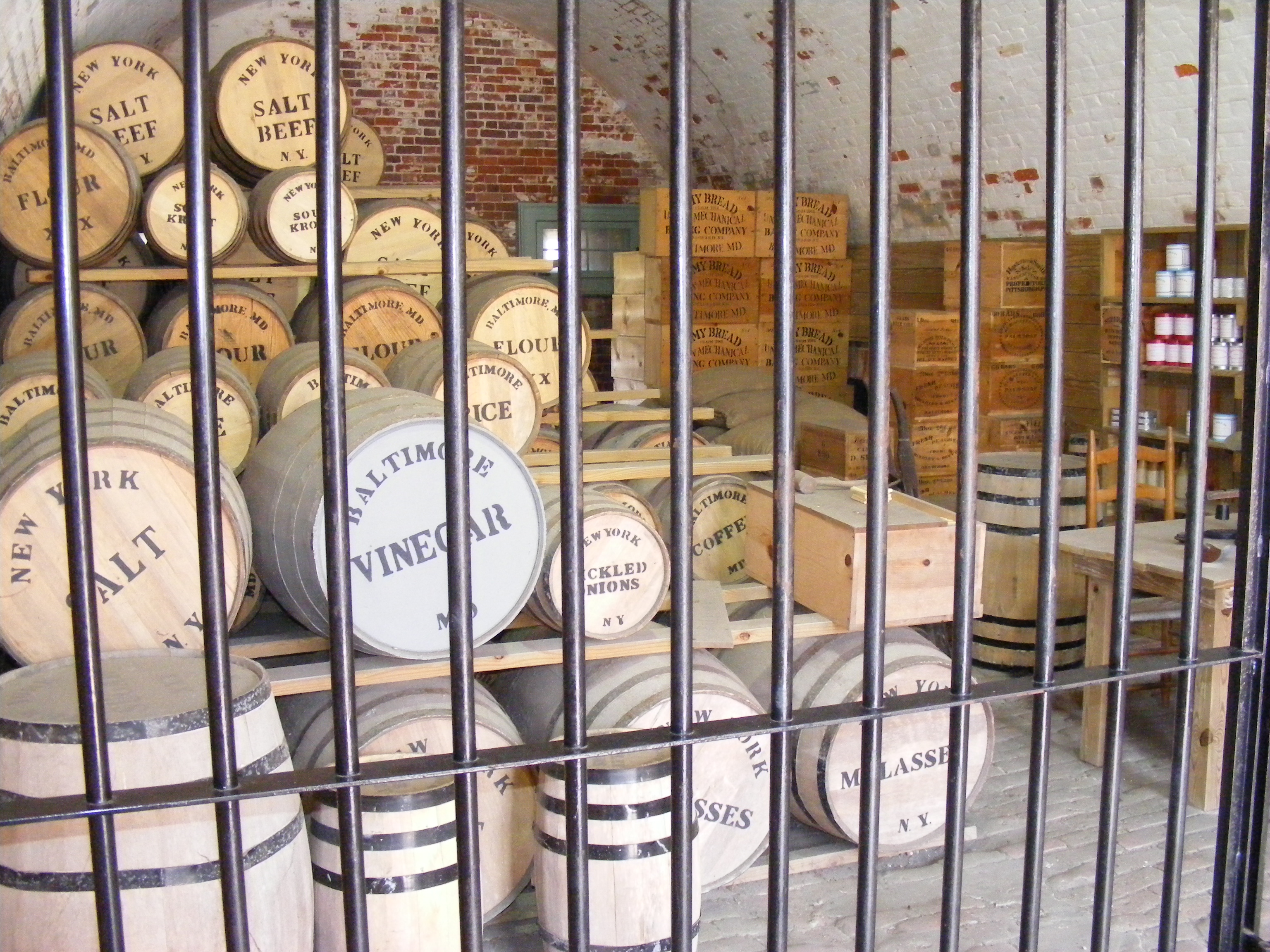
Fort Macon State Park
During World War II, soldiers garrisoned at Fort Macon rolled old cannonballs into their fireplaces to use as andirons. They did not realize the balls were still filled with powder from the Civil War. The explosions killed two men and injured several others -- the last casualties of a war that had ended eighty years earlier. That dark punchline captures something essential about this place: Fort Macon, perched on the eastern tip of Bogue Banks at the entrance to Beaufort Inlet, has never quite finished with its past. Pirates, colonial raiders, Confederate artillerists, and Union siege gunners all left their marks on this narrow strip of North Carolina sand. Today, 1.3 million visitors a year walk through the same casemates, making it the second most visited state park in North Carolina.
Pirates and Plunder at Beaufort Inlet
Long before anyone built fortifications here, Beaufort Inlet was a highway for trouble. Blackbeard and other pirates passed through at will, and his ship Queen Anne's Revenge is believed to have been discovered in shallow water just off the park. During the colonial period, successive wars with Spain, France, and Great Britain kept the region in a state of perpetual anxiety. The Spanish captured and plundered Beaufort in 1747; the British did the same in 1782. North Carolina leaders recognized that the eastern point of Bogue Banks was the natural chokepoint for defending the inlet, and in 1756, construction began on Fort Dobbs, a small fascine fort that was never completed. The inlet remained undefended throughout the American Revolution -- a gap that would take decades and multiple failed fortifications to close.
Three Forts and a Rising Tide
The second attempt, Fort Hampton, was a horseshoe-shaped masonry fort with walls of oyster shell cement called tabby, fourteen feet thick at the base. It mounted five 18-pounder cannons with an effective range of just under a mile. Fort Hampton saw service during the War of 1812, when its garrison was rotated through state militia, the 10th U.S. Infantry, and the 43rd U.S. Infantry as the threat of British attack waxed and waned. But the fort had a relentless enemy that no cannon could stop: the Atlantic Ocean. By 1826, the high tide mark had advanced more than 200 feet behind where Fort Hampton stood. By 1834, the fort lay beneath Beaufort Inlet in a 12-foot-deep ship channel. The sea had swallowed it whole. The Army Corps of Engineers moved 300 yards west and began again.
The Fort That Stands
Fort Macon, the third and final fortification, was part of the federal government's Third System -- a chain of permanent coastal defenses prompted by the weaknesses the War of 1812 had exposed. Named for North Carolina Senator Nathaniel Macon, who secured the funding, the fort was designed by Brigadier General Simon Bernard and built by the Army Corps of Engineers. Construction began in 1826 and took eight years, finishing in December 1834 at a total cost of $463,790. In the 1840s, a young engineer named Robert E. Lee -- decades before he would command the Confederate Army of Northern Virginia -- designed the fort's erosion control system. The pentagonal casemated fort, surrounded by a moat and earthworks, was built to guard Beaufort Harbor, North Carolina's only major deepwater ocean port.
Eleven Hours Under Fire
When the Civil War began on April 12, 1861, local militia from Beaufort seized Fort Macon within two days. Confederate forces spent a year preparing the fort for battle, arming it with 54 heavy cannons. In early 1862, Union forces under Major General Ambrose Burnside swept through eastern North Carolina. Brigadier General John G. Parke was sent to take the fort. Colonel Moses J. White and 400 Confederates inside refused to surrender, even though they were hopelessly surrounded. On April 25, 1862, Parke's batteries opened fire. For eleven hours, heavy siege guns pounded the walls while four Union gunboats attacked from the sea. The fort repulsed the naval assault, but the Union's new rifled cannons -- used against a fort for only the second time in history -- struck it 560 times. The damage was devastating. White surrendered the following morning, and the battle demonstrated that masonry fortifications had become obsolete in the age of rifled artillery.
One Dollar and a New Life
After the war, Fort Macon served as a military prison during Reconstruction, briefly garrisoned troops during the Spanish-American War in 1898, and was finally abandoned by the Army in 1903. In 1923, the government offered the fort for sale as surplus property. North Carolina leaders intervened, and a Congressional Act on June 4, 1924, sold the entire fort and its surrounding reservation for one dollar. The Civilian Conservation Corps restored the fortification during 1934-35, and Fort Macon State Park officially opened on May 1, 1936, as North Carolina's first functioning state park. The Army returned one more time during World War II, stationing Coast Artillery troops at the old fort from December 1941 to November 1944. After that final military chapter ended, the park was returned to the state, and Fort Macon settled into its current role: a place where visitors walk the ramparts, peer through cannon embrasures at the Atlantic, and trace the layers of a coastline that has been fought over, fortified, and fought over again for three hundred years.
From the Air
Located at 34.696N, 76.689W on the eastern tip of Bogue Banks, a barrier island along North Carolina's Crystal Coast. The pentagonal fort with its surrounding moat is clearly visible from the air. Beaufort Inlet lies immediately to the east. Nearby airports include Michael J. Smith Field (KMRH) in Beaufort, approximately 5 nm to the northwest, and Albert J. Ellis Airport (KOAJ) roughly 40 nm to the northwest. Cape Lookout National Seashore extends to the east across the inlet. Best viewed at 2,000-3,000 feet AGL for the fort's geometric shape and its relationship to the inlet.