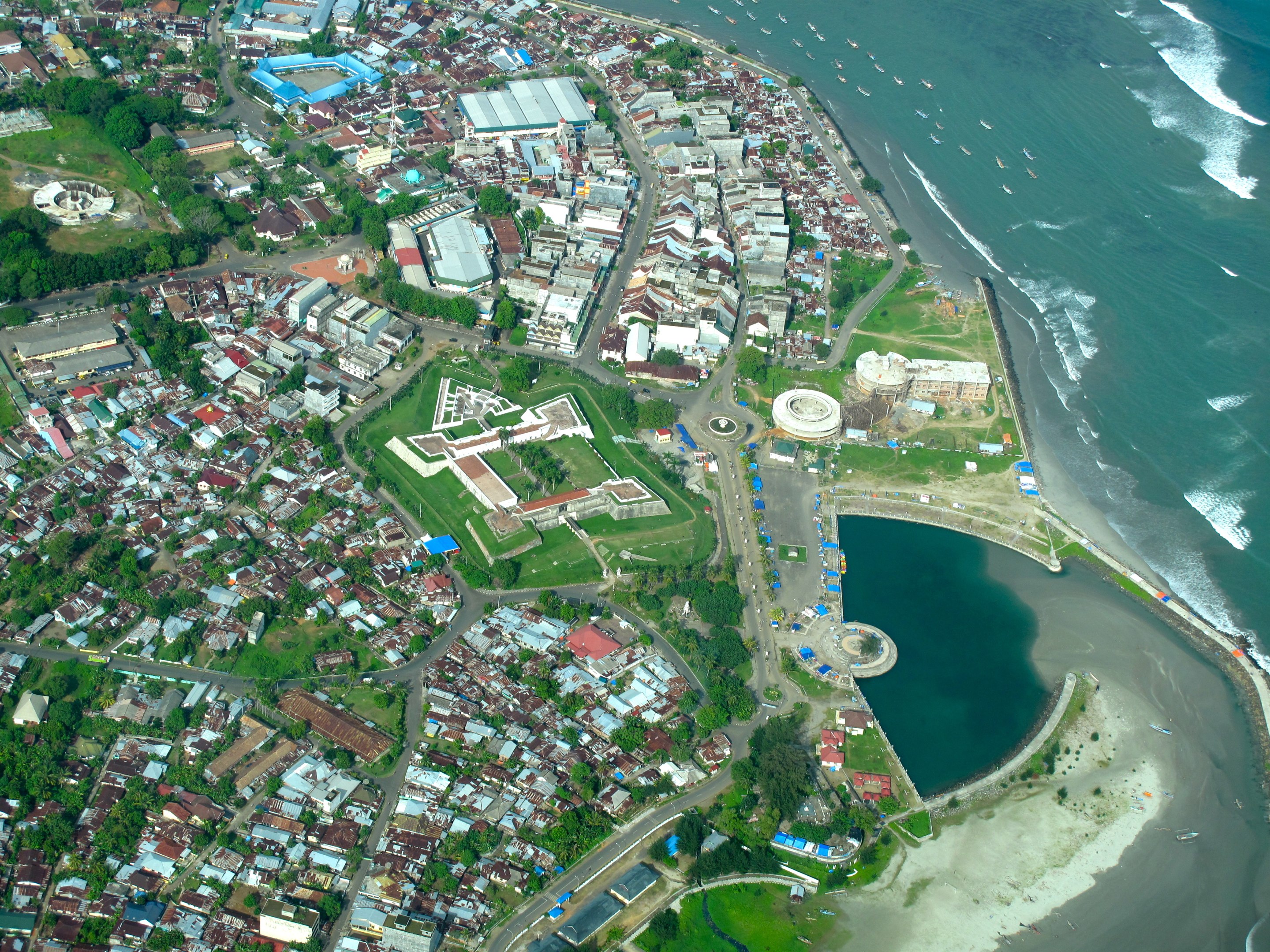
Fort Marlborough
Its builder called it the strongest fortification in India. Deputy-Governor Joseph Collett was exaggerating -- Fort St. George in Madras held that distinction -- but Fort Marlborough, rising from a hill above Sumatra's southwestern coast between 1713 and 1719, was no modest structure. Built of bricks 50 to 180 centimeters thick, with arrowhead-shaped bastions at each corner and a dry moat tracing its rectangular perimeter, the fort was designed to announce that the East India Company intended to stay. The Company did stay, for a time. The fort has stayed longer than anyone.
Born from Desperation
Fort Marlborough replaced Fort York, the Company's original outpost at Bencoolen, which had been built on swampy ground near the seafront in 1685. Fort York was a death trap -- its garrison succumbed to malaria and dysentery at such a rate that the settlement earned the name "the white man's graveyard." Collett chose higher ground two miles to the south, hoping elevation would bring healthier air and better defensibility. The new fortress featured a ravelin protecting the southwestern entrance, a wooden bridge spanning the ditch between the outer and inner buildings, and an arched gateway fitted with heavy wooden doors. It was, by Collett's reckoning, second only to Fort St. George among British fortifications in the East. Yet the higher ground did not cure the fevers, and in 1719, just as construction finished, Malay insurgents captured the fort -- proof that thick walls mean little when the people living around them have had enough.
The Pepper Fortress
Fort Marlborough existed to protect pepper. The East India Company had established British Bencoolen in 1685 to secure a foothold in the lucrative spice trade after being pushed out of their factory at Bantam in Java by the Dutch. For 140 years, the fort served as the administrative center of a string of settlements stretching nearly 500 kilometers along Sumatra's coast. Local cultivators grew pepper along the river valleys of the narrow coastal plain between the Indian Ocean and the Barisan Mountains, selling their harvest to Company agents at the nearest settlement. The pepper was then shipped by sloop to Bencoolen and stored under the guns of Fort Marlborough before export. It was an expensive, inefficient system, and British Bencoolen almost never turned a profit. The fort protected a trade that barely covered its own costs.
Changing Flags
In 1824, the Anglo-Dutch Treaty reshuffled Southeast Asia's colonial borders. Britain ceded Bencoolen to the Netherlands in exchange for Malacca and Dutch acquiescence to Singapore. The Dutch flag replaced the Union Jack over Fort Marlborough. By 1837, a garrison of about sixty Dutch soldiers occupied the fortress. A century later, during World War II, Japanese forces took the fort during their occupation of the Dutch East Indies from 1942 to 1945. After Japan's surrender, the fort housed the headquarters of the Indonesian national police during the turbulent years of the Indonesian National Revolution -- until the Dutch reoccupied it. When the Netherlands finally withdrew from Indonesia in 1950, the Indonesian Army assumed control. Four flags in little more than a century, each claiming the same thick walls that Collett had raised.
Walls That Will Not Fall
In 2000, a magnitude 7.9 earthquake struck Enggano Island, roughly 150 kilometers offshore. The shaking caused significant damage across Bengkulu province. Fort Marlborough stood unaffected. In 2007, another major earthquake sent a 3.5-meter tsunami surging along the coast. Again, the fort survived without damage. Bricks laid three centuries ago, some nearly two meters thick, absorbed what the Sumatran tectonic zone could throw at them. The fort's resilience is not merely structural but historical: it has outlasted every institution that built, occupied, or fought over it. The East India Company dissolved in 1874. The Dutch colonial empire ended in 1949. The Japanese empire collapsed in 1945. Fort Marlborough remains.
Heritage on the Hill
In 1977, the Indonesian Army handed Fort Marlborough to the Department of Education and Culture for restoration and conversion into a heritage site. Today, visitors walk through the arched southwest entrance, cross the wooden bridge over the dry moat, and stand among cannons that once pointed seaward. Gravestones of British residents -- including one for Richard Watts -- mark the human cost of the colonial venture. A room used to interrogate the young nationalist Sukarno, Indonesia's future founding president, serves as a reminder that the fort's history did not end with the colonial era. From its hilltop position in what is now Bengkulu City, Fort Marlborough overlooks the Indian Ocean that brought the traders, the soldiers, and the flags -- all of which eventually departed, leaving the fortress behind.
From the Air
Located at 3.79S, 102.25E in Bengkulu City on Sumatra's southwestern coast. From the air, Fort Marlborough appears as a rectangular fortification with corner bastions on a hill near the coast. The dry moat and the star-shaped trace are visible at lower altitudes. The fort sits just inland from the Indian Ocean shore, with the Barisan Mountains rising to the east. Nearest airport: Fatmawati Soekarno Airport (WIPL), approximately 14 km south of the city center. Look for the contrast between the fort's geometric outline and the surrounding urban fabric of Bengkulu.