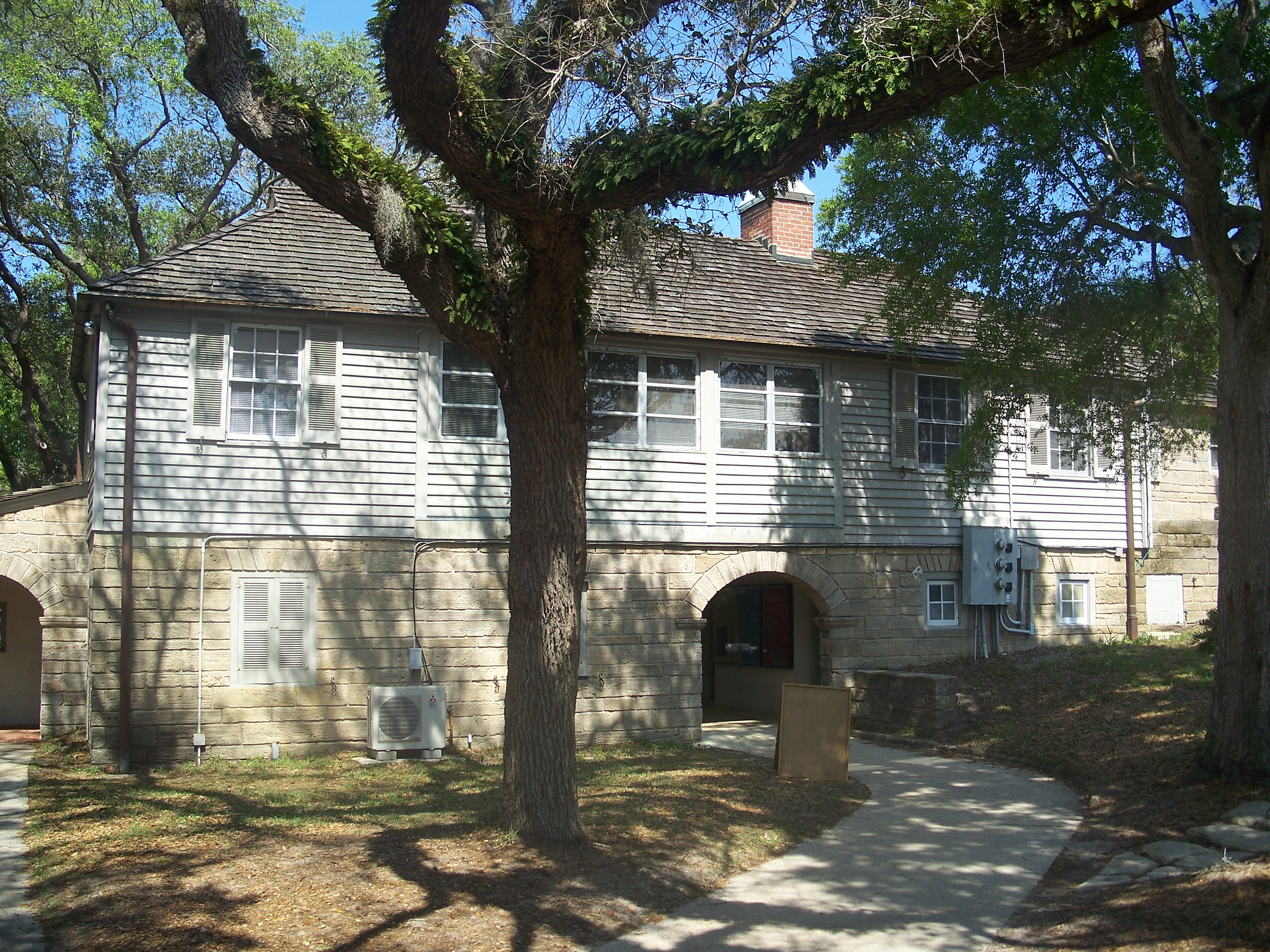
Fort Matanzas National Monument
The name gives it away. Matanzas -- Spanish for slaughters. In 1565, the Spanish commander Pedro Menendez de Aviles executed French Huguenot colonists led by Jean Ribault on the north shore of this inlet, ending France's bid for Florida in blood. Two centuries later, the Spanish built a small fortified tower on Rattlesnake Island to guard that same inlet, not because of ghosts, but because a British general named James Oglethorpe had just demonstrated exactly how vulnerable it was.
The Back Door to St. Augustine
In 1740, Governor James Oglethorpe of Georgia sailed south with a force large enough to threaten St. Augustine itself. Rather than attack the massive Castillo de San Marcos head-on, Oglethorpe slipped through Matanzas Inlet, the undefended southern mouth of the Matanzas River, and blockaded the city from behind. For thirty-nine days, the siege ground on. St. Augustine held, but barely, and the Spanish learned a hard lesson: the back door was wide open. Governor Manuel de Montiano ordered construction of a fortified watchtower to seal the gap. Engineer Pedro Ruiz de Olano, who had already worked on the Castillo de San Marcos, designed a compact coquina tower on Rattlesnake Island, positioned to command the inlet with cannon fire. Convicts, enslaved laborers, and troops from Cuba raised the structure between 1740 and 1742.
Walls Made of Shells
Like the Castillo de San Marcos fourteen miles to the north, Fort Matanzas was built from coquina, a sedimentary rock composed of compressed ancient shells quarried from nearby Anastasia Island. The marshy ground beneath the tower required a foundation of pine pilings to keep the structure from sinking into the salt marsh. The finished tower was modest by fortress standards -- small enough that its standard garrison consisted of just one officer, four infantrymen, and two gunners, all serving on rotation from St. Augustine. Five cannon were mounted at the fort: four six-pounders and one eighteen-pounder, all positioned to cover the inlet. The fort fired on an enemy exactly once, when cannon fire drove off British scouting boats. The warships withdrew without engaging, making that brief exchange Fort Matanzas's entire combat record.
Traded, Abandoned, Forgotten
Spain lost Florida to Britain in the 1763 Treaty of Paris, regained it in 1783, then ceded it to the United States in 1821. Through each transfer, Fort Matanzas mattered less. The Spanish Empire was crumbling, and a small watchtower on a marshy island in northeast Florida was not a priority. By the time American soldiers arrived, the fort had deteriorated so badly that no one could live inside. The United States never garrisoned it. The little tower on Rattlesnake Island became a ruin, slowly returning to the salt marsh that surrounded it.
Rescue in Stone
In 1916, the U.S. Department of War began a major restoration. Three vertical fissures in the coquina walls were repaired and the structure stabilized. In 1924, Fort Matanzas was declared a National Monument and in 1933 was transferred to the National Park Service, which manages it alongside the Castillo de San Marcos. Today the monument encompasses roughly 100 acres of salt marsh and barrier islands along the Matanzas River. A visitor center built in 1936 on Anastasia Island, designed in the National Park Service Rustic architectural style, serves as the gateway to the fort, which is reached by a five-minute boat ride across the water. The visitor center itself was listed on the National Register of Historic Places in 2008, a monument to the monument.
From the Air
Fort Matanzas sits on Rattlesnake Island at the southern end of Matanzas Inlet, approximately 14 nautical miles south of St. Augustine along Florida's Atlantic coast. The fort appears as a small stone structure surrounded by salt marsh and barrier islands at coordinates 29.715N, 81.239W. The Matanzas River and inlet are clearly visible from altitude. The visitor center on Anastasia Island along A1A is nearby. Nearest airports: St. Augustine Airport (KSGJ) approximately 10nm north, Northeast Florida Regional Airport (KSSF) to the northwest. Best viewed at low altitude in clear conditions; the coquina tower contrasts with the surrounding green marsh.