Fort McAllister
The Union Navy threw everything it had at Fort McAllister and the dirt just swallowed it. Seven times between 1862 and 1863 warships steamed up the Ogeechee River and pounded the low earthen walls with the heaviest ordnance of the Civil War, including the 15-inch guns of the ironclad monitor USS Montauk. After hours of bombardment, the smoke would clear to reveal the same muddy parapets, barely scratched, their defenders already shoveling fresh earth into whatever shallow craters the shells had gouged. Fort Pulaski, Savannah's massive brick fortress downriver, had crumbled in 36 hours under similar fire. Fort McAllister, built of nothing more than Georgia clay and marsh mud, proved that the future of coastal defense was dirt -- cheap, abundant, and nearly impossible to destroy with cannon fire.
A Fortress of Mud and Genius
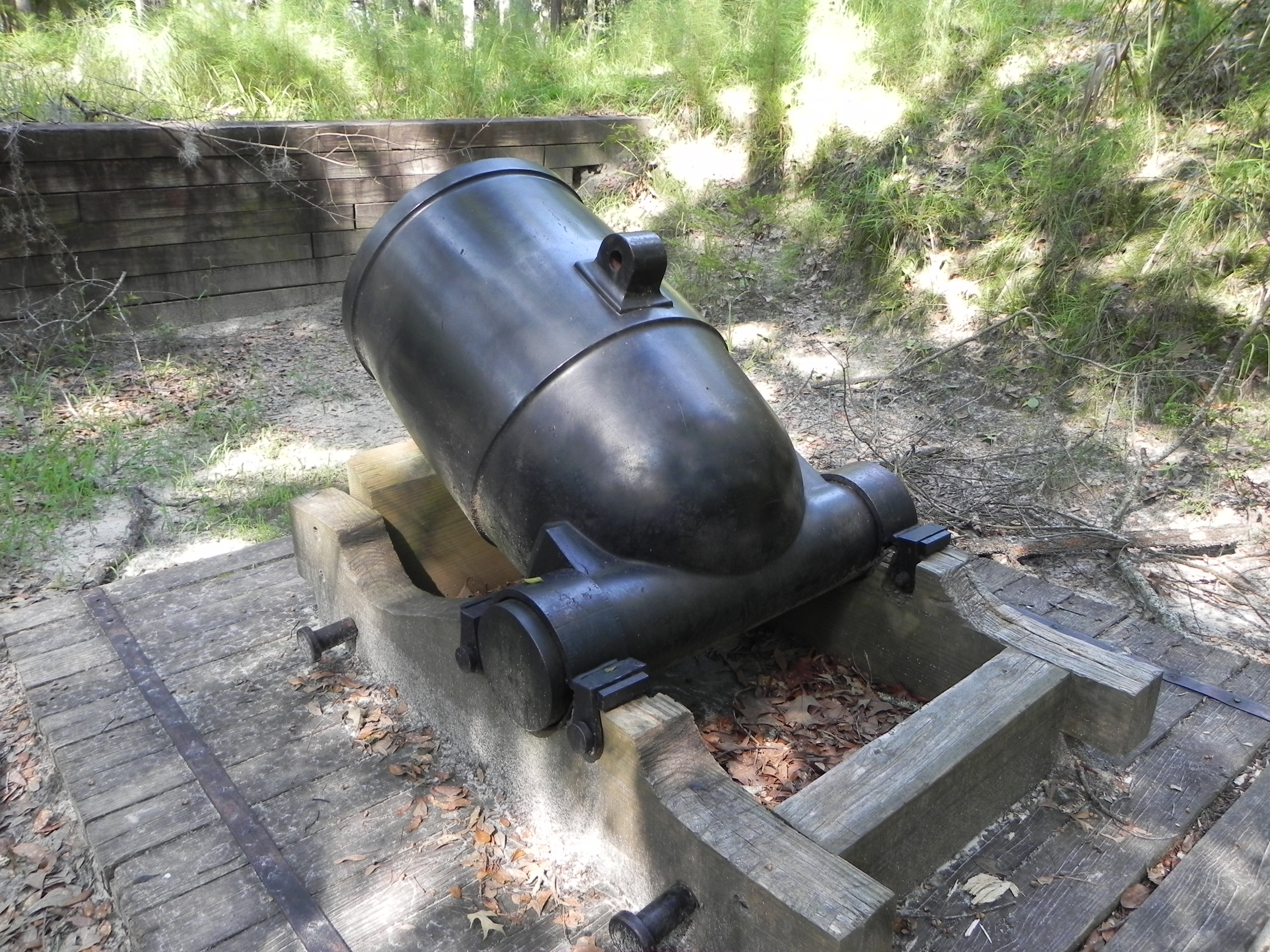
Captain John McCrady designed Fort McAllister as part of Savannah's three-fort defense network, along with Fort Pulaski and Fort James Jackson. In 1861 General Robert E. Lee personally inspected the works and recommended strengthening them. McCrady thickened the earthen walls, which could absorb artillery impacts that would shatter brick and stone. The fort mounted seven cannon emplacements behind its parapets. A central bombproof sheltered a hospital, barracks, officers' quarters, supply stores, and additional weapons. A 10-inch mortar sat outside the main works because its concussive blast would shake the dirt off the walls each time it fired. The design was elegant in its simplicity: sand and clay packed into massive berms that simply absorbed incoming shells, then could be repaired in hours with nothing more than shovels and wheelbarrows. No supply wagons needed, no quarried stone, no skilled masons. Just soldiers and dirt.
Iron Against Earth
The naval attacks began in 1862 and escalated dramatically in early 1863 when the Union sent its newest ironclad monitors. On January 27, 1863, the USS Montauk opened fire with its 11-inch and 15-inch Dahlgren guns -- the largest naval weapons of the war. The bombardment lasted five hours. The result: no casualties, minimal damage. The Montauk's shells buried themselves in the soft earth and the defenders patched the walls overnight. The fort's own guns hit the ironclad 15 times without penetrating its armor. It was a draw between two revolutionary technologies -- ironclad warship versus earthwork fortification -- and neither could destroy the other. The Montauk attacked again on February 1, killing fort commander Major John B. Gallie but failing to breach the walls. A seven-hour bombardment on March 3 by multiple monitors also failed. On February 28, the USS Montauk did score one dramatic victory nearby: it destroyed the Confederate blockade runner CSS Nashville, which had run aground on a sandbar in the Ogeechee River while trying to slip out under the fort's protection.
Fifteen Minutes
What the Navy could not accomplish in two years of shelling, the Army did in a quarter of an hour. On December 13, 1864, General William T. Sherman arrived at the Ogeechee River at the end of his March to the Sea. Fort McAllister was the last obstacle between his army and the supply ships waiting offshore. General William B. Hazen's infantry division attacked overland -- from the rear, where the fort's guns could not bear. Major George Wayne Anderson defended with roughly 230 men. The assault overwhelmed the garrison in about 15 minutes of brutal close combat. With Fort McAllister fallen, Savannah's defenses collapsed. General William J. Hardee withdrew his 10,000 Confederate troops, and Sherman took the city without further resistance, famously wiring President Lincoln to offer Savannah as a Christmas gift.
Cigars and Land Mines
The evening after the battle produced one of the war's more remarkable scenes. Major Anderson, the defeated Confederate commander, was held at the McAllister family home, now General Hazen's headquarters. In a gesture of military courtesy, Hazen invited Anderson to join him and Sherman for dinner. Over the meal, Anderson argued heatedly with Sherman about the tactics and bravery of Fort McAllister's defenders. Cigars were exchanged, tributes paid to the fallen on both sides. But Sherman's generosity had limits. He was furious about Anderson's use of land mines -- buried explosive devices called torpedoes -- in the fort's defenses. Several Union soldiers had been killed or maimed by the hidden weapons during the assault. Sherman ordered Anderson to personally join his fellow Confederate prisoners on mine-clearing detail, forcing the men who planted the devices to dig them up by hand.
From Ford to State Park
Sherman's army burned Fort McAllister's bunkers and moved on. The earthworks slowly eroded back toward the marsh. In the late 1930s Henry Ford purchased the property and began restoration, drawn by his interest in Southern history and the Ogeechee River plantation landscape. After Ford's death, International Paper Company acquired the land from his estate and donated it to the State of Georgia in 1958. The Georgia Historical Commission continued restoration to the fort's 1863-64 appearance, and it was listed on the National Register of Historic Places in 1970. Today Fort McAllister State Historic Park preserves the earthworks, cannon emplacements, and bombproof shelter. The museum displays Civil War artifacts recovered from the site. The fort's earthen walls still hold their shape after more than 160 years -- a final testament to the simple principle that made them nearly invincible: dirt absorbs what stone cannot.
From the Air
Fort McAllister sits at 31.89N, 81.20W on the south bank of the Ogeechee River in Bryan County, Georgia, about 25 miles south of Savannah. From altitude the fort appears as a series of low earthen mounds and ditches in a cleared area along the riverbank, surrounded by marsh and forest. The Ogeechee River curves past the site toward Ossabaw Sound and the Atlantic. The nearest major airport is Savannah/Hilton Head International (KSAV), approximately 20 nm to the northeast. The fort is best viewed at 1,500-3,000 feet AGL, when the geometric outlines of the earthworks -- the parapets, the central bombproof, the cannon positions -- are distinguishable against the surrounding terrain. The river approach that Union ironclads followed is clearly visible from the air.