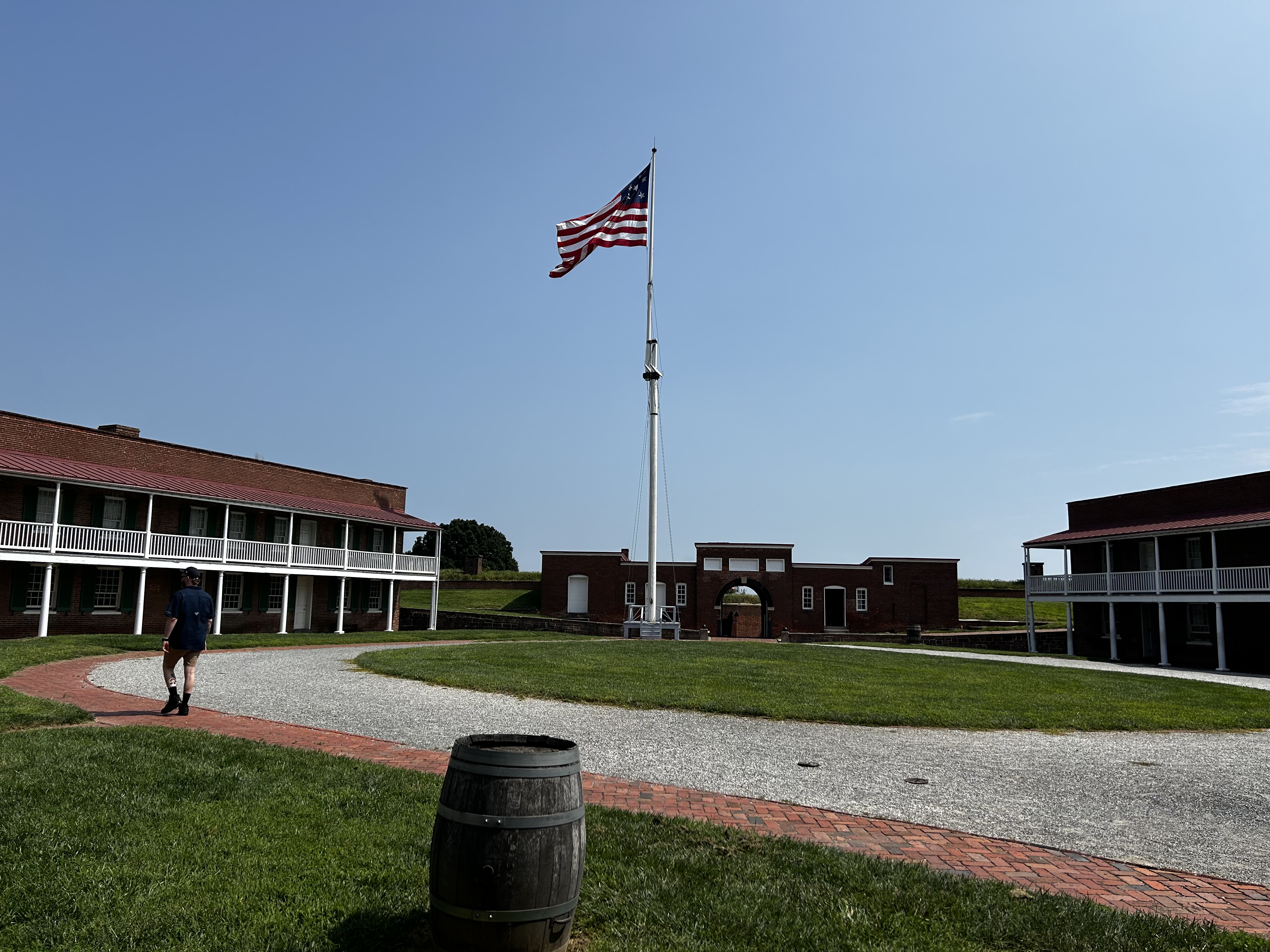
Fort McHenry
A bomb crashed through the powder magazine on the night of September 13, 1814. Had it detonated, Fort McHenry would have been obliterated, the British fleet would have sailed into Baltimore Harbor, and the United States might never have gained its national anthem. But the fuse fizzled -- whether doused by rain or simply defective, no one knows -- and the pentagonal bastion on Locust Point held through 25 hours of relentless bombardment. By dawn, the oversized garrison flag still flew, and a Washington lawyer watching from a truce ship offshore found himself scribbling verses that would become "The Star-Spangled Banner."
A Pentagon on the Patapsco
Fort McHenry sits on Whetstone Point, a spit of land jutting into the mouth of Baltimore Harbor where the Northwest Branch meets the Middle and Southern branches of the Patapsco River. The French engineer Jean Foncin designed it in 1798 as a bastioned pentagon surrounded by a dry moat -- a deep, broad trench where infantry could shelter and mount a crossfire defense. Each of the five pointed bastions could sweep its neighbors with cannon and musket fire, creating overlapping fields of destruction. The fort replaced the older Fort Whetstone, which had defended Baltimore since 1776, and was named for James McHenry, a Scots-Irish immigrant who served as a surgeon-soldier in the Revolution, signed the Constitution, and became Secretary of War under Washington and Adams. Its purpose was straightforward: protect the increasingly vital Port of Baltimore from seaborne attack.
Twenty-Five Hours Under Fire
Beginning at six in the morning on September 13, 1814, British warships under Vice Admiral Alexander Cochrane unleashed a continuous barrage on Fort McHenry. The Americans, commanded by Major George Armistead, answered with 18-, 24-, and 32-pounder cannons, but the British stayed at maximum range, lobbing rockets and mortar shells from a distance where neither side could land reliable hits. Baltimore Harbor's own defenses helped: a chain of 22 sunken ships blocked the channel, preventing the fleet from closing in. The bombardment stretched through the night. Four Americans were killed, including a woman cut in half by a bomb as she carried supplies to the troops, and 24 were wounded. Only one British vessel took a direct hit. By morning on September 14, the British had exhausted their ammunition and withdrew, ending the Battle of Baltimore in an American victory.
The Flag That Wrote a Song
Francis Scott Key, a Washington lawyer, had sailed to the British fleet to negotiate the release of a civilian prisoner named Dr. William Beanes. Detained aboard a truce ship during the bombardment, Key watched through the night as rockets arced and shells burst over the fort. An oversized American flag had been sewn by Mary Pickersgill for $405.90, specifically so it could be seen from a great distance. When dawn broke on September 14 and Key saw that immense banner still flying, he began writing the poem "Defence of Fort M'Henry" on the back of a letter. Set to the melody of a popular British drinking song, "To Anacreon in Heaven," it became "The Star-Spangled Banner" -- adopted as the national anthem in 1931. The original flag, donated to the Smithsonian Institution by the Armistead family in 1912, now rests at the National Museum of American History in dim light, too fragile to hang.
Centuries of Service
Fort McHenry's military career did not end in 1814. It continued as an active military post through the Civil War, when it served as a prison for Confederate soldiers and suspected sympathizers. The fort remained in use through World War I and operated as a Coast Guard base during World War II. In 1925, it was designated a national park, and in 1939 it became a National Monument and Historic Shrine -- the only site in the country to hold both designations. Today, the fort draws thousands of visitors each year to the "Birthplace of the Star-Spangled Banner," accessible by water taxi from the Inner Harbor. Every September, Baltimore commemorates Defenders Day with programs, events, and fireworks at the fort. The United States Code still authorizes Fort McHenry's closure in a national emergency for military use -- a reminder that the old pentagon on the Patapsco was built to fight.
Bricks and Bones
Archaeological digs at Fort McHenry have unearthed artifacts spanning more than two centuries, now displayed in buildings surrounding the Parade Ground. Restoration efforts continue to preserve the original brickwork, primarily through mortar replacement. In November 2025, construction workers unearthed what appeared to be unexploded ordnance, forcing a temporary closure -- a tangible echo of the bombardment that defined this place. The Fort McHenry Guard, a volunteer living history unit, was awarded the George B. Hartzog Award in 2005 as the National Park Service's best volunteer unit. Among its honorary members is former Maryland Governor Martin O'Malley. From reenactments on the parade ground to the bronze Orpheus monument honoring the fort's soldiers and Francis Scott Key, Fort McHenry keeps its story alive not as a relic but as a working piece of American memory.
From the Air
Fort McHenry (39.2633°N, 76.5799°W) is clearly visible from the air as a star-shaped fortification on Locust Point, jutting into the mouth of Baltimore Harbor. The distinctive pentagonal outline stands out against the surrounding Patapsco River waters. Best viewed at 2,000-3,000 feet AGL. Nearby airports include Baltimore/Washington International (KBWI, 8 nm south), and Martin State Airport (KMTN, 10 nm northeast). The Fort McHenry Tunnel (I-95) passes just south of the fort underground.