Fort Michilimackinac State Park
On June 2, 1763, a group of Ojibwe warriors invited the British garrison at Fort Michilimackinac to watch a game of baggattaway -- what we now call lacrosse. The soldiers filed out to spectate. The ball sailed over the fort's walls, and the players chased after it, scooping up weapons hidden by women beneath blankets near the gate. Within minutes, the Ojibwe had seized the fort, killing most of the British inhabitants. They held it for a year. That ambush, part of the uprising known as Pontiac's Rebellion, remains one of the most dramatic events in Great Lakes history. Today, the fort stands rebuilt on its original footprint in Mackinaw City, a National Historic Landmark where costumed interpreters fire cannons and muskets, and archaeologists continue the most extensive excavation of an early French site in the United States.
Strategic Ground at the Straits
The French understood the Straits of Mackinac as the hinge of a continent. Whoever controlled this four-mile passage between Lake Michigan and Lake Huron controlled trade across the entire western Great Lakes. Father Jacques Marquette established a Jesuit mission at St. Ignace on the north shore in 1671. Fort de Buade followed in 1683. But when Cadillac moved the garrison to Detroit in 1701, the Straits went undefended for fourteen years. By 1715, the French recognized their mistake and built Fort Michilimackinac on the south shore -- present-day Mackinaw City. The wooden palisade anchored a fur trading network that stretched from the Mississippi River through the Illinois Country to the St. Lawrence, supplying traders who fanned out across the western Great Lakes.
The Lacrosse Ambush
The French ceded Fort Michilimackinac to the British in 1761, following their defeat in the French and Indian War. The British continued operating the fort as a major trading post, but the Ojibwe in the region found British policies harsh compared to French practices. Resentment built until June 2, 1763, when the Ojibwe staged their deadly ruse during Pontiac's Rebellion. The baggattaway game outside the walls was carefully planned -- the ball was deliberately thrown over the palisade to give warriors a pretext to rush inside. The attack succeeded so completely that the Ojibwe held the fort for a full year before British forces retook it. The British never forgot the lesson. Deeming the wooden fort on the mainland too vulnerable, they built a new fortress of limestone on nearby Mackinac Island in 1781 -- Fort Mackinac, perched on bluffs that no lacrosse trick could breach.
Digging Through Centuries
The fort grounds received National Historic Landmark designation in 1960, and what followed was one of the most ambitious archaeological projects in North American colonial history. Excavations have continued every summer since, making Fort Michilimackinac the most extensively dug early French archaeological site in the United States. Researchers have uncovered the layered story of the site -- French foundations beneath British modifications, trade goods from both empires, and artifacts of daily life spanning decades of occupation. The reconstructed fort today features numerous historical wooden structures rebuilt on their original locations, using archaeological evidence to guide placement and construction. The site belongs to Mackinac State Historic Parks, which also manages Fort Mackinac on the island and other historic properties in the region.
A Living Fort
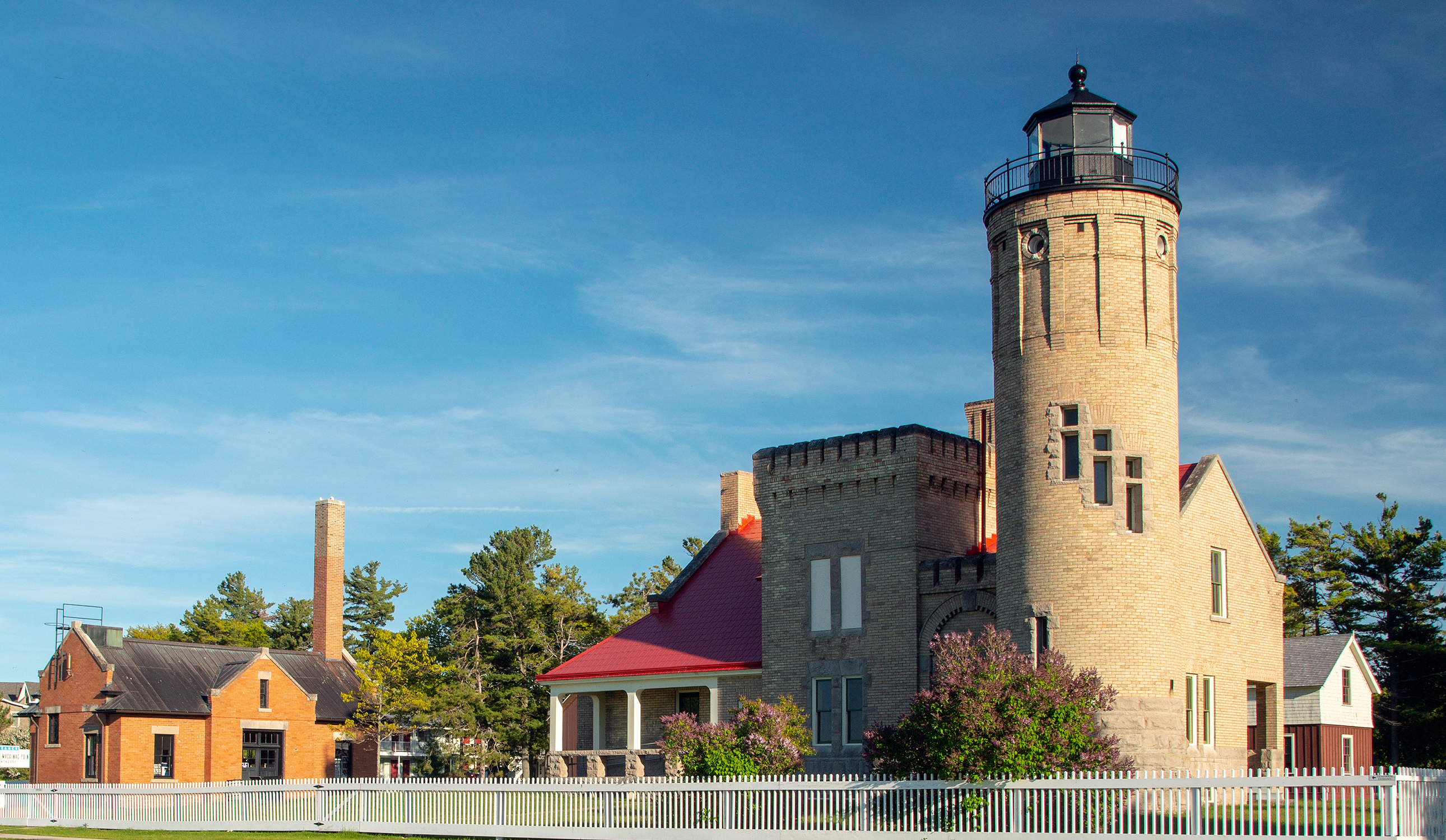
Colonial Michilimackinac, as the reconstructed site is known, brings the 1770s back to life. Costumed interpreters demonstrate daily cannon and musket firings, and visitors can participate in period cooking demonstrations using historically accurate methods. The re-enactments focus on the British occupation and the Revolutionary War era, when the fort served as a remote outpost of an empire stretched thin across a continent. Beyond the palisade walls, Old Mackinac Point Lighthouse stands within the state park grounds, its signal tower still housing a foghorn. The park sits at the northern tip of Michigan's Lower Peninsula, directly beneath the Mackinac Bridge. In summer, tourists arrive by the thousands to walk through the same gate the Ojibwe stormed in 1763 -- entering peacefully now, but stepping into a place where the echoes of that June afternoon have never quite faded.
From the Air
Fort Michilimackinac State Park sits at 45.79N, 84.74W at the very tip of Michigan's Lower Peninsula in Mackinaw City. From altitude, the location is unmistakable: the fort sits directly beneath the south anchorage of the Mackinac Bridge, the five-mile suspension bridge connecting Michigan's two peninsulas. The reconstructed wooden palisade is visible near the waterfront. Mackinac Island lies four miles to the east. Old Mackinac Point Lighthouse is visible within the park. Pellston Regional Airport (PLN) is 16 miles south. The Straits of Mackinac stretch east-west between Lake Michigan and Lake Huron, the strategic waterway that made this location worth fortifying for over a century.