Fort Miles
On May 14, 1945, days after Germany's unconditional surrender, the submarine U-858 surfaced off the Delaware coast and became the first enemy ship to surrender to United States forces in the aftermath of the war. The soldiers who accepted that surrender stood at Fort Miles, a sprawling coastal defense installation on Cape Henlopen near Lewes, Delaware, that had spent the entire war preparing for an attack that never came. Named for Lieutenant General Nelson A. Miles and armed with some of the largest coastal artillery pieces in the American arsenal, Fort Miles was the primary fortress of the Harbor Defenses of the Delaware, built to deny German warships and U-boats access to Delaware Bay and the vital Delaware River shipping lanes beyond.
Guns That Never Fired in Anger
Funds to build Fort Miles were approved in 1934, but construction did not begin until 1938 on what was then called the Cape Henlopen Military Reservation. Battery Smith, housing two massive Navy 16-inch guns on Army barbette carriages, was the crown jewel, completed in October 1942. The guns could hurl shells over 20 miles out to sea. But the fort's most dramatic moment with its biggest weapon was a fiasco: a 16-inch gun was test-fired exactly once, and the recoil so damaged the emplacement that no further shells were ever fired from Battery Smith. Alongside it stood Battery Herring and Battery Hunter with 6-inch guns, Battery 519 with 12-inch guns relocated from Fort Saulsbury, and railway guns that rolled into position on specially built tracks. The fort also operated a controlled underwater minefield in the waters off Lewes. Despite high marksmanship ratings in practice, Fort Miles never engaged an enemy vessel.
Watchers on the Shore
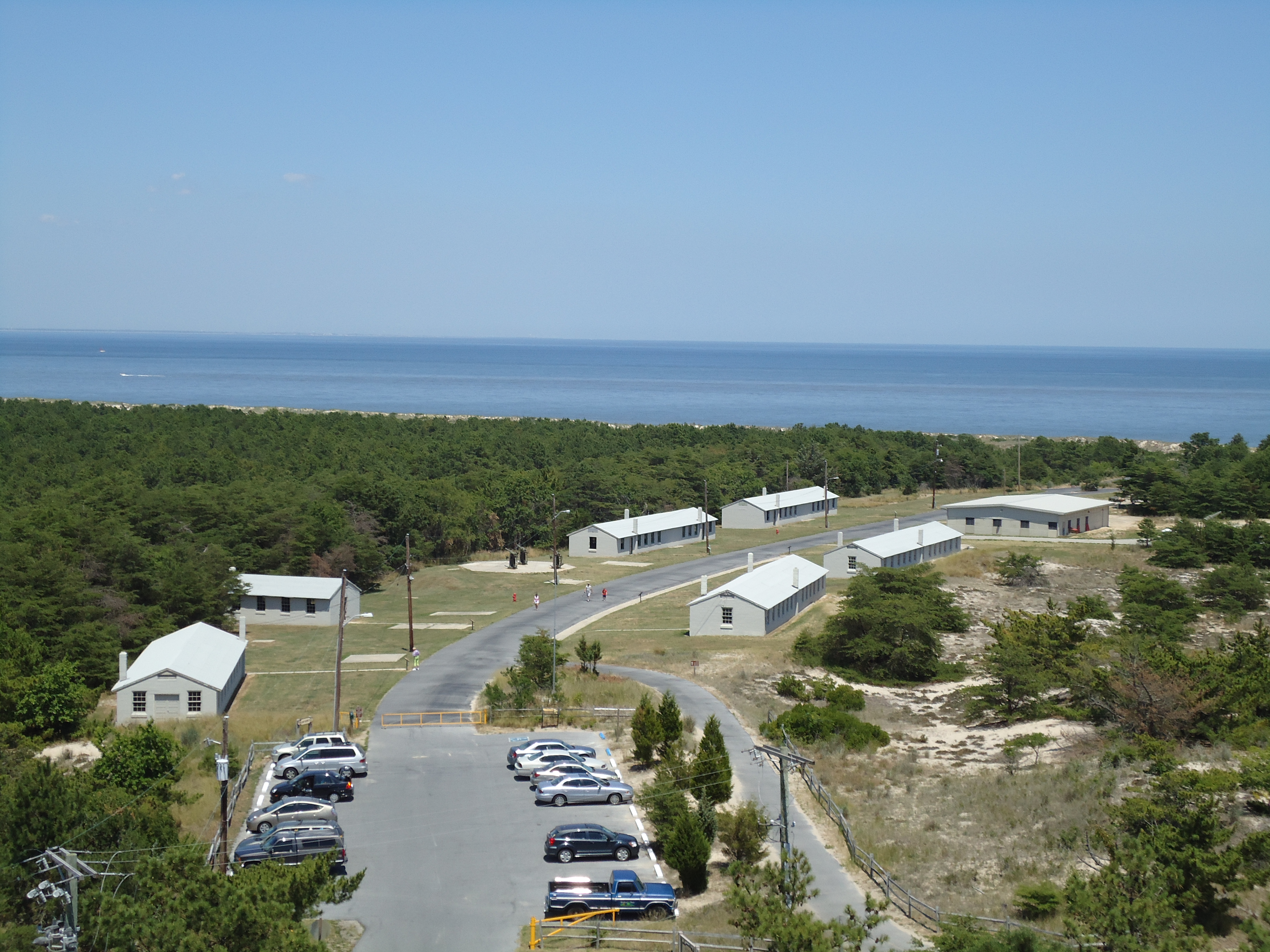
The fort's eyes were its fire control towers, four- to five-story round-base concrete structures topped with flat observation decks. Positioned along the coast as baseline stations, they allowed gunners to triangulate the position of suspicious ships and submarines approaching Delaware Bay. Five of these towers still stand within what is now Cape Henlopen State Park, their stark concrete forms rising above the dunes like sentinels from another age. Tower 7 is open to visitors, offering the same commanding view that wartime observers used to scan the Atlantic for the silhouettes of German surface raiders and U-boat conning towers. From the top, the sweep of the coastline and the mouth of Delaware Bay unfold exactly as the artillery spotters would have seen them eight decades ago.
Cold War Secrets Beneath the Sand
When coastal artillery became obsolete after the war, most of Fort Miles was declared surplus in 1948 and 1949. But the military was not finished with Cape Henlopen. In 1962, the Navy took control of the southern end of the fort, including Batteries Smith and Herring, to establish Naval Facility Lewes, a shore terminal for the Sound Surveillance System, better known as SOSUS. This classified Cold War network of underwater listening arrays tracked Soviet submarine movements across the Atlantic. The equipment had originally been housed at Cape May, New Jersey, until the devastating Ash Wednesday Storm of 1962 damaged that station. A Navy LST ferried the gear across Delaware Bay, and the cable ship Neptune reconnected the array at Lewes. NAVFAC Lewes operated until September 30, 1981, its true purpose remaining classified until 1991.
From Fortress to Parkland
In 1964, the federal government donated 543 acres to Delaware to establish Cape Henlopen State Park. More land followed over the decades, and in 1991 Fort Miles ceased military operations entirely as part of the Base Realignment and Closure process. Its last official use was as a bivouac for soldiers returning from the first Gulf War. The state paid the Army a mere $14,369 for property improvements. Today the former headquarters building serves as the Biden Environmental Conference Center, while a married housing complex has been repurposed for the University of Delaware's College of Earth, Ocean and Environmental Sciences. Battery Smith, which once housed those ill-fated 16-inch guns, is used by the state park for storage.
Bunkers You Can Walk Through
Fort Miles is far from forgotten. In December 2021, the Fort Miles Museum and Historical Area was established as a nonprofit to preserve and interpret the defense of Delaware's coast. Walking tours of restored bunkers and battery positions are available during the summer, led by interpreters and reenactors who portray the 261st Coast Artillery Battalion. A 16-inch/50-caliber Mark 7 gun, the type that armed the battleship USS Missouri, has been remounted at the fort as a commemorative display. Four Panama mounts still stand at Battery 22 near the park's Beach House, and several fire control towers remain scattered around the property. Visitors walking these grounds tread the same sand that covered the batteries during the war, camouflage designed to hide the fort from aerial observation. The concrete remains, but the threat they were built to answer has long since faded into history.
From the Air
Fort Miles / Cape Henlopen State Park sits at 38.777N, 75.087W on the prominent cape at the mouth of Delaware Bay. From the air, the distinctive shape of Cape Henlopen jutting into the bay is unmistakable. Look for the concrete fire control towers rising above the dunes along the coastline. The former battery positions are largely buried under sand but their rectangular footprints may be visible. Nearest airports include Sussex County Airport (GED) about 15 nm to the south and Delaware Coastal Airport (GED) in Georgetown. Cape May (KWWD) sits directly across the bay mouth in New Jersey. The cape marks the transition from the Delaware Bay to the Atlantic Ocean, a strategic chokepoint that explains why Fort Miles was built here.