Fort Monroe (Yosemite)
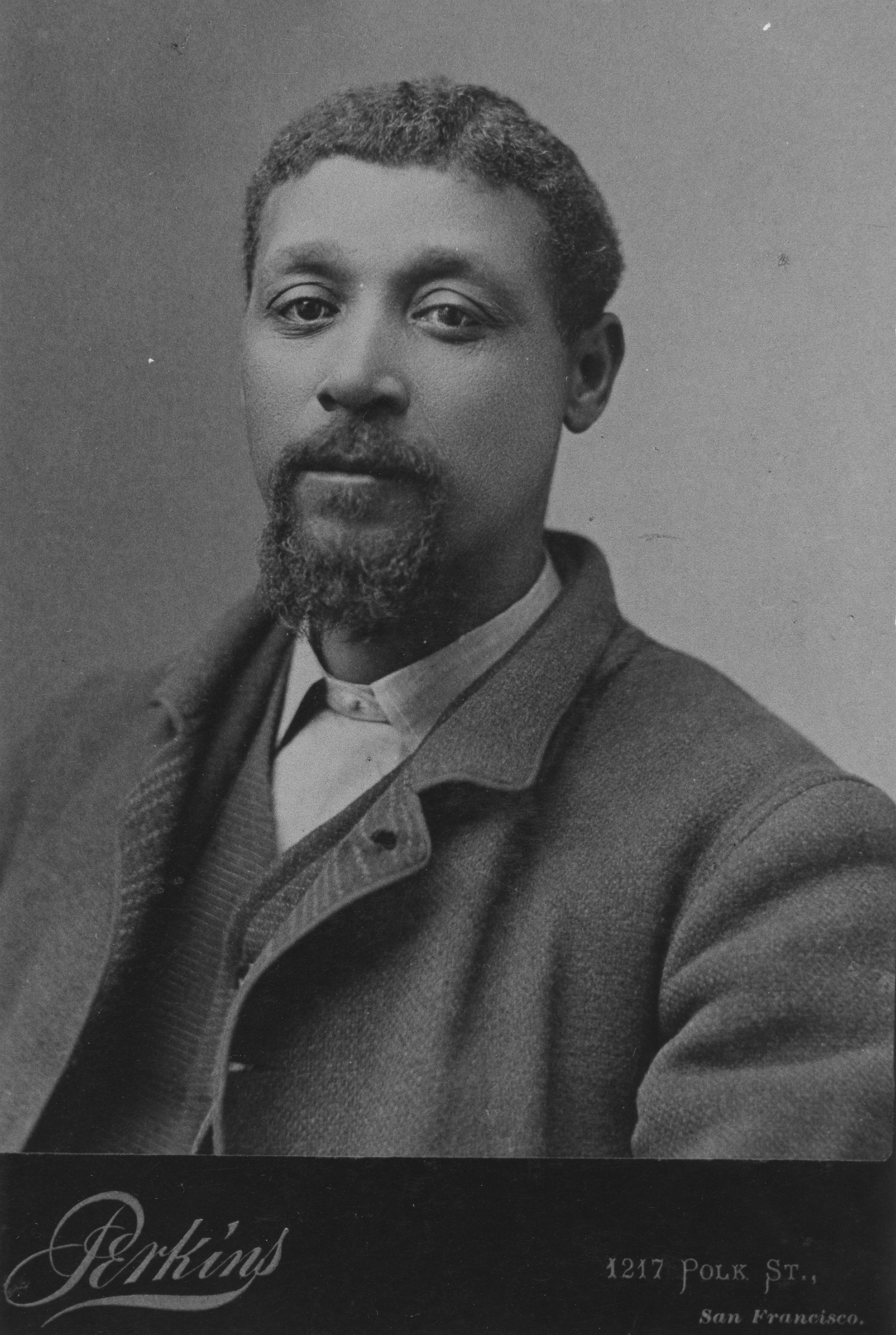
Among George Monroe's passengers were three presidents of the United States: Ulysses Grant, James Garfield, and Rutherford Hayes. None of them drove the Yosemite stage road better than he did. Monroe worked the route for the Yosemite Stage Line from 1866 until his death, navigating a road that featured sharp drop-offs and tight switchbacks through the Sierra Nevada foothills. He never caused an accident that cost the company money or injured a passenger. The "fort" that carries his name was never a military installation - it was a stage team relay station where horses were swapped and travelers camped for the night. Today there are no remnants. Fort Monroe is a location only, a name on a map marking a place where something mattered before the automobile erased most of the evidence.
From Georgia to the Gold Rush
George F. Monroe came to California in 1856, traveling from his native Georgia with an uncle to meet his parents, who had recently moved to Mariposa as part of the gold rush. George was twelve years old. His father Louis became a successful barber in Mariposa and eventually bought a prosperous ranch southeast of town. The family's trajectory - from Georgia to the California foothills, from barbering to ranching - mirrors the broader story of Black families who saw the gold rush not just as a chance at mineral wealth but as an opportunity to build lives in a place less rigidly stratified than the antebellum South. George grew up on that ranch, and in 1866, at roughly twenty-two years old, he started working for the Wabash brothers, who operated the Yosemite Stage Line.
The Best Driver on the Worst Road
The road from Mariposa to Yosemite Valley was not built for comfort. It climbed through steep terrain on narrow grades, with switchbacks so tight that a six-horse team required precise handling to navigate without sending the coach over the edge. Monroe excelled at it. He was eventually promoted to driver - the most visible and responsible position on the stage - and his reputation grew until he was known not just locally but among travelers from across the United States and Europe. The stage ride into Yosemite was, for many visitors, their first experience of the Sierra Nevada, and Monroe was the person who delivered them safely through it. His skill was not theatrical. It was the quiet competence of someone who understood his horses, his road, and the weight of the coach behind him well enough to make something dangerous look routine.
A Death at Forty-Two
The circumstances of Monroe's death carry an irony that his contemporaries would have recognized. By one account, Monroe was riding as a passenger in the stage - not driving - when a horse got away from the driver. Monroe climbed forward to the front horse to stop the runaway team, injuring himself in the process. A few days later, after complaining of feeling ill, he died at his parents' ranch. He was forty-two years old and their only child. The man who had never caused an accident as a driver was killed trying to fix someone else's mistake as a passenger. He was said to be well known throughout the United States and to European travelers, a remarkable reach for a stage driver in an era before mass media. His fame was entirely earned - one trip at a time, one switchback at a time.
What the Name Outlasted
After Monroe's death, the relay station kept his name. Fort Monroe served as a landmark through the transition from horse-drawn stages to automobiles, functioning for a time as a park entrance station with what was described as a fine automobile camp. When the Wawona Tunnel was completed in 1933, the old Wawona Road that passed Fort Monroe was converted into part of the Pohono Trail. The trailhead moved to the Tunnel View parking lot - now one of Yosemite's most photographed overlooks - and the fort's location faded from common knowledge. Monroe Meadows, in Yosemite Valley near Bridalveil Falls, also carries George Monroe's name. Between the meadow and the vanished fort, a stagecoach driver who came to California as a twelve-year-old boy from Georgia has his name written into two different corners of one of America's most famous landscapes. The buildings are gone, but the geography remembers.
From the Air
Located at 37.711°N, 119.695°W on the old Wawona Road alignment in Yosemite National Park, near the modern Pohono Trail. No structures remain - the site is now forested terrain between the Wawona Tunnel (Tunnel View) and the valley floor. Monroe Meadows, also named for George Monroe, is visible near Bridalveil Falls in Yosemite Valley. Best viewed at 4,000-6,000 ft AGL. Nearest airports: Fresno Yosemite International (FAT), approximately 60 miles south; Mariposa-Yosemite Airport (MPI), roughly 25 miles west. Tunnel View and Bridalveil Fall are prominent visual references nearby.