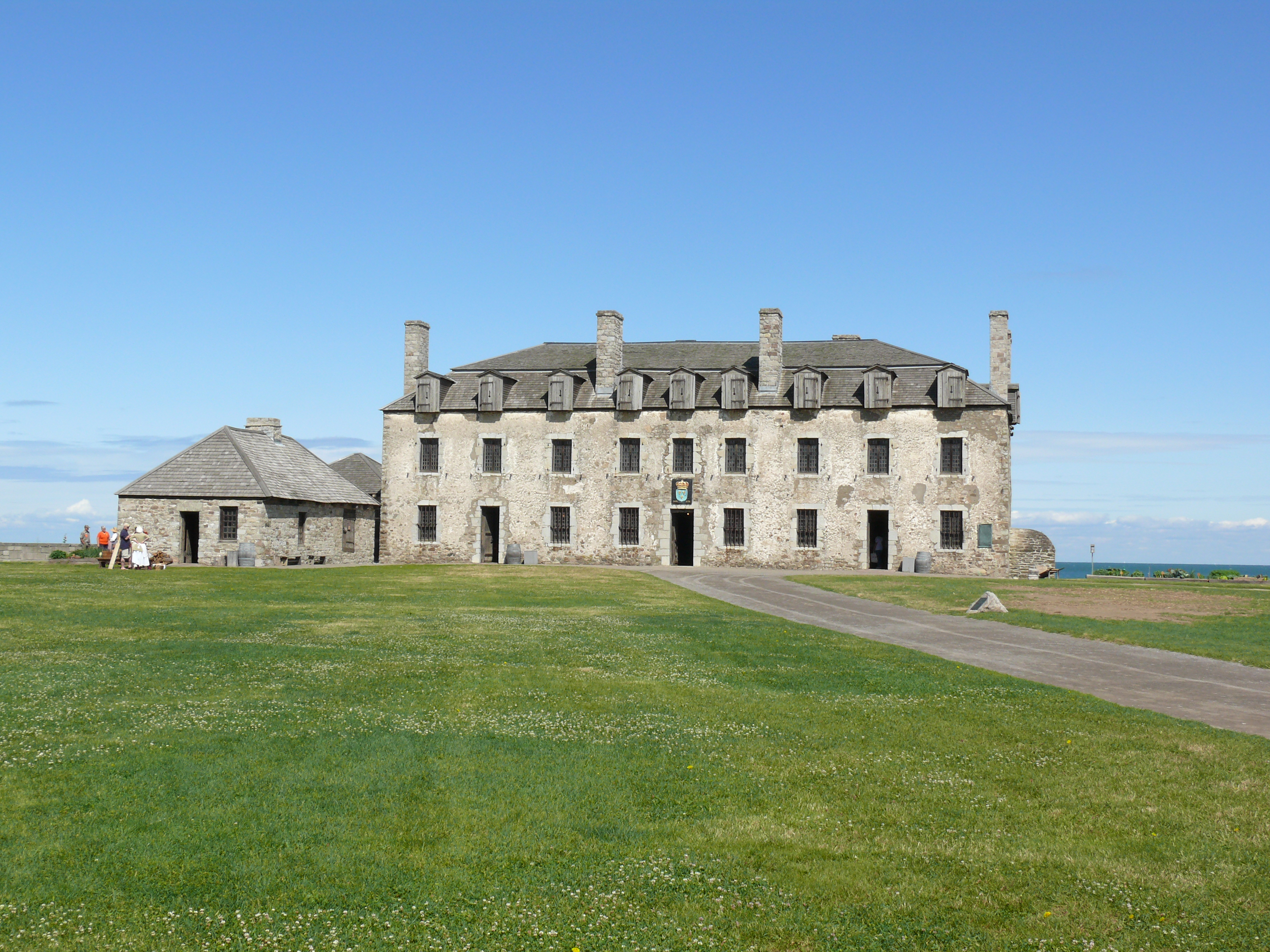
Fort Niagara
The French called it the House of Peace. They had to. In 1726, when engineer Gaspard-Joseph Chaussegros de Lery built a two-story stone structure on the eastern bank of the Niagara River, the Seneca people of the Iroquois League had granted permission for a trading post, not a fortress. So the French disguised their fortification as a grand merchant's house, complete with a fireplace and a chapel. They named it Maison de la Paix. Three centuries later, that deception still stands. The original stone building, known today as the French Castle, remains the centerpiece of Fort Niagara, a fortress that has flown the flags of France, Britain, and the United States across nearly 300 years of continuous military occupation.
A Fort Built on Bones and Diplomacy
The strategic importance of the Niagara River's mouth was obvious to every colonial power that looked at a map. Whoever controlled this point controlled the gateway between Lake Ontario and the interior of the continent. Rene-Robert Cavelier, Sieur de La Salle, built the first fortified structure here in 1678, a wooden stockade called Fort Conti. In 1687, the Governor of New France replaced it with Fort Denonville, garrisoned by a hundred men under Captain Pierre de Troyes. The winter that followed was catastrophic. Disease and cold killed all but twelve soldiers before a relief force arrived from Montreal. The government abandoned the post in 1688 and tore down the stockade. It took a former French captive of the Seneca, Louis-Thomas Chabert de Joncaire, to secure a new foothold. Adopted into the tribe after a turbulent captivity, Joncaire spoke to the Seneca chiefs in 1720 and persuaded them that a man of their tribe had the right to build a dwelling among them. The trading post that followed became the foundation for everything that came after.
The General Who Lost His Head
By 1755, the French had expanded their stone house into a full military fortification, complete with bastions and gun batteries, in response to the Seven Years' War. The fort became a critical target in North America's theater of that global conflict. In July 1759, the British launched a nineteen-day siege known as the Battle of Fort Niagara. A French relief force marching to break the siege was ambushed and routed at the Battle of La Belle-Famille. The siege itself claimed a peculiar casualty on the British side: General John Prideaux, the expedition's commander, literally lost his head when he stepped in front of a mortar being test-fired by his own troops. Command fell to Sir William Johnson, the Irish-born leader of the New York Militia, who accepted the fort's surrender from French commander Pierre Pouchot. Britain would hold Fort Niagara for the next thirty-seven years.
Loyalists, Brawlers, and Bordello Row
During the American Revolutionary War, Fort Niagara served as the Loyalist base in New York for Colonel John Butler and his Rangers. The fort also held Continental Army prisoners, including Lt. Col. William Stacy, captured during Butler's Rangers' attack on Cherry Valley, New York, in 1779. Below the fort's walls, on the riverside flat known as The Bottom, a rough frontier settlement sprouted: crude taverns, makeshift stores, and bordellos that made Niagara notorious for brawling and cheating. Though the 1783 Treaty of Paris technically ceded the fort to the United States, Britain held on for thirteen more years, using it as a staging point for Loyalist refugees fleeing persecution in the new republic. United Empire Loyalists received land grants in Upper Canada, and the fort's military stores helped sustain them through their early years. American forces finally took possession in 1796, after the Jay Treaty reaffirmed the border.
Captured in the Night
Fort Niagara saw action again during the War of 1812. In November 1812, the fort's guns sank the Provincial Marine schooner Seneca on the Niagara River. The following year, on December 19, 1813, British forces captured the fort in a nighttime assault, retaliating for the American burning of the town of Niagara nine days earlier. The British held it until the Treaty of Ghent ended the war, and it has remained in American hands ever since. In the post-Civil War era, the Army built a new military camp outside the original walls, recognizing that masonry forts had become obsolete under modern bombardment. The new fort trained troops for the Spanish-American War and hosted an officer training school during World War I. During World War II, it served as an induction center and then a prisoner-of-war camp holding 1,200 German soldiers captured in North Africa. During the Korean War, it housed anti-aircraft artillery and Nike missile defenses.
Three Centuries and Counting
The U.S. Army officially deactivated Fort Niagara in 1963, but military presence continues to this day with a Coast Guard station operating at The Bottoms. Since 1931, a nonprofit organization has preserved and operated the colonial-era fortress as a state park and museum. Fort Niagara was designated a National Historic Landmark in 1960, among the first sites to receive that distinction. Today, visitors walk through the original French Castle, watch reenactments of 18th-century battles on the parade ground, and look across Lake Ontario toward Toronto's skyline on the horizon. The fort also carries a ghost story: legend holds that a headless French soldier, decapitated in a duel, wanders the grounds searching for his missing head. In 2025, the fort announced plans to build a replica 18th-century log cabin as a Native American Education Center, recognizing the Iroquois nations whose land and diplomacy made the fort's existence possible from the very beginning.
From the Air
Fort Niagara sits at the mouth of the Niagara River on Lake Ontario, at 43.26N, 79.06W, near Youngstown, New York. The star-shaped fortification is clearly visible from the air on the river's eastern bank, with Lake Ontario opening to the north. Fort George and Fort Mississauga are directly across the river on the Canadian side at Niagara-on-the-Lake. Best viewed at 1,500-3,000 feet AGL. Nearby airports: Niagara Falls International Airport (KIAG) 12nm south, Niagara District Airport (CYSN) 6nm south across the river, Buffalo Niagara International (KBUF) 25nm south. Toronto's skyline is visible across the lake on clear days.