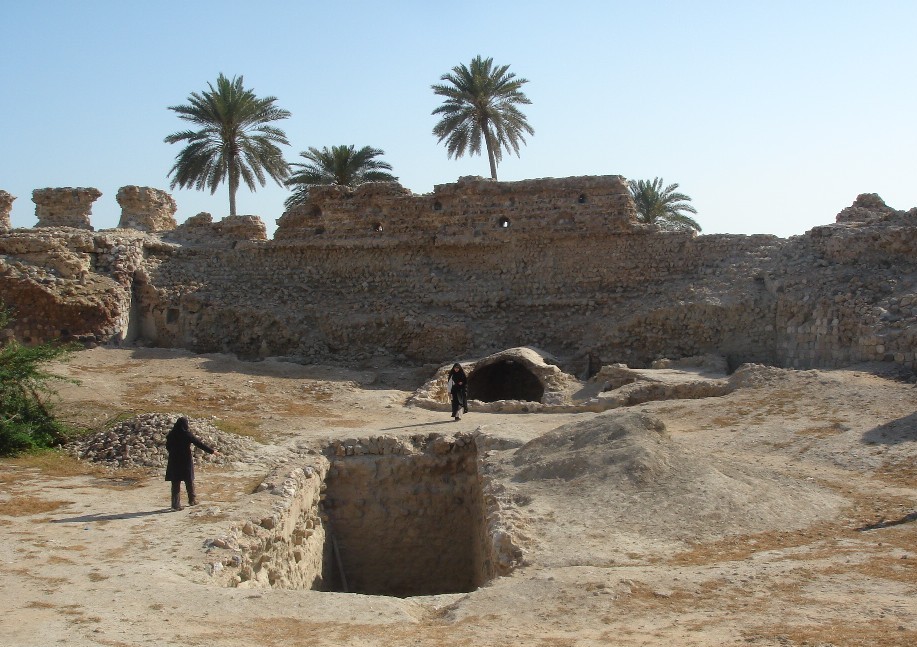
Fort Nossa Senhora da Conceicao
Built from the same iron-rich red stone as the island beneath it, the Fort of Our Lady of the Conception looks as if it grew from the earth rather than being placed upon it. This Portuguese castle at the northern tip of Hormuz Island is the last major surviving monument of Portugal's colonial era in the Persian Gulf -- a relic of the century when Lisbon's ambitions stretched from Brazil to Japan, with small fortified outposts marking the route. Its roofless walls and crumbling bastions stand against a backdrop of turquoise water and red sand, the kind of ruin that makes its own argument for how empires end.
Albuquerque's Gamble
The fortress exists because of one man's tenacity. In 1507, the Portuguese commander Afonso de Albuquerque arrived at Hormuz Island with a small fleet, part of King Manuel I's policy of seizing strategic points across the Indian Ocean. Albuquerque ordered his men -- soldiers, sailors, officers of every rank -- to begin building a fort immediately. He named it the Fort of Our Lady of Victory. But the forced labor provoked a revolt among his own troops, and Albuquerque was compelled to retreat, leaving the unfinished fortress behind. Eight years later, in 1515, he returned, recaptured the island, and completed the fort, renaming it the Fort of Our Lady of the Conception. The reddish stone came from the island itself, quarried from the same iron-oxide-rich rock that gives Hormuz its otherworldly color. A moat once separated the castle from the rest of the island; traces of it remain.
A Century of Portuguese Control
For over a hundred years, the fort anchored Portugal's presence in the Persian Gulf. Hormuz Island became an emergency stopover for Portuguese ships traveling to Goa and Gujarat. The fort deterred attacks from rival powers and local rulers alike. In 1552, the Ottoman admiral Piri Reis -- better known today as the cartographer behind one of history's most famous early world maps -- laid siege to the island but failed to take it. Augustinian monks settled on Hormuz in 1575, using the island as a base to establish a Christian mission in Isfahan. The fortress watched over a thriving if small colonial outpost at the junction of the Persian Gulf and the Indian Ocean, one link in the chain of forts that stretched from Mozambique to Macau.
The Fall to Persia
The end came in 1622. Shah Abbas the Great of Persia, who ruled from 1587 to 1629, was determined to expel the Portuguese from his southern coast. He found an unlikely ally in the English East India Company, whose ships cooperated with Persian land forces to seize the island. The fortress fell. Abbas, however, had no interest in maintaining Hormuz as a trading center. He distrusted the local population and preferred to develop the mainland port that would bear his name: Bandar Abbas. Hormuz went into slow decline. Its inhabitants drifted back to the mainland, following seasonal agricultural rhythms. Only fishermen remained year-round, and the island's exports dwindled to small quantities of rock salt and iron oxide lumps used as ballast in sailing ships. The great fortress began its long slide into ruin.
What Remains
Today, most of the fort's roof has collapsed, but the lower walls remain substantially intact, thick and imposing, laid out across multiple levels of the rocky promontory. The moat has silted in, leaving only a depression. Walking through the roofless chambers, visitors find the fort's layout still legible -- barracks, storerooms, gun emplacements -- all rendered in that distinctive red stone that makes the ruin seem to bleed into its surroundings. The fortress is one of several Portuguese castles scattered across the Persian Gulf islands, including a similar structure on Qeshm. Together they mark the furthest reach of European colonial architecture into the Gulf, built during the same Habsburg dynasty period that saw Portuguese fortifications rise at Dibba Al-Hisn and defensive walls encircle coastal towns across Oman. The fort endures as a monument to the ambition and fragility of empires that measure their reach in sea lanes.
From the Air
The Fort of Our Lady of the Conception sits at the northern tip of Hormuz Island at 27.101N, 56.452E, visible as a prominent structure against the red terrain. The fortress's red stone walls blend with the island's geology but are distinguishable by their geometric outline. Approach from the north for the best view, with the fort silhouetted against the island behind it. Bandar Abbas International Airport (OIKB) is approximately 25 km to the northeast. The fort is best observed below 5,000 feet to appreciate its layout and the moat traces.