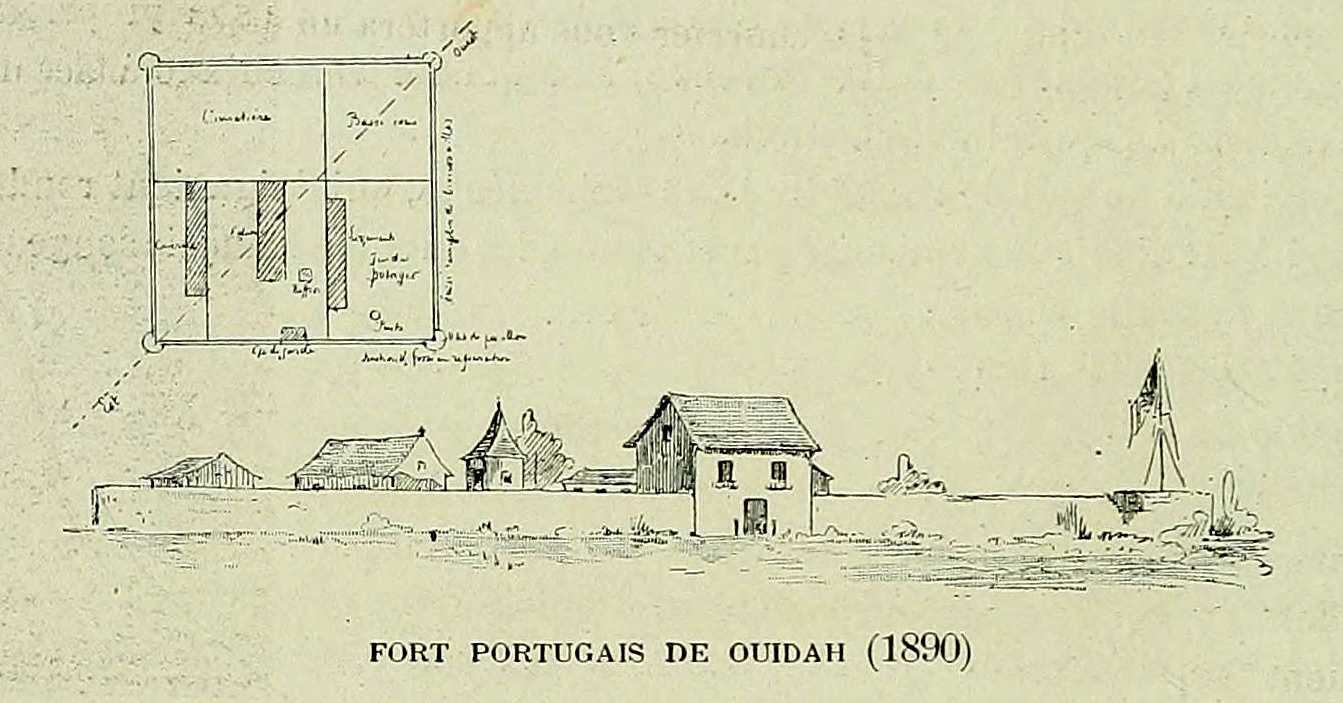
Fort of Sao Joao Baptista de Ajuda
In 1958, the Guinness Book of World Records declared it the smallest colony on Earth: a Portuguese fort in French West Africa, garrisoned by one officer and a handful of men, entirely surrounded by foreign territory. Fort Sao Joao Baptista de Ajuda in Ouidah, Benin, had by then become a geopolitical absurdity -- a colonial holdout so small it barely qualified as a dot on the map. But its origins were anything but trivial. Built in 1721 to supply enslaved people to sugar and tobacco plantations in Bahia, Brazil, the fort was the last of three European fortifications erected in Ouidah to tap the human trade of the Slave Coast. Its history spans the full arc of the Atlantic slave trade, from peak brutality to legal abolition to the illicit trade that flourished in defiance of the law.
Three Forts, One Purpose
Ouidah in the early 18th century was a slave-trading hub where European powers competed for access to the human cargo flowing from the interior. The French had established a small trading post there in 1671, upgrading it to Fort Saint-Louis in 1704. The English Royal African Company built William's Fort in 1692. The Portuguese were the latecomers. After losing Elmina Castle to the Dutch in 1637, they had spent decades without a base on the Gulf of Guinea -- an intolerable position for a nation deeply invested in the slave trade to Brazil. In 1721, Bahia merchant Captain Jose Torres sailed to Ouidah and erected the Portuguese fort on a site chosen by the Hueda king, a few hundred yards east of the English fort. All three fortifications were built of dried mud by enslaved African laborers using local masonry methods -- roughly 100 meters square each, with earthen walls two to three meters thick, 20-foot moats, and thatch roofs that made them terribly vulnerable to fire.
Subject to the Insults of Kings
The kings of Hueda, and later the kings of Dahomey who conquered the region in 1727, refused to allow European forts on the coastline. Positioned four kilometers inland, all three forts depended entirely on royal goodwill. Directors were required to travel 100 kilometers north to the Dahomean capital of Abomey each year to pay their respects during the annual festivities the Europeans called "customs" -- in reality, a ritual reminder of who held the real power. When King Tegbesu suspected the Portuguese fort director Joao Basilio of conspiring with his enemies in 1743, he had him imprisoned and expelled. Dahomean troops subsequently assaulted the fort, and the Portuguese gunpowder magazine exploded, destroying the structure entirely. It was rebuilt, but the incident illustrated a persistent truth: these European forts existed at the pleasure of African rulers, not despite them.
The Chacha and the Illicit Trade
When Britain, France, and Portugal legally abolished the slave trade in the early 19th century, the Ouidah forts were abandoned or repurposed. The British and French forts became palm oil trading stations. The Portuguese fort sat empty. But the trade in enslaved people did not end -- it went underground. Francisco Felix de Sousa, a Brazilian-born clerk who had once worked at the Portuguese fort, became one of the most powerful illicit slave traders on the coast. He helped a younger brother of the ruling Dahomean king seize the throne as Ghezo, and in return was installed as "captain of the Whites" -- a position of extraordinary privilege. Known by his nickname chacha, de Sousa and his sons dominated Brazil's illegal slave-trading network along the Slave Coast. In 1822, he reportedly hoisted the flag of the newly proclaimed Brazilian Empire over the fort, though he conducted his operations and lived with his many wives and children elsewhere in Ouidah.
The World's Smallest Colony
Portugal reoccupied the fort in 1865 and clung to it with remarkable tenacity. When France colonized Dahomey in the 1890s, Portuguese diplomats insisted on retaining sovereignty over the tiny enclave, now entirely surrounded by French territory. A small detachment of troops from Portuguese Sao Tome and Principe garrisoned the fort until 1911; after that, only the residente -- the governor -- his assistant, and their families remained. By the 1921 census, the fort had five inhabitants. When the Republic of Dahomey gained independence in 1960 and issued an ultimatum to Portugal in August 1961, only two Portuguese citizens remained. Rather than surrender, they attempted to burn the fort. Portugal did not formally recognize Dahomey's annexation until 1975. Today the restored fort houses the Ouidah Museum of History, its mud walls rebuilt to preserve the memory of what happened within them -- a place where the stories of enslaved people, colonial politics, and the stubborn persistence of empire converge.
From the Air
Fort Sao Joao Baptista de Ajuda sits at 6.359N, 2.09E in Ouidah, Benin, approximately 4 km inland from the Gulf of Guinea coast. From 3,000-5,000 feet AGL, the fort's restored square compound and surrounding grounds are visible in the urban fabric of Ouidah. The town lies along the main coastal road between Lome, Togo, and Cotonou, Benin. The nearest major airport is Cotonou Cadjehoun Airport (DBBB), approximately 40 km to the east. The Route des Esclaves (Slave Route), a 4-km path from Ouidah to the beach lined with monuments, may be visible as a distinct track. The flat coastal plain and lagoon systems characterize the terrain. Tropical haze is common.