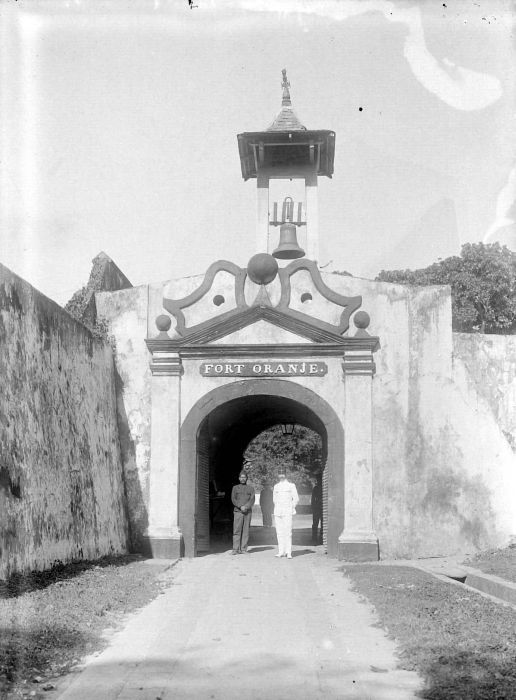
Fort Oranje (Ternate)
For twelve years, from 1607 to 1619, the administrative capital of the Dutch East Indies was not Jakarta, not Malacca, not any of the great cities of Java. It was a rectangular stone fort on a small volcanic island in the Maluku archipelago, ringed by a deep moat and bristling with cannon. Fort Oranje on Ternate was where the Governor-General of the Dutch East Indies first set up his office, where the council of the VOC conducted the business of building a commercial empire, and where the Dutch made their initial bid to control the most valuable trade in the world: spices.
From Shipwreck to Sultanate
The European entanglement with Ternate began almost by accident. In 1512, Francisco Serrao was shipwrecked near Seram and rescued by local inhabitants. Sultan Hairun brought the survivors to Ternate and gave the Portuguese permission to build. For decades the relationship between the Portuguese and the Ternatan sultans deteriorated, punctuated by forced spice monopolies and culminating in the assassination of Sultan Hairun. His son Babullah expelled the Portuguese after a five-year siege in 1575, and Ternate became an expanding Islamic state. When the first Dutch ships arrived in 1599 under Commander Wybrand van Warwijck, they found a sultanate open to new trading partners, provided those partners proved more reliable than the last Europeans.
A Fort Named Orange
In 1607, VOC Admiral Cornelis Matelief de Jonge helped the Sultan of Ternate expel a Spanish garrison, and in gratitude the sultan granted the Dutch permission to establish a fort and a monopoly on the spice trade. The new fort, initially called Fort Malay, was built on top of an older, damaged Malay sultan's fortress. In 1609, the first Dutch authority on Ternate, Paul van Carden, renamed it Fort Oranje after the House of Orange. The old name stubbornly persisted for years. On February 17, 1613, the VOC's governing body, the Heeren XVII, designated Ternate and Ambon as official residences for the Governor-General. When Pieter Both was appointed the first Governor-General of the Dutch East Indies, Fort Oranje became the administrative nerve center of the VOC's entire Asian operation.
Capital of an Empire, Briefly
Fort Oranje's tenure as the capital of the Dutch East Indies was short but significant. From here, the VOC directed operations across the Maluku Islands, negotiated with local sultanates, and coordinated the spice trade that was the company's reason for existing. In 1619, the headquarters moved to Batavia on Java, a location better suited to managing the VOC's expanding interests across the archipelago. But Fort Oranje remained the seat of a VOC governor who controlled trade across North Maluku throughout the eighteenth century. When the VOC went bankrupt in 1800, the fort's administration was absorbed by the colonial government of Maluku. The British captured it in 1810 during the Napoleonic Wars, and it was returned to the newly created United Kingdom of the Netherlands in 1817 after the Congress of Vienna redrew Europe's colonial map.
The Fort That Survived the Earthquakes
Fort Oranje is the largest fortification on Ternate Island, and despite sitting on one of Indonesia's most seismically active volcanic islands, most of its walls still stand. The roughly rectangular plan features four corner bastions, thick stone walls, a deep moat, and an array of period cannon. Part of the southern wall collapsed during an earthquake in 2018, but repairs were completed promptly. A major clean-up and refurbishment program finished in 2019 gave the fort a second life as a public venue. Today it hosts cultural events and remains Ternate's most important tourist attraction, a stone monument to the moment when a trading company from the Netherlands decided that this small volcanic island at the edge of the Pacific was the right place to build the capital of a commercial empire.
From the Air
Fort Oranje is located at approximately 0.79N, 127.39E on the eastern coast of Ternate Island, within Ternate City. From the air, the rectangular fort with its four corner bastions and moat is visible near the waterfront. Ternate's massive volcanic cone, Mount Gamalama (1,715 m), dominates the island above. Sultan Babullah Airport (WAMN) is on the eastern side of the island, very close to the fort. The strait between Ternate and Halmahera to the east, and between Ternate and Tidore to the south, provides dramatic visual context. Best viewed at 2,000-5,000 feet when circling the island.