Fort Osage
In June 1804, Meriwether Lewis and William Clark camped across the Missouri River from a bluff that commanded the water below. Clark noted its 'high commanding position, more than 70 feet above high-water mark, and overlooking the river, which is here but of little depth.' Four years later, Clark would return to that very spot to build one of the most important outposts on the American frontier -- Fort Osage, a government trading post designed to win the loyalty of the Osage Nation through fair commerce, while extending federal authority into the vast unknown of the Louisiana Purchase.
Jefferson's Gambit on the Missouri
The fort was born from a promise. In 1804, Pierre Chouteau -- part of the powerful fur-trading family and agent for the Osage -- escorted Osage chiefs to Washington, D.C. President Thomas Jefferson assured them the United States would build a trading post for their benefit. Jefferson had a broader strategy: expand federal trading posts on the frontier to undersell private traders, drive out unscrupulous merchants, and 'earn the good will of the Indians.' Fort Osage was one of three forts the U.S. Army established to control the newly acquired Louisiana Purchase territories west of the Mississippi. Fort Madison in Iowa guarded the Upper Mississippi, Fort Belle Fontaine near St. Louis controlled the Missouri's mouth, and Fort Osage would anchor the western frontier. William Clark led a construction team to the site in September 1808. Two months later, Pierre Chouteau negotiated the Treaty of Fort Clark with members of the Osage Nation. In exchange for access to the trading post and federal protection from rival tribes, the Osage ceded all their lands east of the fort -- effectively confining them to a narrow strip on Missouri's extreme western border. The Great Osage received $1,000 and the Little Osage $500.
A Frontier Crossroads
Captain Eli Clemson officially christened the post 'Fort Osage' and commanded its garrison from 1808 until its evacuation in 1813. The fort quickly became a critical waypoint on the Missouri River, attracting an extraordinary roster of frontier figures. Daniel Boone visited in 1816, at the age of 82, during one of his last hunting trips into the wilderness. Sacagawea and her husband Toussaint Charbonneau, who had guided Lewis and Clark to the Pacific, stayed at the fort on their way back north to Dakota Territory after spending time in St. Louis. Factor George C. Sibley oversaw the trading operations and reported thriving commerce with the Osage, noting that goods were sold 'at prices less than half what the traders extort from them.' The fort was a rare experiment in the government directly competing with private enterprise to benefit Native American communities -- however briefly and imperfectly that experiment lasted.
Abandoned and Reborn
Fort Osage was evacuated in June 1813 during the War of 1812, not because it was threatened, but because the soldiers were needed elsewhere. It was reoccupied in 1815 after the war ended. The Adams-Onis Treaty, which settled the border with Spain, further reduced the strategic need for the post. By the 1820s, as the Osage ceded the remainder of their Missouri lands through subsequent treaties, Fort Osage ceased operations entirely. The site lay quiet for over a century. Between 1948 and 1961, a replica of the fort was painstakingly constructed on the original foundations, and in 2007 the Fort Osage Education Center opened with exhibits on the site's geology, 19th-century natural history, the Hopewell and Osage native cultures, Lewis and Clark, and the Missouri River. The reconstructed post is designated a National Historic Landmark and is listed on the National Register of Historic Places. Operated by Jackson County Parks and Recreation, it offers living history demonstrations of early 19th-century military and civilian life.
The View Clark Remembered
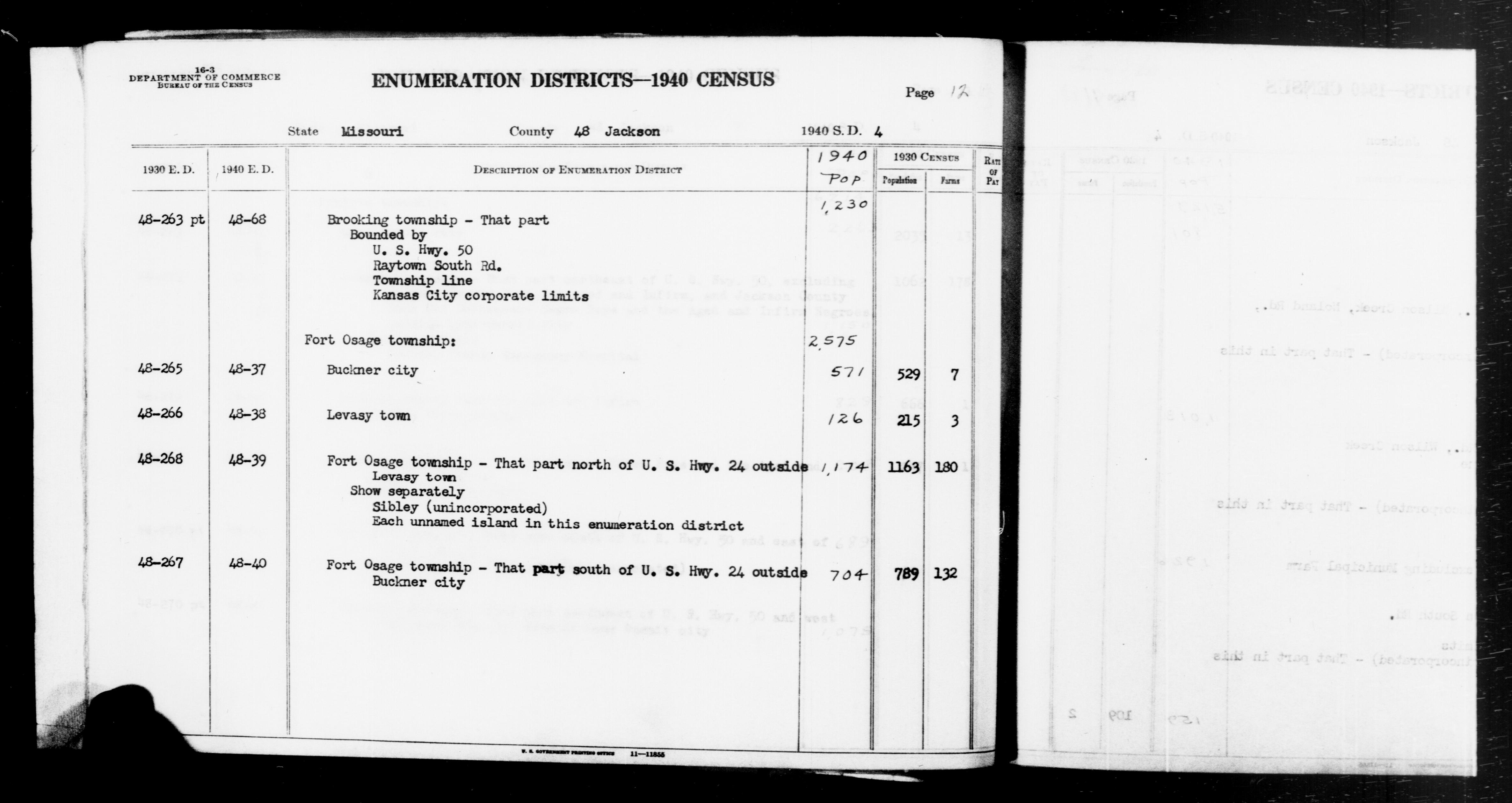
Standing on the bluff today, visitors look out over the same bend in the Missouri River that William Clark surveyed in 1804. The river has shifted course many times since then, but the commanding elevation remains -- more than 70 feet above the water, just as Clark described it. Fort Osage sits in present-day Sibley, Missouri, northeast of Independence, in the Kansas City metropolitan area. It was here that the United States first planted its flag deep in the Louisiana Purchase, not with an army of conquest but with a trading post and a promise. That the promise was imperfectly kept -- that the Osage would eventually lose all their Missouri homeland -- does not erase the ambition of the moment. For a few years on this high bluff, the federal government tried to build something unprecedented: a commercial relationship with Native Americans based, at least in theory, on fair dealing rather than exploitation.
From the Air
Located at 39.19N, 94.19W on a prominent bluff above the Missouri River in Jackson County, Missouri. The reconstructed fort site is visible from altitude as a cleared area on a high river bluff, northeast of Independence. Nearest airports include Kansas City Downtown Airport (KMKC, roughly 20nm west) and Lee's Summit Municipal Airport (KLXT, roughly 15nm southwest). Recommended viewing altitude: 2,000-4,000 ft AGL to appreciate the river bluff positioning. The Missouri River bend below the fort is a distinctive visual landmark.