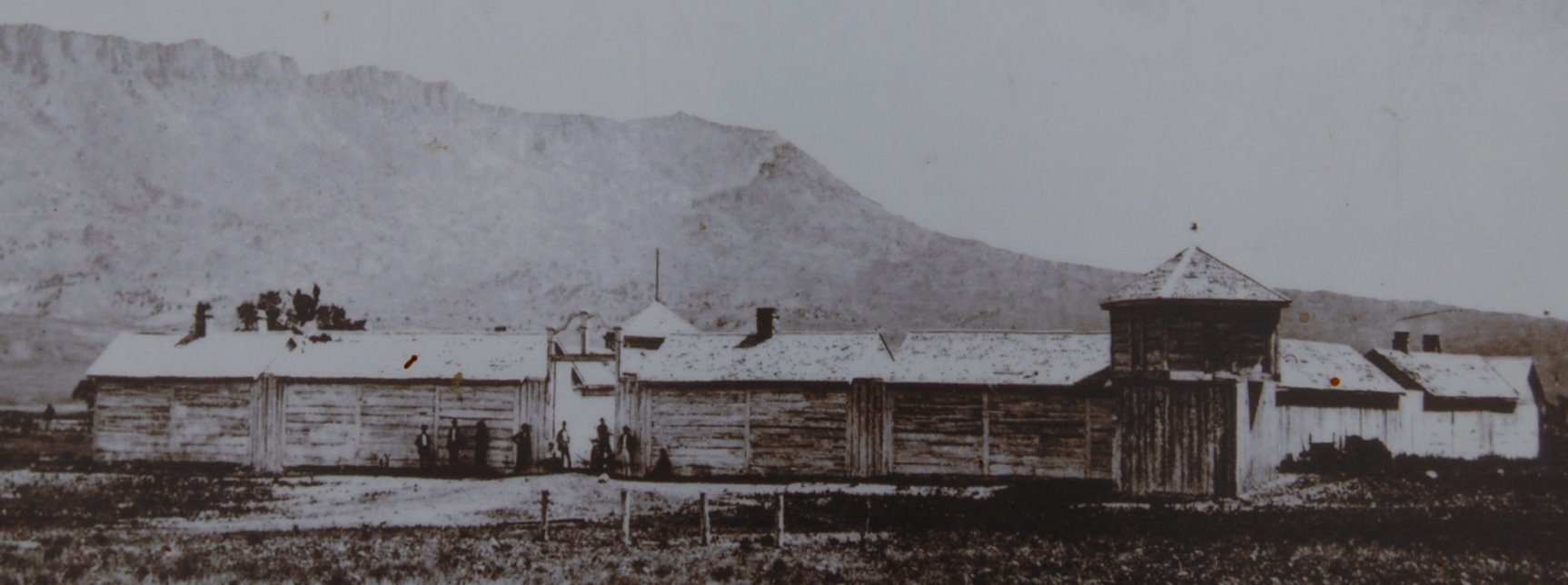
Fort Parker Massacre
Benjamin Parker knew the math. Five men against a war party that stretched across the fields. The walls of Fort Parker, a crude stockade north of present-day Groesbeck in Limestone County, Texas, would hold for seconds at most -- the raiders could scale them with ropes. So on the morning of May 19, 1836, when a contingent of Comanche, Kiowa, Caddo, and Wichita warriors appeared before the fort under a white flag no one believed, Benjamin walked out to meet them. He was buying time. Behind the fort, women and children fled through the back gate. Benjamin Parker was killed, along with his father John, his brother Silas, and two others. Five people were captured. Among them was a girl of about nine years old named Cynthia Ann Parker, whose abduction set in motion a family saga that would span decades, two cultures, and the entire arc of the Texas frontier.
A Baptist Colony on the Edge of Comancheria
Fort Parker was established around 1834 by the Parker family, members of the Pilgrim Predestinarian Baptist Church from Crawford County, Illinois. Led by the elderly patriarch John Parker and his sons, the group had come to Texas in 1833, settling in what was then the extreme edge of Anglo colonization. The stockade sat in Comanche territory -- a fact the settlers understood but chose to accept. By May 1836, the Republic of Texas was barely two months old, its independence won at San Jacinto just weeks earlier. The frontier families at Fort Parker had no military support. When Rachel Plummer, a seventeen-year-old captive, later wrote her memoir, she recalled the speed of the attack: 'One minute the fields were clear, and the next moment, more Indians than I dreamed possible were in front of the fort.' Five settlers died. Five were taken captive: Cynthia Ann Parker, her brother John Richard Parker, their cousin Rachel Plummer, Rachel's infant son James Pratt Plummer, and Elizabeth Duty Kellogg.
Between Two Worlds
Cynthia Ann Parker lived with the Comanche for nearly twenty-five years. She married Chief Peta Nocona and bore three children, including a son named Quanah. By all accounts she became fully Comanche, adopting the language, customs, and identity of the people who had taken her. In 1860, Texas Rangers attacked her band at the Battle of Pease River. Cynthia Ann was captured -- or, from her perspective, captured again. Her uncle Isaac Parker identified her and brought her back to Anglo Texas. She never readjusted. After her daughter Prairie Flower caught influenza and died from pneumonia, Cynthia Ann starved herself to death in 1870, at the age of forty-three. Her brother John Richard, ransomed back in 1842, fared no better in white society. He ran back to the Comanche, contracted smallpox during a raid into Mexico, was nursed back to health by a captive Mexican girl, married her, and spent the rest of his life in Mexico, where he died in 1915.
The First Texas Captivity Narrative
Rachel Plummer endured two years of captivity before her father negotiated her ransom. Her account, published in Houston in 1838 as Rachael Plummer's Narrative of Twenty-One Months' Servitude as a Prisoner Among the Comanchee Indians, became a sensation. It was the first narrative about a Texas Indian captive published in the Republic of Texas, and it circulated widely across the United States and abroad. Rachel's infant son James Pratt was separated from her during captivity and given to another Comanche band. He was ransomed in late 1842, but his grandfather James W. Parker refused to return the boy to his father Luther Plummer, claiming Luther had not paid for the ransom. Even when the Governor of Texas intervened, the grandfather held firm. Rachel herself died in 1840, in childbirth, just a year after being freed. She never learned what happened to her son.
The Last Chief of the Staked Plains
Quanah Parker, son of Cynthia Ann and Peta Nocona, rose to become a leader among the Quahadi Comanche -- the last free band on the Staked Plains of West Texas. He fought in the Red River War of 1874-75, the final major military campaign against the southern Plains tribes. When the Quahadis finally surrendered, they were the very last group to come in. Forced onto a reservation in Oklahoma Territory, Quanah was made chief of all Comanche tribes there. He became a skilled diplomat between Native and Anglo worlds, adapting to reservation life while preserving Comanche identity. Shortly before his death in 1911, he arranged to have his mother Cynthia Ann and sister Prairie Flower disinterred and reburied next to his own future grave at Post Oak Cemetery near Cache, Oklahoma. Congress passed a special allotment to fund the reburial. In 1957, all three were moved to Chief's Knoll at the Old Post military cemetery in Fort Sill.
What Remains at Fort Parker
Today, Fort Parker State Park preserves the landscape near the original stockade site, north of Groesbeck. A reconstructed fort stands as a state historic site, its timber walls a reminder of how thin the barrier was between two colliding civilizations. The story that began here on a May morning in 1836 reverberates far beyond this patch of central Texas prairie. It inspired John Ford's film The Searchers. It shaped the mythology of the Texas frontier. And it produced one of the most complex family narratives in American history -- a story in which captivity and belonging, violence and adaptation, and the question of where home truly lies refuse any simple answer. The Parker family's descendants, both Anglo and Comanche, carry that complicated inheritance forward.
From the Air
Located at 31.564N, 96.548W, in Limestone County, about 6 miles north of Groesbeck, Texas. Fort Parker State Park is visible as a green area along the Navasota River. Nearest airport is Hilltop Lakes Airport (0TE4) about 25nm southeast, or Waco Regional (KACT) about 40nm northwest. The terrain is gently rolling central Texas prairie with scattered tree lines. From altitude, the park and lake are identifiable landmarks.