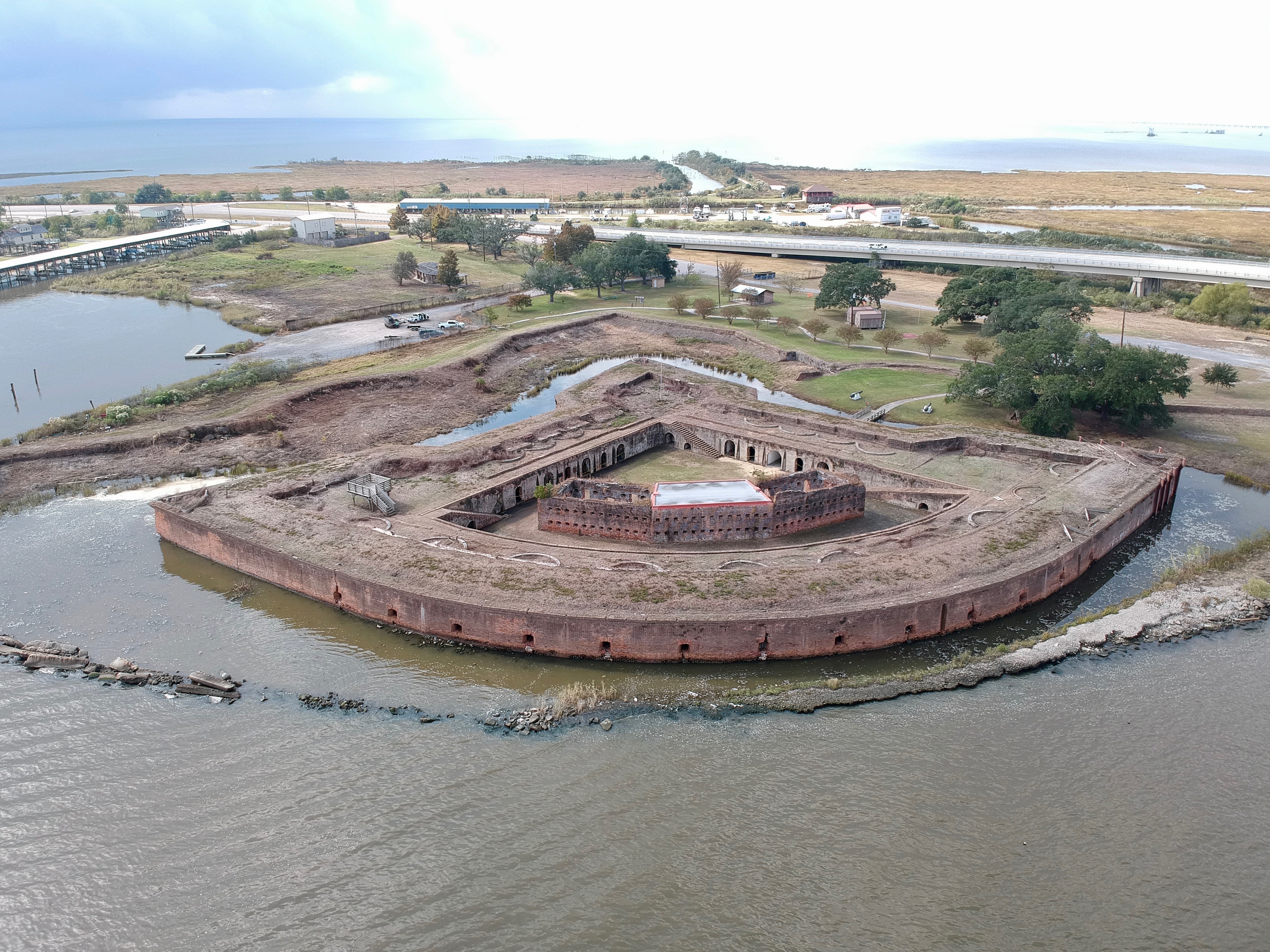
Fort Pike
No cannon was ever fired in anger at Fort Pike. That single fact would seem to make the place a footnote, a brick-and-mortar monument to nothing happening. Yet this citadel perched on the Rigolets, the narrow strait connecting Lake Borgne to Lake Pontchartrain, has absorbed two centuries of American conflict: the aftermath of the War of 1812, the Seminole Wars, the Civil War, and the long slow siege of Louisiana hurricanes. Named for Brigadier General Zebulon Pike, the explorer who gave his name to Pikes Peak in Colorado, the fort was built beginning in 1819 to guard the water approach to New Orleans from the east. Its casemates and ramparts still stand, battered but defiant, on the marshy shore where the Gulf's influence meets the lake.
The Third System's First Son
After the War of 1812 exposed the vulnerability of American coastal defenses, the federal government launched an ambitious program known as the Third System to fortify the nation's coastline. Fort Pike was the first of three forts constructed in Louisiana under this initiative, joined later by Fort Jackson and Fort Livingston. Construction began in 1819 on the site of an older fortification at Petit Coquilles, which dated to 1793 and had been found woefully inadequate during the British advance that led to the Battle of Lake Borgne in 1814. The new fort was built of brick and mortar, its casemates designed to house cannon that could command the Rigolets and deny any hostile fleet access to Lake Pontchartrain and, by extension, the back door to New Orleans.
Prisoners and Soldiers
Fort Pike's first real test had nothing to do with naval bombardment. During the Second Seminole War of the late 1830s, the U.S. military used the fort as a temporary holding facility for captured Seminole Indians from Florida. The prisoners were held within the casemates before being transported west to the Seminole Reservation in Indian Territory, present-day Oklahoma. It was a grim early chapter in the long story of forced removal that would define federal policy toward Native Americans for decades. The fort returned to prominence during the Civil War. In 1861, the Louisiana Continental Guard seized it just weeks before Louisiana officially joined the Confederacy. When Union forces captured New Orleans in 1862, Confederate troops evacuated. The Union turned the installation into a base for raids and, notably, a training site for the United States Colored Troops beginning in 1864, regiments composed primarily of formerly enslaved men preparing to fight for their own freedom.
The Silence After
The Army abandoned Fort Pike in 1890, leaving behind a citadel that had never fulfilled its designed purpose of repelling an invading fleet. The brick-and-mortar structure slowly decayed through the 20th century, maintained as a state historic site but always at the mercy of the Louisiana climate. The Rigolets are an unforgiving environment: salt air corrodes, moisture seeps into mortar joints, and hurricanes periodically remind everyone that coastal Louisiana is a place where the land is always negotiating with the water. The fort became a quiet tourist attraction, its casemates and ramparts offering visitors a tangible connection to early American military architecture, with cannons displayed across the moat and the Rigolets flowing past just beyond the walls.
Storms That Keep Coming
Hurricane Katrina's storm surge in 2005 completely submerged Fort Pike, destroying adjacent state park buildings and accelerating the decay of the already-deteriorating brickwork. The fort reopened after repairs, only to be shuttered again after Hurricane Gustav in September 2008. It reopened once more, then closed again after Hurricane Isaac in 2012. Each storm peeled away another layer of the fort's fabric, and each round of repairs grew more costly. In February 2015, the fort closed yet again, this time not because of a hurricane but because of state budget cuts. Fort Pike has appeared in several films, including the 2013 movie G.I. Joe: Retaliation, where it stood in for Fort Sumter in Charleston, South Carolina. The real Fort Sumter saw the opening shots of the Civil War; Fort Pike saw none, but its brick walls proved convincing enough for Hollywood. The fort's cycle of damage, repair, closure, and reopening mirrors the broader story of Louisiana's coast, a landscape perpetually rebuilding itself against forces that refuse to relent.
From the Air
Located at 30.17N, 89.74W on the Rigolets, the narrow strait connecting Lake Borgne to Lake Pontchartrain. The fort sits on the south shore of the pass, visible from low altitude as a pentagonal brick structure with a surrounding moat. The old and new US 90 bridges over the Rigolets are visible nearby. Lake Pontchartrain stretches to the west, Lake Borgne to the east. The marshlands of eastern New Orleans spread to the south. Nearby airports include Lakefront Airport (KNEW) approximately 20 miles west and Louis Armstrong New Orleans International (KMSY) approximately 35 miles to the west-southwest. Best viewed at lower altitudes to appreciate the citadel's shape against the water.