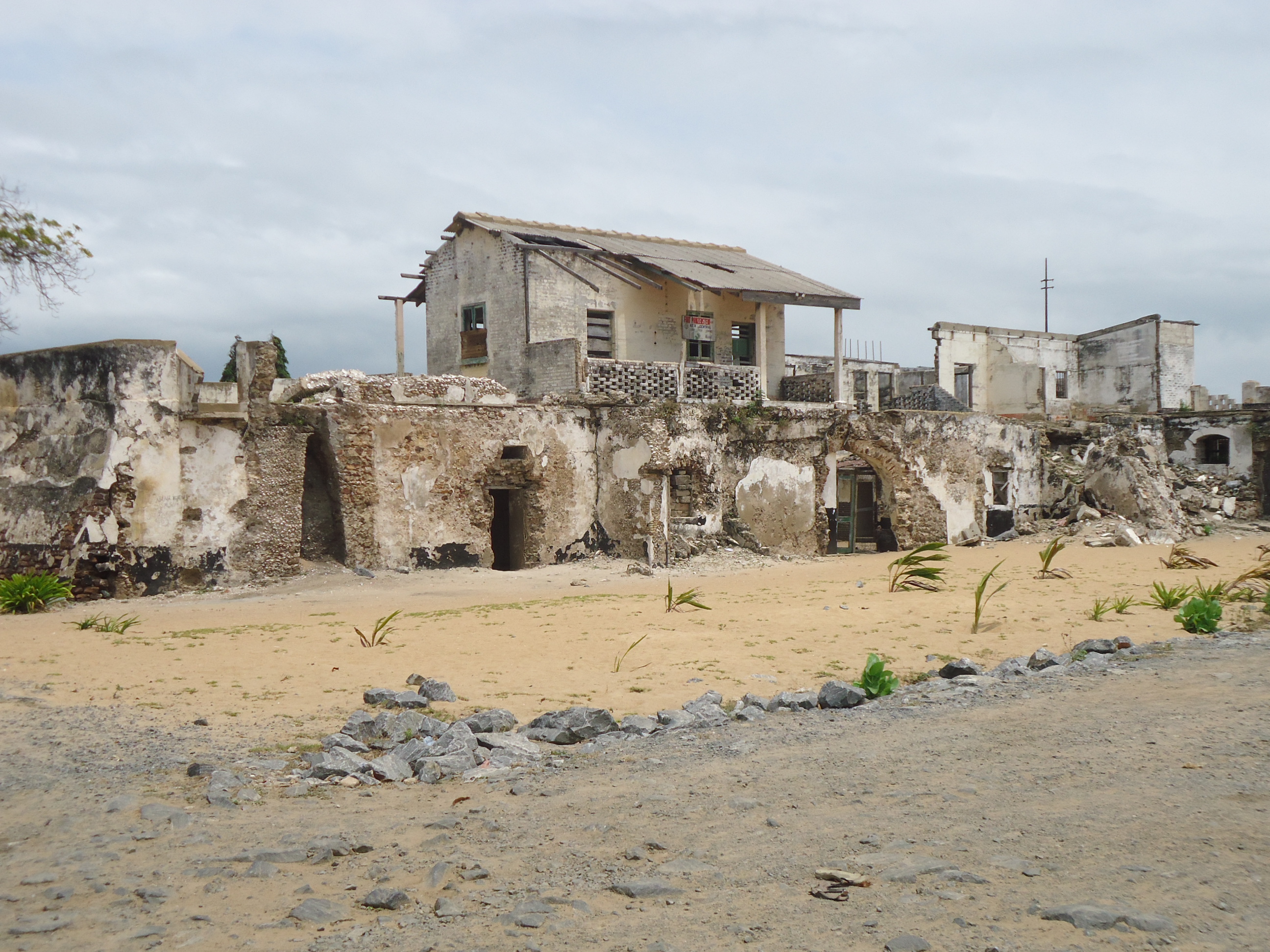
Fort Prinzenstein
The stone came from Accra, hauled across the Gold Coast to build a fort that would hold human beings in chains. Fort Prinzenstein, erected at Keta in 1784, stands as one of the few European slave-trade fortifications east of Ghana's Volta River. Unlike the better-known castles at Cape Coast and Elmina, Prinzenstein was built by the Danes -- a smaller colonial power whose role in the transatlantic slave trade is often overlooked but was no less brutal for its scale. Today the fort is a UNESCO World Heritage Site, its crumbling walls a testament to the lives that passed through them and the commerce in human suffering that built Europe's colonial wealth.
Victory and Conquest
Fort Prinzenstein was not built on neutral ground. It was the spoils of war. The Danish had established trading interests in Keta, the commercial capital of the Anlo Ewe people along the coast of what is now Ghana's Volta Region. In 1783, the Anlo people attacked and pillaged the local Danish agent -- an act of resistance against the foreign commercial presence in their territory. The response was swift and calculated. The Governor of Christiansborg assembled an army drawn from peoples with longstanding hostilities toward the Anlo: the Ada, Akwapim, Ga, and Krobo. This coalition defeated the Anlo in what became known as the Sagbadre War. The resulting treaty of 1784 imposed two conditions: the Danes would be permitted to build a fort at Keta, and the Anlo would be compelled to trade exclusively with Denmark. Fort Prinzenstein rose from that forced agreement.
The Dungeons Below
From 1784 until 1803, the fort served a purpose that its UNESCO designation unflinchingly documents: it was a dungeon for enslaved people awaiting forced transportation to the Caribbean. Men, women, and children captured in raids and wars across the interior were held in the fort's dark, cramped chambers before being loaded onto ships. The trade that passed through Prinzenstein was part of a vast system -- not only in enslaved people but also in gold, ivory, and other goods exchanged for European muskets, brandy, iron rods, textiles, and cowrie shells. But the human trade was the engine that drove colonial interest in the region. The enslaved people who passed through these walls were not statistics in a ledger; they were individuals torn from families and communities, held in darkness before a journey that many would not survive.
Flags Over Keta
Denmark's colonial ambitions on the Gold Coast were ultimately modest compared to those of Britain, the Netherlands, and Portugal. In 1850, the entire Danish Gold Coast -- including Fort Prinzenstein -- was sold to Britain, and Keta became part of the expanding British colonial territory. The transfer was part of Denmark's broader withdrawal from the transatlantic slave trade, which it had formally abolished in 1803 -- the same year Prinzenstein's dungeons were emptied. Under British control, the fort took on new administrative functions, though its original purpose was never far from memory. The transition from Danish to British hands illustrates how African coastlines were traded between European powers like commercial real estate, with little regard for the Anlo and other peoples whose land it occupied.
What the Walls Remember
Today Fort Prinzenstein stands battered by coastal erosion and time. Photographs from the 1970s show a structure already losing its battle with the elements, and by 2012 significant portions had deteriorated further. The fort draws visitors from across the world -- from the United Kingdom and United States, from Scandinavia, from neighboring Benin and other West African nations. Many come as part of heritage tourism, tracing the routes of the transatlantic slave trade along Ghana's coast. Fort Prinzenstein's designation as a UNESCO World Heritage Site, grouped with other castles and forts in Ghana, reflects its importance not as a monument to Danish engineering but as evidence of a crime against humanity that shaped the modern world. The walls that remain do not celebrate their builders. They bear witness to the people who were held inside them.
From the Air
Fort Prinzenstein sits at 5.911N, 0.992E on the coast at Keta, Ghana, in the Volta Region east of the Volta River. From 3,000-5,000 feet AGL, the fort's remains are visible along the shoreline of the Keta Lagoon area. The coastline here is low-lying and subject to significant erosion. The nearest major airport is Kotoka International Airport (DGAA) in Accra, approximately 160 km to the west. Lomé-Tokoin Airport (DXXX) in Togo is roughly 50 km to the east. The flat coastal terrain and lagoon system make the area visually distinctive from the air.