Fort Pulaski National Monument
Thirty hours. That is all it took for new rifled cannons to punch through walls that had been engineered to withstand any bombardment known to warfare. On the morning of April 10, 1862, Confederate Colonel Charles H. Olmstead stood inside Fort Pulaski on Cockspur Island, Georgia, confident that the massive brick walls surrounding him were impenetrable. By the following afternoon, Union shells were screaming through gaping holes in those walls, passing dangerously close to the fort's main powder magazine. Olmstead surrendered, and in doing so witnessed the end of an era. Every masonry fortification on Earth had just become obsolete.
A Polish Hero's Namesake
Fort Pulaski sits at the mouth of the Savannah River on Cockspur Island, positioned between Savannah and Tybee Island. Construction began in 1829 as part of a sweeping coastal defense program ordered by President James Madison after the War of 1812. A young Second Lieutenant named Robert E. Lee, fresh out of West Point, helped oversee the early engineering work. The fort was named in 1833 for Casimir Pulaski, a Polish cavalryman who fought under George Washington during the American Revolution and died during the siege of Savannah in 1779. The structure took eighteen years to complete, using an estimated 25 million bricks arranged into walls seven and a half feet thick. It was part of the Third System of coastal fortifications, built to withstand anything the age of smoothbore cannons could deliver.
Seized Before the First Shot
When the fort was finally finished in 1847, the nation had no immediate use for it. For thirteen years, only two caretakers watched over the massive structure. Then South Carolina seceded in December 1860, and Georgia Governor Joseph E. Brown acted quickly. A steamship carrying 110 men departed Savannah and traveled downriver to seize the fort before federal forces could reinforce it. Georgia joined the Confederacy in February 1861, and Confederate troops moved in. But by December of that year, the Confederates abandoned nearby Tybee Island as too isolated to defend. That mistake proved fatal. Union Captain Quincy A. Gillmore recognized the opportunity and began constructing artillery batteries along the Tybee Island beaches, positioning his new rifled cannons just over a mile from the fort's southeast corner.
The Bombardment That Changed Everything
Gillmore's 36 guns included James Rifled Cannons and Parrott rifles, weapons that could hurl elongated shells with devastating accuracy at distances of four to five miles. When Olmstead refused a demand for surrender, the bombardment began. The rifled projectiles carved through the brick walls with a precision that smoothbore cannonballs could never achieve. Within thirty hours, Union fire had breached the southeast corner, and shells were passing through the fort perilously close to the main powder magazine, which held enough gunpowder to destroy the entire structure. Olmstead surrendered. Only two soldiers died in the entire engagement. The colonel's decision haunted him for decades, but he later wrote: "That the fort could and would be absolutely destroyed by the force of the enemy was a demonstrated fact." Gillmore's triumph earned him a promotion from engineer captain to brigadier general, and military planners worldwide took notice. The age of the brick fort was over.
From Freedom's Shore to Prison Walls
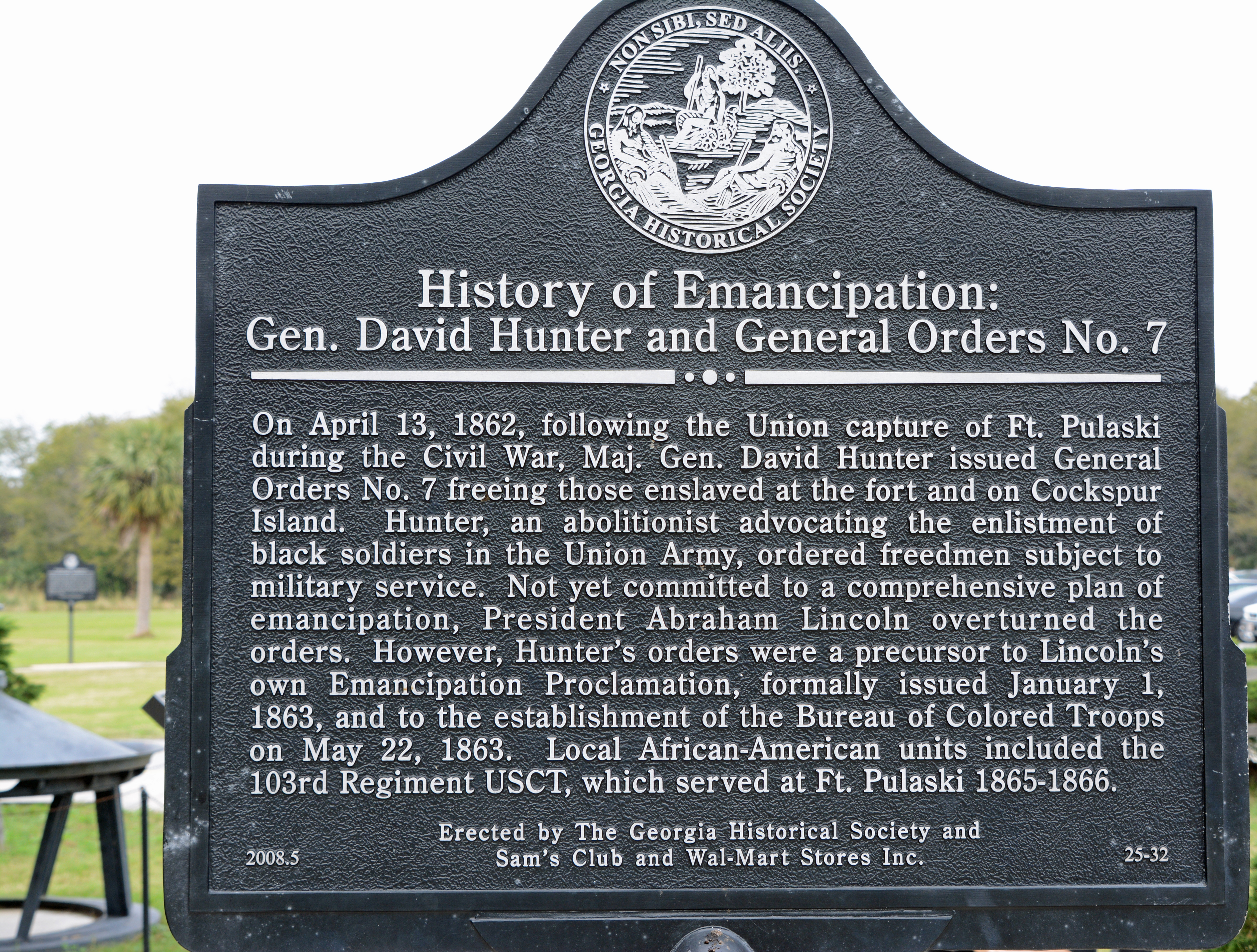
After the Union took control, Fort Pulaski became a final destination on the Underground Railroad. Enslaved people throughout the region were freed upon arrival at Cockspur Island. But the fort also served a darker purpose. In October 1864, it became a prison for captured Confederate officers. Six hundred men, known as the Immortal Six Hundred, were confined under brutal conditions. Their rations consisted of moldy bread, soured pickles, and limited water. Starvation, dehydration, dysentery, and scurvy ravaged the prisoners. Thirteen died and were buried outside the fort's walls. After the war ended, the fort continued as a political prison, holding a Confederate Secretary of State, Secretary of the Treasury, Secretary of War, three state governors, and a senator.
Brick and Memory
The fort fell into disrepair by the turn of the twentieth century. In 1924, President Calvin Coolidge declared it a National Monument, and the National Park Service took control in 1933. Members of the Civilian Conservation Corps rehabilitated the structure during the Depression. World War II brought the U.S. Navy to Cockspur Island, but after the war the fort returned to the Park Service. Today, visitors can walk through the rooms where Olmstead made his agonizing decision, trace the repaired breach in the southeast wall where rifled shells rewrote military history, and peer into the moat that still encircles the pentagonal fortress. The scars in the brickwork remain visible, a permanent record of the day technology outpaced centuries of defensive engineering.
From the Air
Fort Pulaski sits on Cockspur Island at 32.027N, 80.890W, at the mouth of the Savannah River between Savannah and Tybee Island. The pentagonal fort with its surrounding moat is clearly visible from 2,000-3,000 feet AGL. The nearest airport is Savannah/Hilton Head International (KSAV), approximately 12 nautical miles west-northwest. Tybee Island and the Savannah River channel provide excellent visual references for navigation.