Fort Ramsay
Most Canadians, if they think about World War II at home, think of convoys departing Halifax or the training bases of the Prairies. Few remember that German submarines hunted ships within sight of Quebec's shore -- that the war came up the St. Lawrence River itself. HMCS Fort Ramsay, a Royal Canadian Navy base built on Sandy Beach at the southern edge of Gaspe Bay, was Canada's answer to that threat. Commissioned in 1940 and inaugurated on May 1, 1942, the base anchored a network of shore batteries, submarine nets, and convoy escorts that defended one of the most strategically important waterways in the Allied war effort. One week after its official opening, the first U-boats appeared in the Gulf.
Why Gaspe Mattered
Gaspe Bay sits near the mouth of the St. Lawrence River, which funnels shipping from Montreal, Quebec City, and the Great Lakes into the Gulf and out to the Atlantic. In early 1940, the Department of National Defence recognized that the bay's depth and shape made it ideal for harboring merchant ships and, if the worst came, the British fleet in case Great Britain was invaded. The RCN's High Command developed top-secret plans for convoy escort procedures covering the Gulf and the river. Throughout 1940 and 1941, army, navy, and air force bases went up along the St. Lawrence corridor between Gaspe and Montreal. Fort Ramsay became the eastern anchor of this defensive chain. The base supported armed yachts and patrol vessels that formed the RCN's local fleet, and it served as a logistics hub for warships operating across the Gulf.
The Battle Comes Home
After German U-boats were sighted near Newfoundland and Nova Scotia in 1941, Fort Ramsay's facilities were expanded rapidly. Shore batteries were constructed around the bay, and a submarine net was strung across the entrance. On May 1, 1942, thirteen officers and nearly sixty men of the 1st Battalion of Les Fusiliers du St-Laurent witnessed the base's inauguration. By December, the 3rd Battalion had been posted to Fort Ramsay, growing to 34 officers and 291 men. Construction continued through 1943, when approximately 2,000 soldiers, airmen, and sailors were fortifying the bay. The timing was not abstract. One week after the opening ceremony, U-boats entered the Gulf of St. Lawrence, beginning the Battle of the St. Lawrence -- a campaign that would see 26 ships torpedoed by German submarines in Canadian home waters. The battle was fought intensely through late 1942, with sporadic sinkings continuing into 1944.
Guns on Both Shores
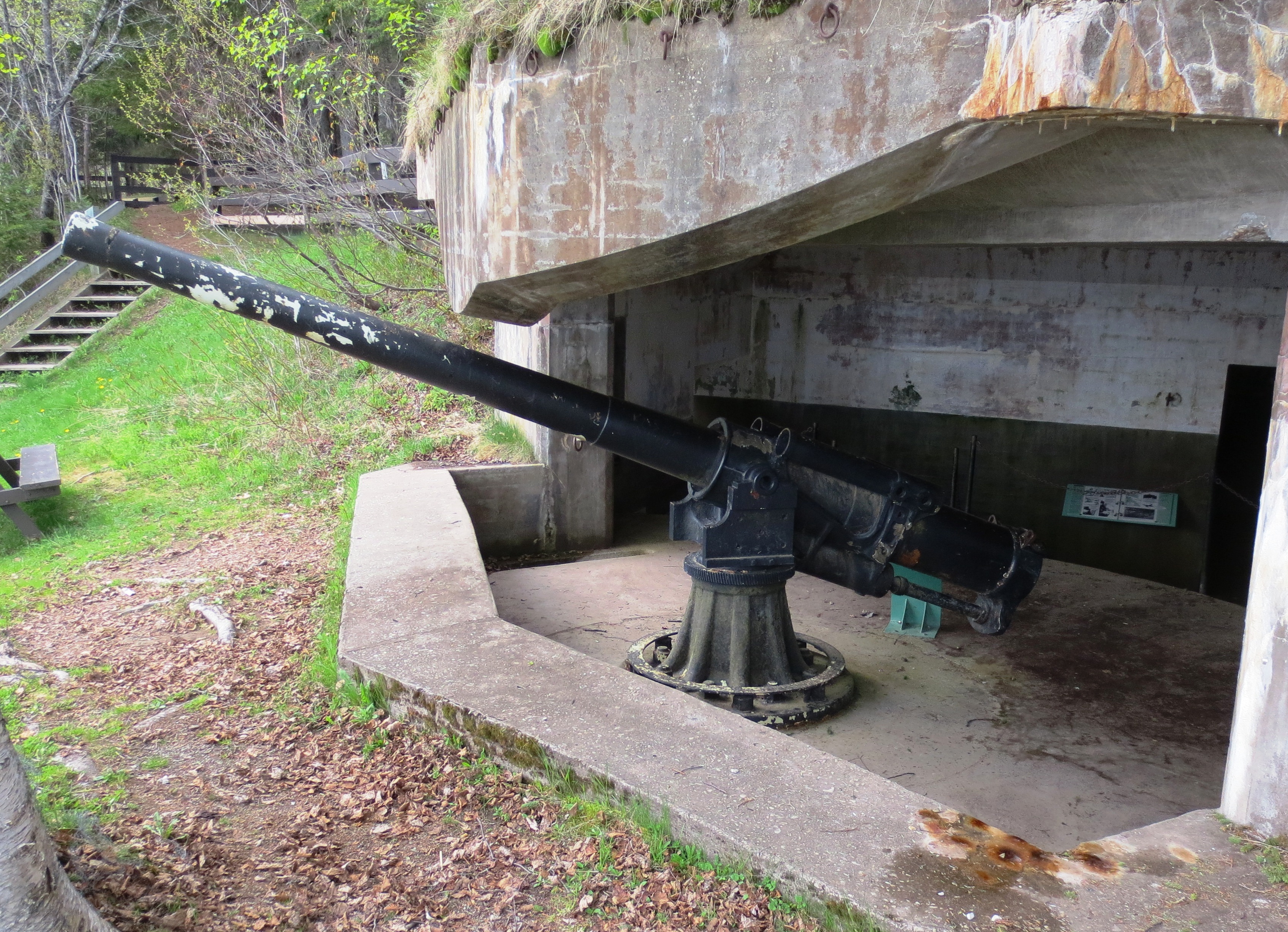
Fort Ramsay was the command center, but its real teeth were the shore batteries positioned to create a crossfire across Gaspe Bay. Fort Peninsule, on the north shore near what is now Forillon National Park, was armed with two 4.7-inch guns, four 60-inch searchlights, and storage facilities, with 15 buildings for personnel along Boulevard Forillon. According to period information displayed at the site, the station could engage any ship or submarine in the bay within 15 seconds of spotting it. On the south shore opposite, Fort Prevel mounted two ex-American 10-inch guns -- one on a disappearing carriage, one on a barbette mount -- giving the defenses heavy firepower to complement the lighter guns across the water. Today, Fort Peninsule is open to the public within Forillon National Park, with two original 4.7-inch guns still displayed in their casemated positions. Fort Prevel's site is now a hotel and golf course, the Auberge et Golf Fort Prevel, with one gun still on display.
The Guns Fall Silent
By late 1944, the Allied position in Europe had improved decisively, and the U-boat threat in the Gulf had diminished. On October 1, 1944, the first shore batteries at Fort Ramsay began to be dismantled. The base itself was decommissioned on March 31, 1946, almost a year after the war ended. The last regiment stationed there, the Gaspe-Bonaventure Regiment -- the 3rd Battalion of Les Fusiliers du St-Laurent, renamed in August 1944 -- was officially disbanded. Today the base property operates as the Sandy Beach Terminal of the Port of Gaspe, used for industrial and commercial shipping. The transformation from wartime fortress to peacetime port is complete, but the guns at Fort Peninsule and Fort Prevel remain as reminders that the war reached further into Canada than most people realize.
From the Air
Located at 48.83N, 64.44W on the southern shore of Gaspe Bay, Quebec. The former base site is now the Sandy Beach Terminal of the Port of Gaspe. Fort Peninsule is visible on the north shore of the bay near the entrance to Forillon National Park. Nearest airport is Michel-Pouliot Gaspe Airport (CYPG) approximately 10 km northwest. The bay's strategic shape -- deep water with a narrow entrance -- is clearly visible from altitude. Approach from the east over the Gulf of St. Lawrence for the best perspective on the bay's defensive geography.