Fort Reno (Wyoming)
On August 15, 1865, Civil War veterans fresh from the Army of the Potomac began building a fort on a bluff above the Powder River. These soldiers of the 6th Michigan Cavalry had fought at Gettysburg just two years earlier. Now they found themselves in Dakota Territory, constructing sod-roofed buildings with dirt floors on the Bozeman Trail. The fort they built would become a critical link in a chain of outposts stretching into hostile territory, and within three years it would be reduced to ashes.
From Connor to Reno
The fort began life as Fort Connor, named for Brigadier General Patrick Edward Connor, commander of the Powder River Expedition. That August, the post served as the jumping-off point for soldiers who fought at the Battle of the Tongue River. By September 1865, the left, right, and center columns of the expedition had all rendezvoused at the small outpost. Units from California, Michigan, Ohio, Iowa, Kansas, and Missouri crowded the Powder River crossing. Most marched south to Fort Laramie in October to muster out. The Michigan cavalry stayed behind. In November, the post was renamed Fort Reno to honor Major General Jesse Lee Reno, who had been mortally wounded at the Battle of South Mountain in Maryland in 1862. The name had no connection to Major Marcus Reno of Little Bighorn fame.
The Galvanized Yankees
In October 1865, the 6th Michigan handed the garrison to an unusual group of soldiers: the Galvanized Yankees. These were former Confederate prisoners of war who had sworn allegiance to the Union and agreed to serve on the frontier rather than in prisoner-of-war camps. Companies C and D of the 5th United States Volunteer Infantry, along with a company of tribal scouts, settled in for the brutal winter of 1865-1866. The cold proved merciless. By April, the garrison had suffered 33 casualties from desertions, illness, and one accidental shooting. Captain George W. Williford, the commanding officer, died of illness on April 29, 1866. When Colonel Henry Beebe Carrington arrived with 700 men of the 18th Infantry in June, only 104 of the original 137 Galvanized Yankees remained. The survivors headed to Nebraska to muster out, as one account noted, 'without a single regret.'
Fortifying the Powder River
The Regular Army soldiers of the 18th Infantry transformed the vulnerable outpost. They constructed a log stockade around the garrison buildings, complete with bastions on the northwest and southeast corners. They built sturdy adobe quarters for the commanding officer. The garrison grew to between 125 and 300 soldiers who endured the routines of frontier life: harsh winters, blazing summers, and occasional skirmishes with Lakota, Cheyenne, and Arapaho warriors. The soldiers kept the southern end of the Bozeman Trail open for emigrants heading to the Montana gold fields. To the Lakota Sioux, the fort was an unwelcome intrusion into their hunting grounds.
Flames on the Prairie
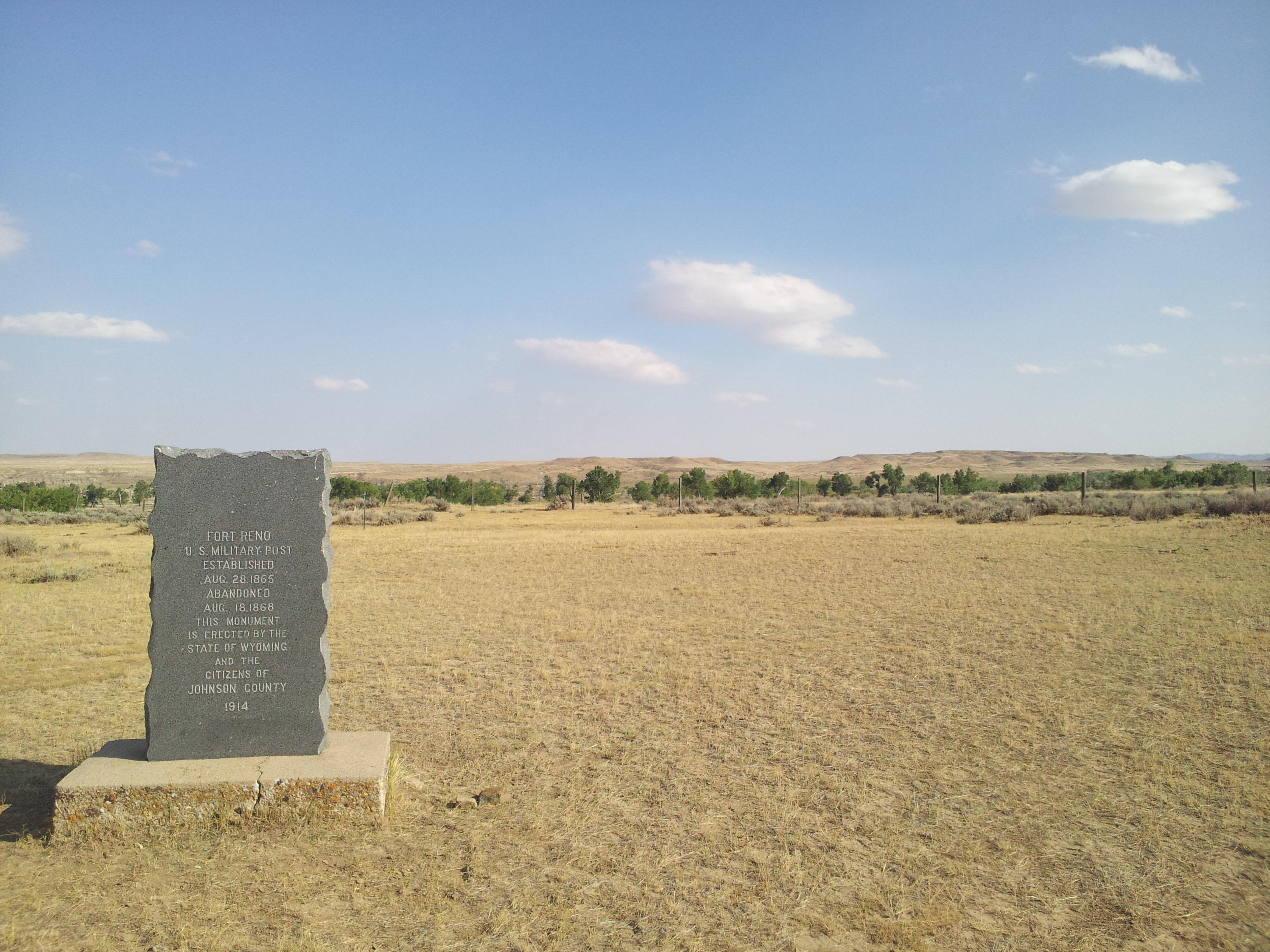
In 1868, the Fort Laramie Treaty ended Red Cloud's War and ceded the Powder River Country to the Lakota Sioux. Fort Reno, along with Fort Phil Kearny and Fort C.F. Smith to the north, was abandoned as a condition of peace. Shortly after the soldiers marched away in August, Cheyenne warriors set fire to the entire post. When Brigadier General George Crook's Big Horn Expedition returned in March 1876, they found only adobe walls and debris. Crook used the ruins as a supply base anyway. On March 5, his command fought warriors in the Fort Reno Skirmish directly across the river from the burned-out fort. Today, prairie grasses cover the parade ground where Michigan cavalry once drilled, where Galvanized Yankees once shivered through winter, and where the last wisps of smoke rose in the summer of 1868.
From the Air
Fort Reno is located at 43.8275N, 106.24W in Johnson County, Wyoming, northeast of Sussex. The site sits on a bluff above the Powder River where the Bozeman Trail once crossed. A stone monument and interpretive signs mark the location, accessible by gravel road. The nearest major airport is Sheridan County Airport (KSHR), approximately 40 miles north. From the air at 3,000-4,000 feet AGL, look for the flat prairie along the Powder River with the monument visible in clear conditions. The Big Horn Mountains rise to the west.