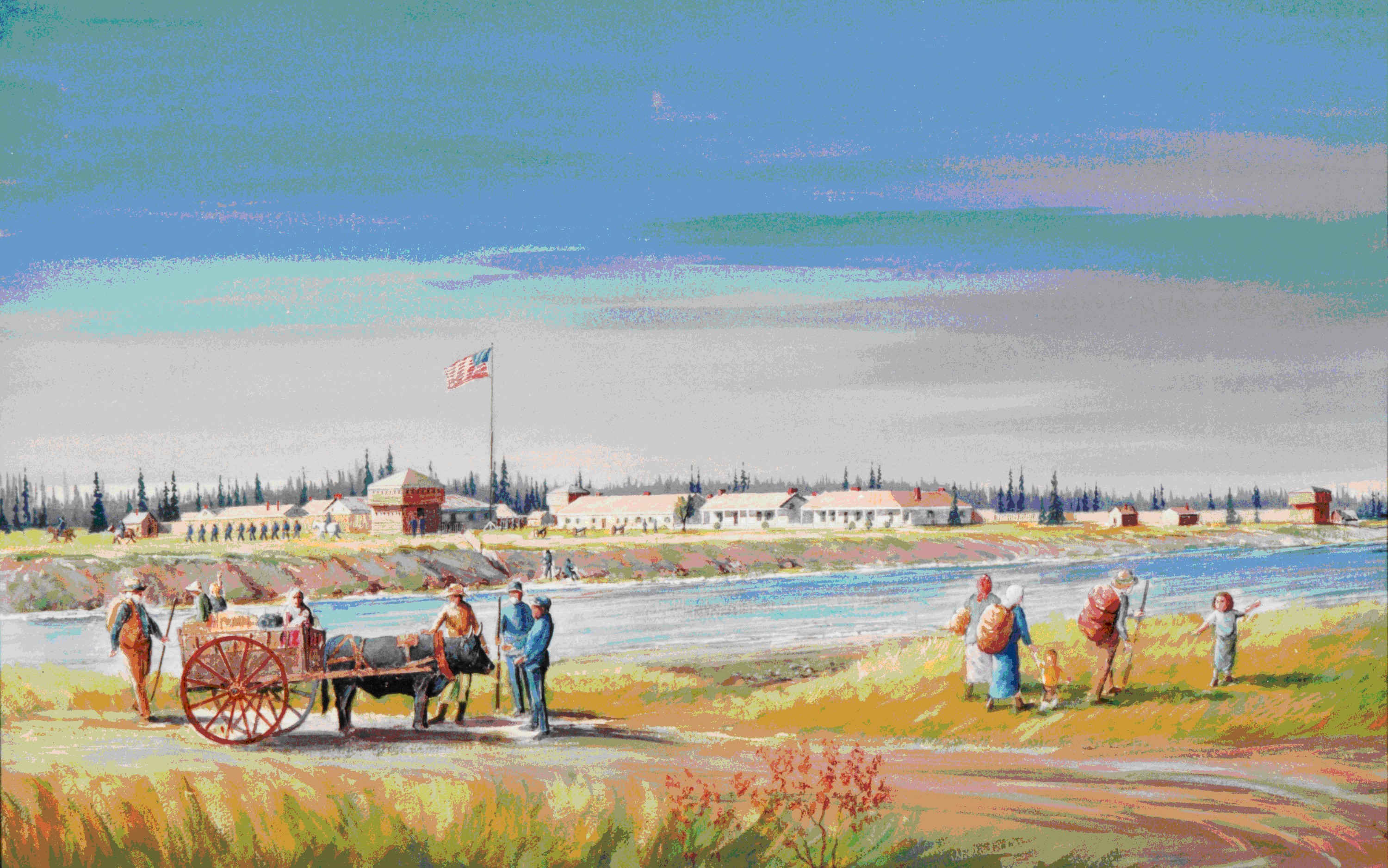
Fort Ripley (Minnesota fort)
The first commander of Fort Ripley was a first cousin of Mary Todd Lincoln. Captain John Blair Smith Todd arrived at the upper Mississippi in 1849 to take charge of a raw outpost that had already been renamed twice -- from Fort Marcy to Fort Gaines and, by 1850, to Fort Ripley, honoring Brigadier General Eleazer Wheelock Ripley of the War of 1812. This was Minnesota's second major military reservation, established a few miles from the Indian agencies for the Ho-Chunk and Ojibwe, and it would become far more than a lonely frontier garrison. Over its three decades of active service, Fort Ripley spurred pioneer settlement, witnessed the Metis oxcart trains of the Red River Trails creak past its gates, and stood at the center of one of the most remarkable episodes of the U.S.-Dakota War of 1862.
Mosquitoes, Oxcarts, and Annuity Payments
Daily life at Fort Ripley tested the patience of every soldier posted there. Geographic isolation, clouds of summer mosquitoes, and winters that locked the Mississippi under ice for months made the garrison one of the least coveted assignments in the frontier army. Twice each year, troops trekked to the Long Prairie Agency to supervise government annuity payments of money and goods to the Ho-Chunk, then repeated the duty for the Ojibwe at the Crow Wing Agency. The Metis oxcart trains traversing the eastern route of the Red River Trails between Fort Garry and Fort Snelling rumbled past regularly, their ungreased wheels shrieking across the prairie. The fort's military reservation was enormous -- nearly all of the east bank of the Mississippi plus a single square mile on the west side for the garrison proper. When the army tried to auction surplus eastern lands in 1857, bidders colluded to underbid, the Secretary of War annulled the sale, and squatters who had already built farms ignited twenty years of litigation.
The Night March to Fort Ridgely
In August 1862, Lieutenant Timothy J. Sheehan and Company C of the 5th Minnesota were posted at Fort Ripley when word came to proceed to the Upper Sioux Agency. After a tense confrontation, Sheehan convinced the Indian agent Galbraith to distribute food to nearly 4,000 Sisseton and Wahpeton. The task seemingly complete, the Fort Ripley men started home. Near Glencoe, a messenger caught them with devastating news: the Lower Sioux Agency had been attacked and the Redwood Ferry ambushed. Sheehan's company double-timed through the night to Fort Ridgely, arriving to learn that the post commander, Captain Marsh, was dead. First Lieutenant Sheehan assumed command by rank and is credited with leading the fort's desperate defense during the battles that followed. He was wounded twice there and twice more at Nashville during the Civil War. Decades later, in 1898, the same Sheehan commanded the right flank at the Battle of Sugar Point, where he was wounded three more times.
700 Warriors, Waving Flags
As the Dakota War spread panic across Minnesota in the fall of 1862, rumors circulated that Chief Hole-in-the-Day of the Gull Lake Band might launch a simultaneous uprising in the north. Terrified settlers flooded into Fort Ripley for protection. Companies from the 6th and 7th Minnesota were rushed to reinforce the post. Then came a sight no one expected. Chief Shaw-Bosh-Kung of the Mille Lacs Band of Ojibwe organized between 700 and 750 warriors and marched them to Fort Ripley -- not to attack, but to defend it and to volunteer to fight the Sioux. According to the record, they arrived waving flags and beating drums. Indian Commissioner Dole met with them and asked them to return to their reservation, promising they would be called if needed. The townswomen prepared a welcome meal, and the men smoked the peace pipe with the warriors. Shortly after, Ojibwe leaders were summoned to Washington, where Lincoln affirmed that the Mille Lacs could remain on their reservation. In recognition of their loyalty, the participating bands were designated 'non-removable' -- a legal distinction that protected their homeland for generations.
Fire, Abandonment, and a New Name
On a sub-zero night in January 1877, fire destroyed three buildings at Fort Ripley. The War Department, concluding the post had outlived its purpose, chose to close it permanently rather than rebuild. The troops marched out that summer. The buildings stood abandoned for years, slowly collapsing under Minnesota winters, until by 1910 only the ruins of the stone gunpowder magazine remained. In 1879 Congress passed a bill restoring most of the military reservation to the public domain. Then, in 1929, Minnesota announced a new National Guard training site in central Minnesota. The land was purchased, and purely by coincidence, the remains of old Fort Ripley lay within the proposed boundaries. The new installation -- Camp Ripley -- took its name from the old fort. Fort Ripley was listed on the National Register of Historic Places in 1971 for its significance in military history and historical archaeology, a quiet recognition that the crumbled stone magazine and the stories it contained deserved preservation.
From the Air
Located at 46.18°N, 94.37°W in central Minnesota along the upper Mississippi River. The historic fort site lies within the boundaries of modern Camp Ripley, a Minnesota National Guard training facility. The confluence area is visible from moderate altitude, with the Mississippi River winding through dense forest. Nearby airports include Brainerd Lakes Regional Airport (KBRD) approximately 15 nm to the north and Camp Ripley's own military airfield. The surrounding terrain is flat to gently rolling glacial outwash plain with extensive pine and hardwood forest. Best viewed from 3,000-5,000 feet AGL.