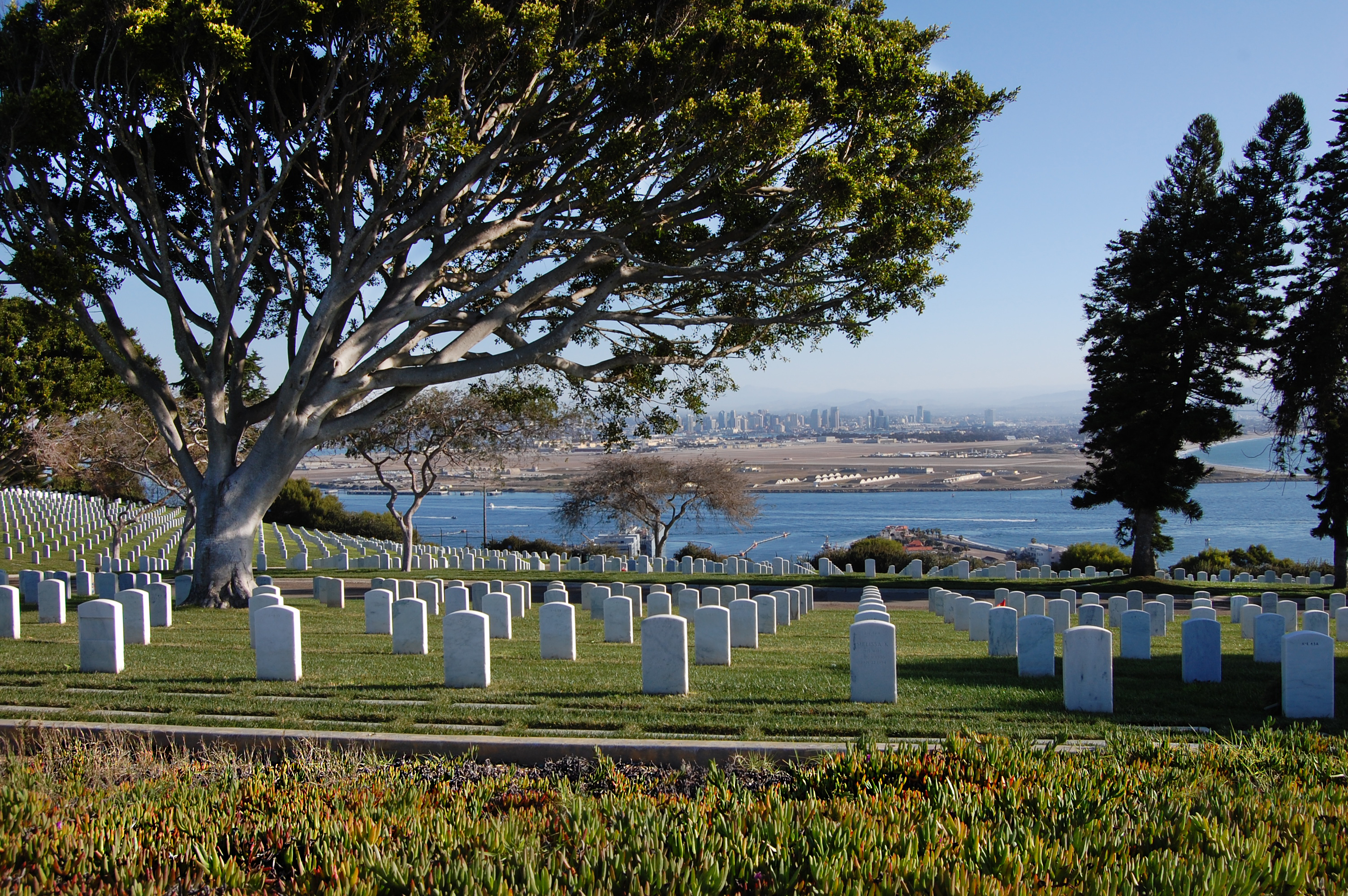
Fort Rosecrans National Cemetery
Sixty-two sailors died in the harbor on a summer morning in 1905, when a boiler exploded aboard the USS Bennington as she prepared to depart San Diego Bay. Two days later, their remains were carried up the hill to a quiet cemetery on Point Loma, where they were laid to rest in what became known as Bennington Plot. This tragedy accelerated a transformation already underway. Fort Rosecrans National Cemetery, perched on this narrow peninsula between the Pacific Ocean and San Diego Bay, would become one of America's most dramatically situated final resting places, a landscape where military sacrifice and natural beauty converge in solemn beauty.
Before the Headstones
The dead arrived here long before the cemetery bore its current name. Among the earliest interments are casualties of the Battle of San Pasqual, a bloody 1846 engagement where 19 of Brigadier General Stephen W. Kearny's soldiers fell fighting Californio lancers during the Mexican-American War. Originally buried where they died, these soldiers were exhumed in 1874 and brought to the San Diego Military Reservation. Eight years later, they were reinterred at what would become Fort Rosecrans. In 1922, the Native Sons and Daughters of the Golden West placed a boulder from the original battlefield at their gravesite, with a plaque listing each name. The cemetery takes its name from William Starke Rosecrans, a Union general in the Civil War, honoring the Army coastal artillery station that once occupied this strategic promontory.
Admirals and Unknowns
The headstones here tell stories spanning every American conflict since California statehood. General Holland Smith, who commanded the Fleet Marine Force in the Pacific and led the island-hopping campaign that turned the tide of World War II, rests here. So does Lieutenant General Victor H. Krulak, whose son became the 31st Commandant of the Marine Corps. Major General Bruno Hochmuth lies among them, the first Marine division commander killed in any war. But for every admiral and decorated general, there are thousands of ordinary sailors, soldiers, and Marines. Sergeant Rafael Peralta, who earned the Navy Cross at Fallujah in 2004, is buried near actors who served, pilots who flew, and merchant mariners who braved submarine-infested waters. Two British servicemen from the Commonwealth War Graves Commission also rest here, far from home.
The Bennington Disaster
The monument that dominates one section of the cemetery commemorates one of the Navy's worst peacetime disasters. On July 21, 1905, the gunboat USS Bennington lay anchored in San Diego Harbor, fresh from Pacific maneuvers. At 10:30 that morning, orders came to depart in search of another vessel that had lost a propeller at sea. Before she could weigh anchor, an explosion in the boiler room ripped through the ship, killing or wounding most of the crew. Sixty-two sailors died. The survivors brought their shipmates here, creating Bennington Plot, a section of the cemetery forever marked by that single catastrophic morning. The granite monument rises above the graves, a permanent reminder that military service carries risks even in peacetime harbors.
Between Two Waters
The cemetery's setting makes it unique among national cemeteries. Point Loma juts southward into the Pacific, a narrow finger of land with the ocean crashing against its western cliffs while San Diego Bay spreads peacefully to the east. The white headstones march in precise rows across the hillside, their alignment creating visual patterns that shift with each step a visitor takes. Downtown San Diego's skyline rises across the water. Naval vessels pass through the harbor below. The morning fog that so often shrouds Point Loma burns off to reveal this landscape where the living city and the honored dead coexist in view of each other. Registered as California Historical Landmark #55 in 1932, the cemetery was added to the National Register of Historic Places in 2016.
A Cemetery Full
By the late 1960s, Fort Rosecrans had exhausted its available space for casketed remains, though cremated remains continued to be accepted. The last traditional burial plots have long since been claimed. Southern California's explosive postwar growth had made space precious everywhere, and even this sacred hillside reached its capacity. In 1973, the Veterans Administration assumed control of the cemetery. Today, it stands as both active burial ground and living monument, a place where families still gather to honor ancestors while joggers and tourists discover the solemn beauty of its setting. The eligibility rules have evolved over decades, extending burial rights to spouses, dependent children, and now even parents of servicemembers killed in combat, ensuring that families can remain together in death as in life.
From the Air
Located at 32.69N, 117.25W on Point Loma, San Diego. The cemetery's white headstones are visible from altitude as geometric patterns against the green hillside. Best approached from the west over the Pacific or from the east across San Diego Bay. Nearby airports: San Diego International (KSAN) 4nm northeast, North Island NAS (KNZY) 3nm east. The narrow Point Loma peninsula and Cabrillo National Monument at its tip provide excellent visual references.