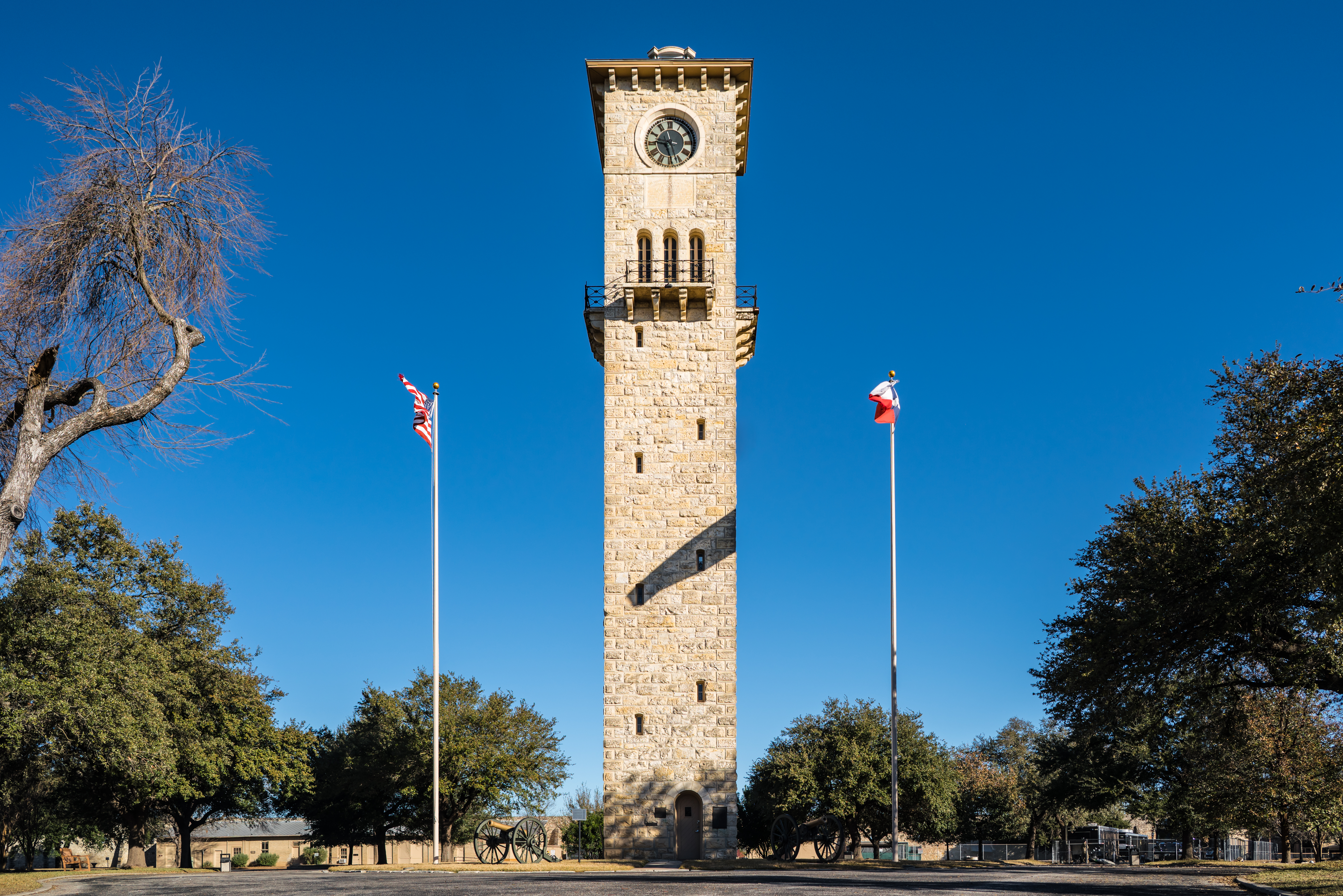
Fort Sam Houston
San Antonio calls itself the 'mother-in-law of the Army,' and the nickname starts here. A young lieutenant named Dwight Eisenhower arrived at Fort Sam Houston in 1915, met a girl named Mamie Doud, and married her within two years. He was posted here again in 1941, and was sitting on this post when word came that the Japanese had bombed Pearl Harbor. Their first home on the base is still standing, preserved as a historic monument -- one of more than 900 buildings in a sprawling military complex that has served continuously since the first soldier arrived in 1845, making it one of the oldest installations in the entire United States Army.
The Quadrangle and Its Ghosts
At the heart of Fort Sam Houston sits the Quadrangle, a limestone courtyard built in the 1870s under the direction of Major General Edward Ord, a West Point-trained engineer. Congress allocated $100,000 for the new post in 1873, and Edward Braden Construction Company won the contract in 1876 for $83,900. What makes the Quadrangle unusual is not its architecture but its residents: deer and peacocks wander freely through the enclosed space, and nobody is entirely sure how they got there. The animals predate even Geronimo's time as a prisoner here. The Apache leader was held in the Quadrangle during the 1880s, and legends have grown around the courtyard ever since. In 1975, the post's historic significance was formally recognized when it was designated a National Historic Landmark, honoring one of the largest collections of historic military structures in the country.
Where Every Combat Medic Begins
Fort Sam Houston earned two nicknames that explain its modern purpose: 'Home of Army Medicine' and 'Home of the Combat Medic.' After World War II, the Army chose this post as its principal medical training facility, and the decision only grew larger with time. The Army Medical Department Center and School trains more than 25,000 students each year across 170 courses in 14 medical specialties, partnering with universities including Baylor, the University of Texas, and the University of Nebraska-Lincoln. The 2005 Base Realignment and Closure Commission consolidated all military medical training here, pulling Navy programs from San Diego, Great Lakes, and Portsmouth, and Air Force programs from Sheppard Air Force Base. The Medical Education and Training Campus opened in 2011, capping a construction effort approaching one billion dollars. It is the largest and most important military medical training facility in the world.
A Roll Call of Legends
The list of officers who served at Fort Sam Houston reads like a textbook of American military history. Arthur MacArthur Jr. -- father of Douglas -- was posted here. So was Leonard Wood, John J. Pershing, and Frederick Funston. Billy Mitchell, the controversial air power advocate, was sent here after being demoted from brigadier general to colonel for disobeying orders. General Jonathan Wainwright, who endured three years as a Japanese prisoner of war after the fall of Corregidor, took command of the Fourth United States Army here in 1946. Benjamin Foulois, a pioneer of military aviation, served at the post. But it is Eisenhower's connection that resonates most: the future president and Supreme Allied Commander first learned the rhythms of military life in these Texas buildings, walking the same grounds where 27,000 military and civilian personnel work today.
One Base, Three Installations
On October 1, 2010, Fort Sam Houston merged with Lackland Air Force Base and Randolph Air Force Base to form Joint Base San Antonio, administered by the Air Force. The consolidation tied together three storied installations into a single entity with an annual payroll and operating budget of $1.9 billion. Fort Sam Houston contributes more than $105 million in local purchases each year and averages $30 million in annual construction. The post operates its own school district -- one of only three military facilities in Texas to do so. President William Taft dedicated the Gift Chapel here on October 17-18, 1909. Between 1885 and 1893 alone, 60 additional buildings went up on the post. The careful preservation of each era's construction reflects different Army concepts in planning and design, creating a living timeline of American military architecture stretching back more than 150 years.
From the Air
Located at 29.4575N, 98.44W in San Antonio, Texas. The post is northeast of downtown San Antonio. Best viewed at 2,000-4,000 ft AGL in clear conditions. The Quadrangle and extensive historic district buildings are visible from the air. Nearest airports: KSAT (San Antonio International, 7 nm N), KSKF (Lackland AFB/Kelly Field, 10 nm SW). Fort Sam Houston is part of Joint Base San Antonio. Note proximity to restricted military airspace.