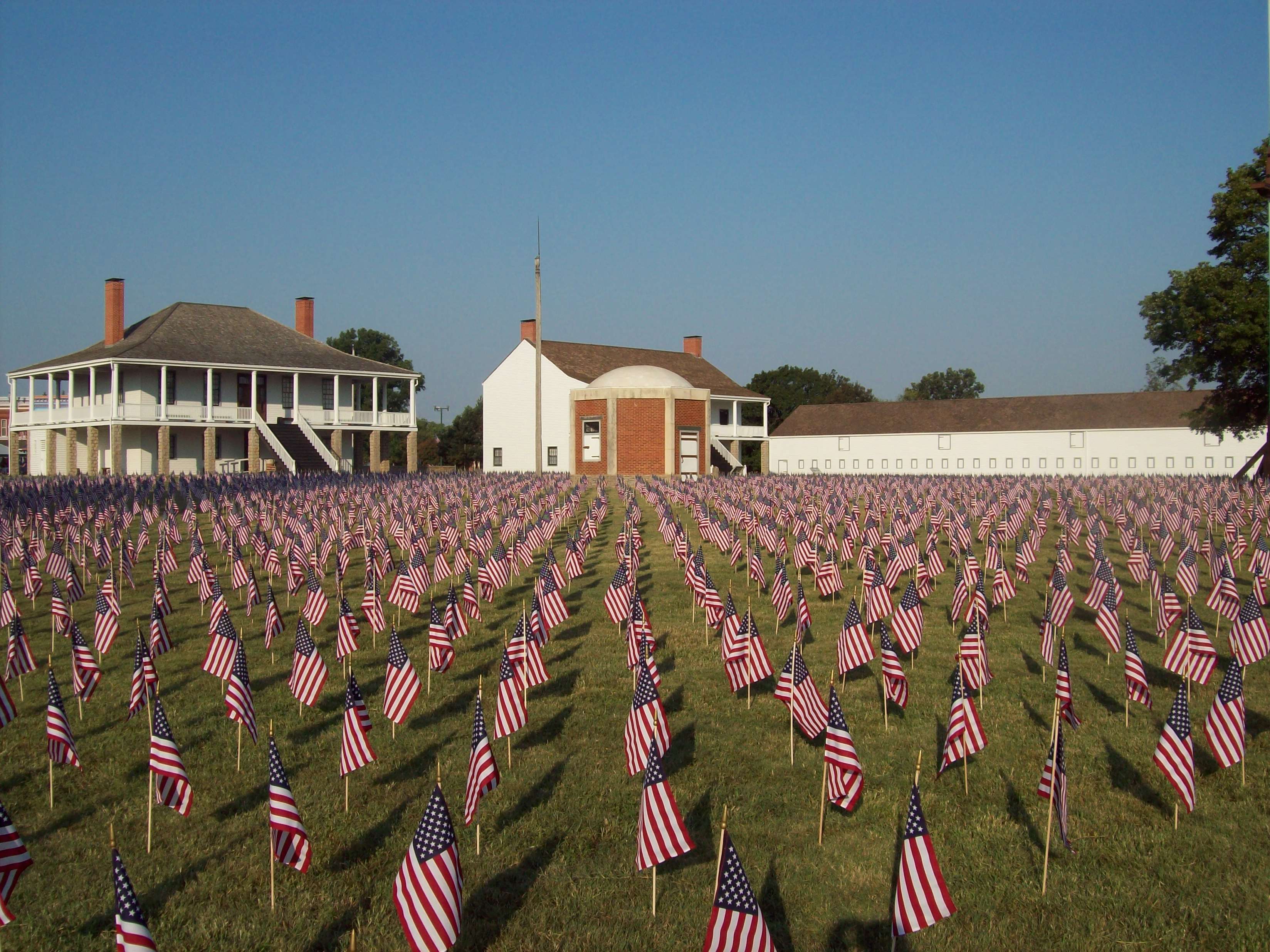
Fort Scott National Historic Site
Two hotels, one fort, and the question that nearly tore America apart. When the U.S. Army abandoned Fort Scott in the early 1850s, its buildings were auctioned to civilians. Two of the old military structures became hotels -- and when the Kansas-Nebraska Act of 1854 reopened the slavery question, each hotel was claimed by an opposing faction. Free-Soil settlers took the Fort Scott Hotel. Pro-slavery Missourians claimed the Western Hotel. The two camps faced each other across the same parade ground where soldiers had drilled just months before. Fort Scott, named for Mexican-American War hero General Winfield Scott and established in 1842 on the eastern Kansas prairie, had been built to keep the peace. Instead, it became a stage for the violence that would soon consume the entire nation.
Building on the Treeless Prairie
On April 22, 1842, soldiers from the recently abandoned Fort Wayne arrived at the site that would become Fort Scott, in the Osage Cuestas section of eastern Kansas. The Army had left Fort Wayne partly to placate the Cherokee, who objected to a military post in their territory, and partly to better defend settlers against Osage raiding parties. Captain Thomas Swords, the post quartermaster, faced a daunting construction challenge: the Kansas prairie had few trees. He had only two bricklayers and three carpenters. Wood was available, but the mill sat far enough away that transport consumed entire days. Freak accidents destroyed much of the lumber intended for construction. By 1844, only one of five planned officer duplexes had been completed. Yet when Colonel George Croghan inspected the fort that year, he rated it "above average" compared to other frontier installations -- a verdict that says something about the rough standards of the 1840s frontier.
The Bleeding Ground
Fort Scott's most volatile chapter began in 1854, when the Kansas-Nebraska Act repealed the Missouri Compromise and reopened the question of whether Kansas would permit slavery. Pro-slavery Missourians poured across the border to sway the vote. Free-soil settlers from New England arrived with equal determination. Most residents within the town of Fort Scott supported slavery, but those in the surrounding countryside leaned free-soil. The result was not political debate but guerrilla warfare: murders, attempted arsons, and running skirmishes that made Bleeding Kansas one of the bloodiest preludes to the Civil War. The old fort's buildings, now in civilian hands, stood at the center of this storm. The conflict previewed the larger violence to come and demonstrated that the question of slavery could not be settled by popular sovereignty alone.
Black Soldiers and Rebel Threats
When the Civil War erupted in 1861, the Union Army reclaimed Fort Scott and transformed it into a major military post. The Army took over several city blocks for commissary and quartermaster operations, renting properties from civilian owners. Troops from Indiana, Iowa, Colorado, Ohio, and Wisconsin flowed through, either garrisoning the fort or pressing on to fight in Missouri, Arkansas, or Indian Territory. Fort Scott became one of the few installations in the country that recruited and trained Black soldiers for the United States Colored Troops -- men who would fight to end the very institution that Bleeding Kansas had violently contested just years earlier. After the war ended, the Army auctioned off its holdings in October 1865 and departed.
Soldiers Against Settlers
The Army returned once more in January 1870, but this time its mission had an ironic twist. The Post of Southeast Kansas, based at Fort Scott, was sent to protect railroad workers and construction crews -- not from Indians, but from settlers. The railroads had received government land grants for development, and squatters who had homesteaded along the rights-of-way feared eviction. The settlers lumped soldiers and railroad men together as enemies. Conflicts with remaining Indian populations and former Confederate insurgents using the old rebel cause as cover for robbery added to the disorder. By spring 1873, the Army withdrew for good. The fort's buildings deteriorated for nearly a century before the National Park Service began restoration in 1965. Today, 20 historic structures survive around the original parade ground, alongside five acres of restored tallgrass prairie.
From the Air
Located at 37.844N, 94.705W within the city of Fort Scott, Kansas, at approximately 850 feet MSL. Fort Scott Municipal Airport (K78K) is 3 nm south of the site. The historic site's parade ground and surrounding structures are visible from low altitude. The terrain is gently rolling tallgrass prairie typical of the Osage Cuestas region. Kansas City lies approximately 90 nm to the north-northeast. Best viewed from 2,000-4,000 feet AGL. The fort sits along what was the historic military road between Fort Leavenworth (KFTL, 100 nm north) and Fort Gibson in Indian Territory.