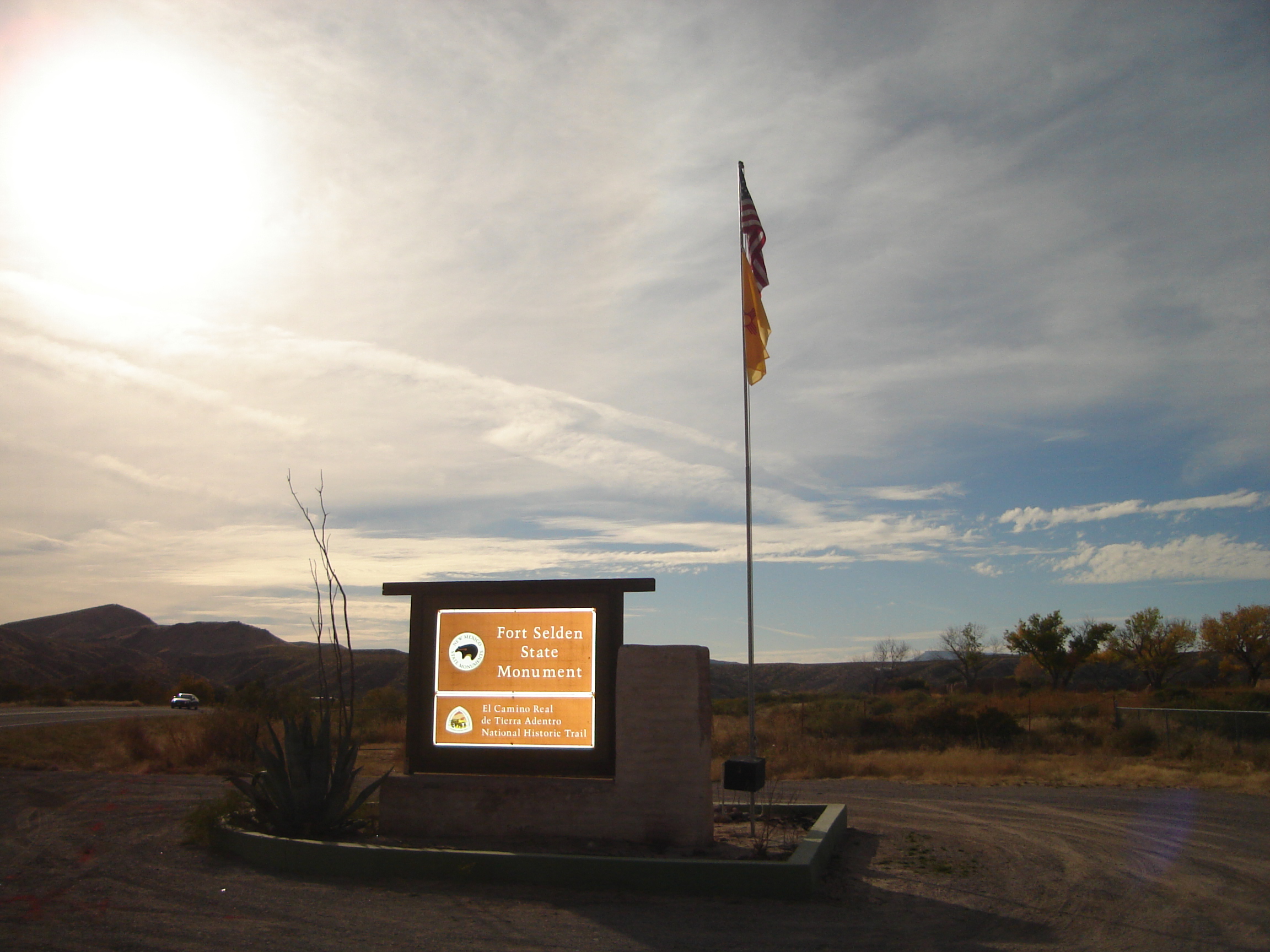
Fort Selden
A four-year-old boy practices his aim in the New Mexico desert, steadying a rifle nearly as tall as himself. His father, Captain Arthur MacArthur Jr., watches from the shade of an adobe barracks. The year is 1884, and young Douglas MacArthur is learning lessons at Fort Selden that will shape one of America's most famous generals. He later wrote that he and his brother "learned to ride and shoot, even before we learned to read and write." The ruins that stand today along the Rio Grande mark a place where frontier childhood forged military destiny.
Where Spanish Bones Rest
Long before the U.S. Army arrived, this stretch of river held deep significance. For centuries, the site served as Paraje de Robledo, a critical campground along the El Camino Real de Tierra Adentro. The name honored Pedro Robledo, an old Spanish soldier who died here during Juan de Onate's 1598 expedition and was buried beneath a wooden cross. Travelers called the spot La Cruz de Robledo, the Cross of Robledo. It marked the last reliable water before the wagon road left the Rio Grande to enter the Jornada del Muerto, the ominous "Journey of the Dead Man" stretching northward toward Santa Fe. By the 1860s, Apache raids had made this fertile corridor dangerous for the settlers farming the Mesilla Valley.
From Confederate Camp to Union Fort
The Civil War came to this remote stretch of New Mexico in unexpected ways. In 1861, Confederate forces established Camp Robledo at this ancient crossing, using it as a base for cavalry patrols against Union-held Fort Craig and operations along Confederate Arizona's northern border. The Confederates understood the strategic value of controlling the Rio Grande corridor. After the war, the U.S. Army established Fort Selden in 1865 with a different mission: protecting settlers and travelers from Apache raids that had terrorized the region. Built of adobe bricks beneath the harsh desert sun, the fort became a linchpin in the Army's southwestern defense network.
The General's Playground
Fort Selden's most famous chapter began in 1884 when Captain Arthur MacArthur Jr. arrived as post commander with his wife and two young sons. The frontier post became a classroom unlike any other for seven-year-old Arthur III and four-year-old Douglas. The boys learned horsemanship from cavalry troopers, marksmanship from infantry sergeants, and the rhythms of military life from their father's disciplined command. For two years the MacArthur family called this dusty outpost home before transferring to Fort Wingate. That childhood on the frontier left an indelible mark on Douglas MacArthur, who would return to the American Southwest's harsh landscapes in his imagination throughout a career that spanned two World Wars and the Korean conflict.
The End of the Frontier
Geronimo's surrender to General Nelson A. Miles at Skeleton Canyon in 1886 signaled the close of the Indian Wars and the beginning of the end for frontier outposts like Fort Selden. General William Tecumseh Sherman ordered the consolidation of six military posts into a single massive installation. Fort Selden briefly competed for selection as this new combined post, but the railroads had transformed El Paso into a booming hub, and Fort Bliss won the prize. By 1890, the fort had outlived its purpose. On January 20, 1891, Lieutenant James Brett filed the final post return with bureaucratic finality: "All public property from this post having been disposed of, it was abandoned on this date."
Ruins Reclaimed
For decades after abandonment, the elements and treasure-seekers slowly consumed Fort Selden's adobe walls. Wind, rain, and snow eroded the structures while vandals carted away anything portable. In 1963, longtime area resident Harry N. Bailey donated the land to New Mexico. The fort gained National Register of Historic Places status in 1970 and became a New Mexico State Monument in 1974. Today, visitors walk an interpretive trail among the weathered ruins, the crumbling walls still tracing the outline of barracks, officers' quarters, and the parade ground where a future five-star general once played. A visitor center offers exhibits on frontier military life, connecting these silent stones to the larger story of America's westward expansion.
From the Air
Fort Selden Historic Site lies at 32.50N, 106.93W along the Rio Grande, approximately 15 miles north of Las Cruces. From the air, look for the rectangular layout of the ruins against the desert terrain, with the river corridor visible to the east. The nearest airport is Las Cruces International (KLRU), about 15 nautical miles south. Best viewed at 2,000-3,000 feet AGL. The Organ Mountains provide a dramatic backdrop to the east. Interstate 25 runs nearby, providing visual reference for navigation.