Fort Smith, Arkansas
Miss Laura's Social Club is the only former house of prostitution listed on the National Register of Historic Places in the United States. Today it serves as the Fort Smith Convention and Visitors Bureau, greeting tourists with a straight face where frontier cowboys once spent their wages. That kind of reinvention defines Fort Smith, Arkansas -- a city built on the border between civilization and wilderness, where Judge Isaac Parker sentenced 160 people from his courtroom at the old fort, where Elvis Presley received his famous G.I. haircut in 1958, and where more than ten Asian languages are now spoken by over two percent of the population.
Hell on the Border
Fort Smith grew up around the military post established in 1817 on the Arkansas River, at the very edge of Indian Territory. The fort's most famous chapter began in 1875 when Judge Isaac C. Parker arrived to preside over the United States District Court for the Western District of Arkansas -- the only federal court with jurisdiction over the lawless territory to the west. Over twenty-one years, Parker tried more than 13,000 cases and earned his nickname, "The Hanging Judge." His courtroom and the frontier jail known as "Hell on the Border" became synonymous with the city itself. Bass Reeves, thought to be one of the first African Americans commissioned as a U.S. Deputy Marshal west of the Mississippi, rode out from Fort Smith to bring law to the territory.
Crossroads and Culture
Fort Smith sits at the intersection of Interstate 40 and Interstate 49, on a bend of the Arkansas River that forms the state border with Oklahoma. The city has long been a manufacturing center, with plants operated by companies like Rheem, Georgia-Pacific, and Mars Petcare. But Fort Smith's cultural identity runs deeper than industry. The Belle Grove Historic District covers 22 blocks of restored homes spanning 130 years of architectural styles. The Fort Smith Trolley Museum runs genuine antique trolleys. The U.S. Marshals Museum documents the heritage of America's oldest federal law enforcement agency. And at the Chaffee Barbershop Museum, visitors can see the very chair where Elvis Presley sat on March 25, 1958, before receiving the buzz cut that turned the King of Rock and Roll into Private Presley.
A City of Many Voices
Fort Smith's population of roughly 89,000 people reflects a remarkable diversity for a mid-sized Arkansas city. Vietnamese, Laotian, and Tagalog are among more than ten Asian languages spoken widely in the community, a legacy of refugee resettlement programs. Spanish-speaking residents make up a growing share of the population, with Salvadoran and Guatemalan communities alongside the larger Mexican-American presence. This diversity shows up in the city's cultural calendar: the Old Fort Days Rodeo has run every May since the 1930s, the Riverfront Blues Fest has been going since 1991, the Unexpected Urban Contemporary Art Festival has transformed downtown walls with murals by international artists since 2015, and the Juneteenth Community Festival celebrates one of the oldest nationally recognized commemorations of the end of slavery.
Where the River Bends
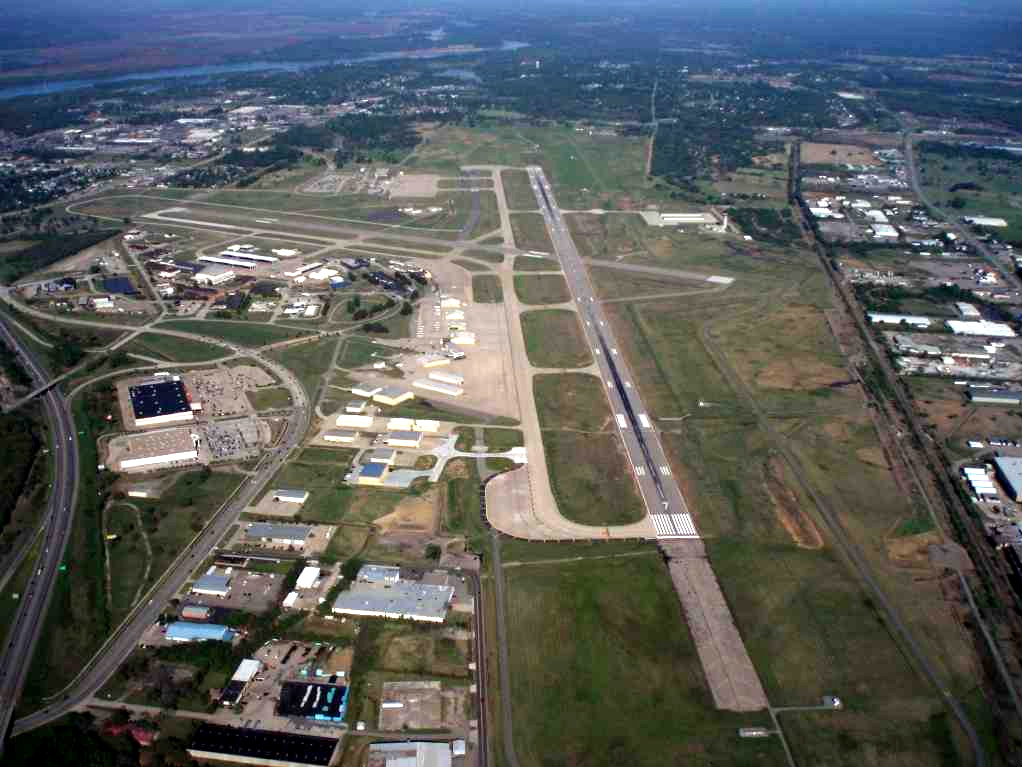
From the air, Fort Smith reveals itself as a city shaped by water. The Arkansas River wraps around three sides of the city, part of the McClellan-Kerr Navigation System that connects the heartland to the Gulf of Mexico via the Port of Fort Smith. Fort Smith Regional Airport serves both civilian and military aviation, including the 188th Wing of the Arkansas Air National Guard. The city's sister-city relationship with Cisterna di Latina, Italy, honors Fort Smith native William Orlando Darby, the World War II general who led Army Rangers at the Battle of Cisterna. It is a fitting connection for a city that has always been a gateway -- first to the frontier, now to the broader world.
From the Air
Located at 35.380N, 94.382W on the Arkansas-Oklahoma border. Fort Smith Regional Airport (KFSM) is the primary facility, serving both civilian and military operations. The Arkansas River wraps around the city on three sides and is a dominant visual landmark. Interstate 40 and Interstate 49 intersection visible from altitude. Best viewed at 3,000-5,000 ft AGL. The city sprawls across flat river valley terrain.
Sources
- Encyclopedia of Arkansas - Miss Laura Social Club
- Encyclopedia of Arkansas - Isaac Charles Parker
- Encyclopedia of Arkansas - Bass Reeves
- Encyclopedia of Arkansas - William Orlando Darby
- 188th Wing - Arkansas Air National Guard
- Discover Fort Smith - Elvis Chaffee Barbershop
- Fort Smith Arkansas Demographics