Fort St. Joseph
Captain Charles Roberts had his orders. On July 16, 1812, less than a month after the United States declared war on Britain, Roberts assembled a force of British soldiers, French Canadian voyageurs from nearby Sault Ste. Marie, and roughly four hundred Ottawa, Ojibwa, Menominee, and Winnebago warriors. They pushed off from Fort St. Joseph in a flotilla of bateaux and canoes, paddling through the night toward Fort Michilimackinac. By dawn on July 17, Roberts had his guns positioned on the heights above the American garrison. Lieutenant Porter Hanks, caught completely off guard, surrendered without a shot. It was the first British victory of the War of 1812, and it was launched from a half-finished fort on the southern tip of a remote island in Lake Huron.
Britain's Farthest Reach
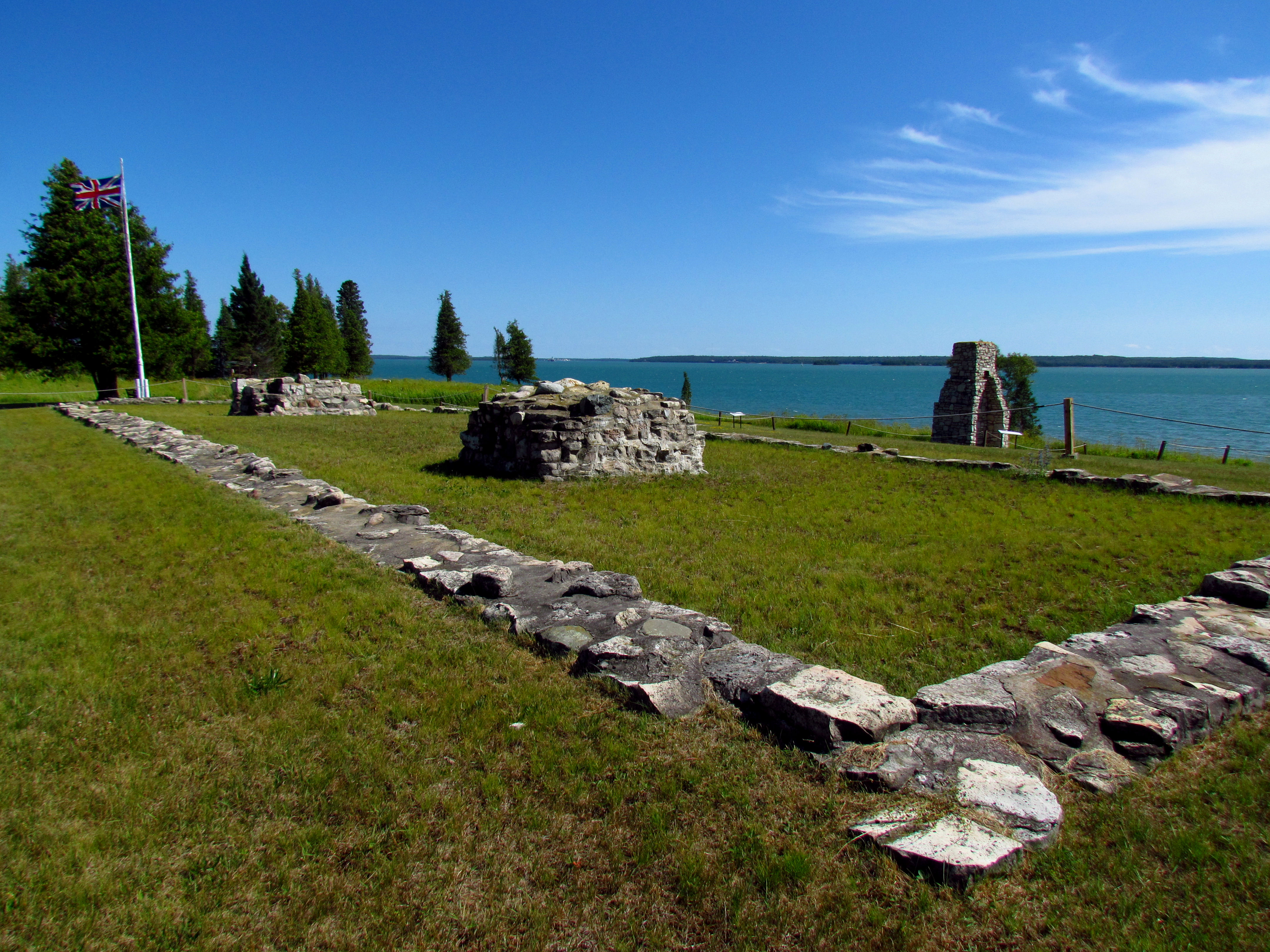
Fort St. Joseph began as a replacement for Fort Mackinac, which the British had been forced to hand over to the Americans under the Jay Treaty in 1796. Officials in Quebec selected the southern point of St. Joseph Island, where the St. Marys River empties into Lake Huron, as the site for a new garrison. The location was strategic: it sat along the main water route between the Great Lakes, close to the fur trade networks that were the economic lifeline of the region. Construction began in the summer of 1796 on roughly 325 hectares of shoreline. The fort grew to include a blockhouse, powder magazine, bakery, Indian council house, and storehouse, all enclosed by a wooden palisade. During its short occupation, Fort St. Joseph held the distinction of being the most westerly British outpost in North America, a lonely sentinel at the edge of empire.
A Fort Unready for War
By 1807, tensions between Britain and the United States were escalating over trade policies and control of the Great Lakes. Fort St. Joseph was painfully unequipped for the conflict everyone could see coming. The garrison was undermanned, its weapons outdated, and the fort itself remained unfinished. Yet when war came in June 1812, the fort's very remoteness became its advantage. Major-General Sir Isaac Brock, military commander of Upper Canada, understood that seizing Mackinac would secure British control of the upper Great Lakes and rally First Nations support. He sent word to Captain Roberts to strike immediately. Roberts gathered his mixed force of regulars, voyageurs, and Indigenous warriors and moved swiftly. The capture of Michilimackinac sent shockwaves across the frontier and gave Britain early momentum in the war.
Burned and Abandoned
The fort's triumph was short-lived. While Roberts and his men held Mackinac, American forces from Detroit arrived at St. Joseph Island to find it deserted. They burned the fort and the North West Company storehouses that surrounded it. The ruins smoldered on the shoreline, but strategically it no longer mattered: Mackinac was the prize, and the British held it until the peace treaty was signed in December 1814. When that treaty restored Mackinac to the Americans, the British chose not to rebuild Fort St. Joseph. They established a new garrison on Drummond Island instead, though they continued to use the powder magazine at the abandoned fort. Eventually, even that use ended when the garrison relocated to Penetanguishene as the fur trade declined. Fort St. Joseph slipped from memory.
Ruins Reclaimed
For more than a century, the remains of Fort St. Joseph lay undisturbed on the southern point of St. Joseph Island. It was not until the early 1920s that the Sault Ste. Marie Historical Society began exploring the ruins. After World War II, a road was built to the site and a small picnic area was established. The University of Toronto conducted archaeological digs in the summers of 1963 and 1964, unearthing artifacts from the fort's brief but eventful life. In 1974, Parks Canada assumed control of the site, building a visitor centre and designating it a National Historic Site. Today, occasional archaeological excavations continue to turn up new discoveries, and a few thousand visitors each year walk the grounds where Roberts marshaled his improbable army. The stone foundations, the outline of the palisade, and the restored powder magazine are all that remain of the outpost that fired the opening shot of the War of 1812.
From the Air
Fort St. Joseph National Historic Site (46.06N, -83.95W) occupies the southernmost tip of St. Joseph Island in Ontario, Canada. The ruins are visible on the shoreline where the St. Marys River meets Lake Huron. Nearest airports: Sault Ste. Marie Airport (CYAM) in Ontario, approximately 30 nm northwest, and Sanderson Field (KANJ) in Sault Ste. Marie, MI. The island is connected to the mainland by the Bernt Gilbertson Bridge to the north. Best viewed at 1,500-3,000 ft AGL to see the fort ruins against the waterfront. Neebish Island (Michigan) is directly to the west across the shipping channel.