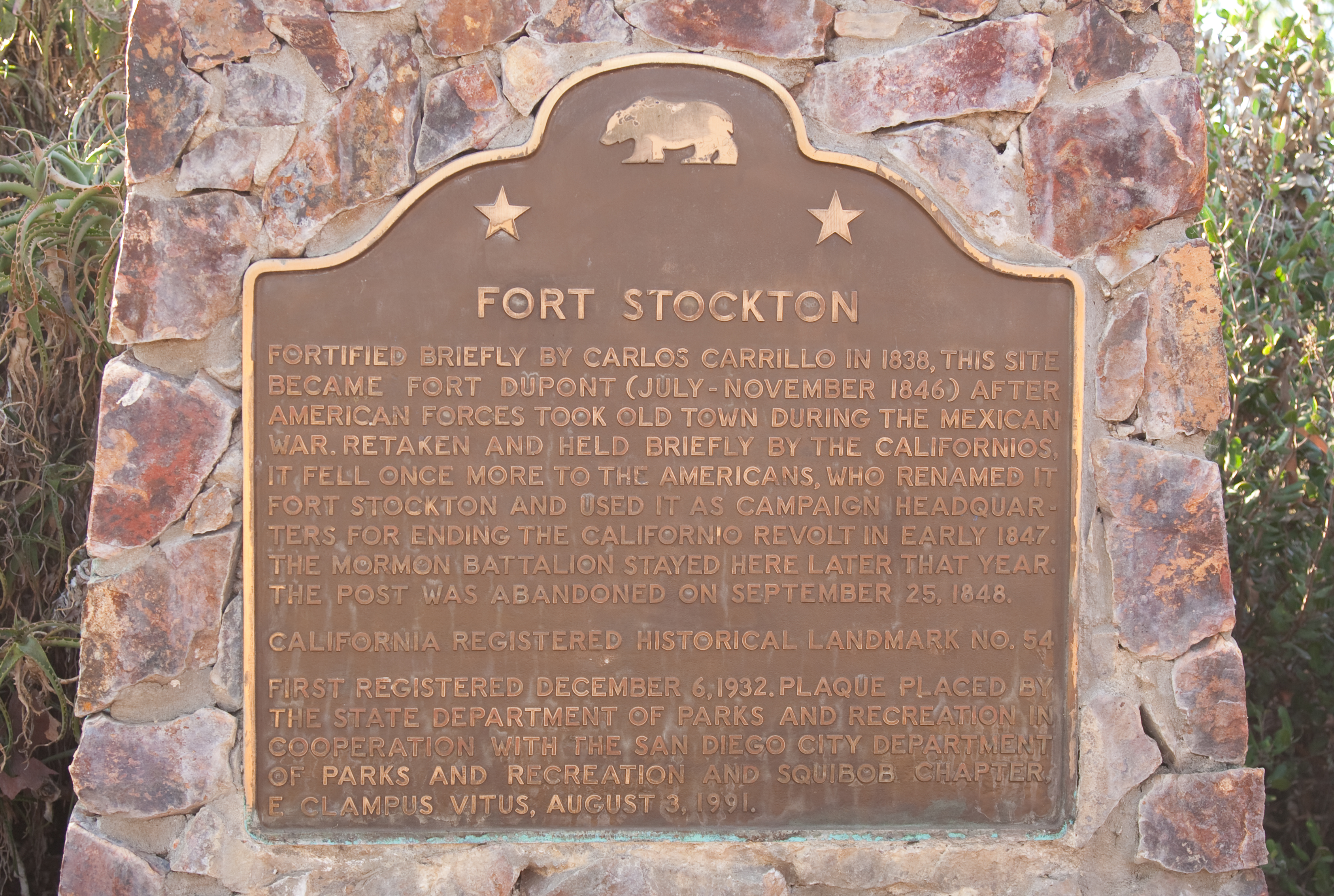
Fort Stockton (San Diego, California)
Fort Stockton is a hill in Presidio Park, but it was once a fortification that changed hands between three nations in a matter of months — built by New Spain, occupied by Mexico, seized and renamed by the United States during the Mexican-American War, and abandoned when the war was over.
Built to Watch Over the Bay
In 1828, New Spain's Carlos Carrillo oversaw the construction of a fortification on the hill above the Pueblo de San Diego. The location was chosen for the same reason that military planners always chose elevated ground: from the top of this hill, you could see the harbor, the bay, and the approaches to the settlement below. A cannon placed here could command the water.
New Spain had already been replaced by Mexico by the time the fort was completed, but the logic of the position remained. The structure was built of adobe and earthwork, a small garrison post in a remote corner of what was then Mexican Alta California. It held watch over a town that was still very much a frontier outpost — a mission, a presidio, and a pueblo that together represented Spain's and then Mexico's northwesternmost foothold on the continent.
Three Flags in One Year
In July 1846, the United States moved against Mexican California as part of the Mexican-American War. Navy Captain Samuel F. DuPont arrived at San Diego Bay aboard the USS Cyane on July 29, 1846, accompanied by Major John C. Frémont, Kit Carson, and their troops. Stephen Rowan and William Maddox were among the first to come ashore.
The fort changed hands. Those aboard the Cyane rebuilt the old earthwork on the hill and named it Fort Dupont, after the captain whose ship had brought them. Frémont and most of the troops then marched north toward Los Angeles, leaving Captain Ezekiel Merritt and John Bidwell in command of the fort.
The Californios — California's Spanish-Mexican population — did not give up the port easily. Mexican forces under Francisco Rico and Serbulo Varela reclaimed the fort. American forces, using a chartered whaling ship, the Magnolia, returned with 50 sailors and volunteers, laid siege, and retook it. Then Ramon Carrillo and Captain Leonardo Cota came back with Mexican troops on October 26, 1846.
On October 31, 1846, Commodore Robert F. Stockton arrived by frigate with reinforcements under Archibald Gillespie, and with the help of local Californios Santiago Arguello and Miguel de Pedrorena, the Americans retook the fort for good.
Fort Stockton
After the final American recapture, the fort was reinforced and renamed Fort Stockton in honor of Commodore Stockton. It became the United States headquarters for operations against the remaining Californio resistance in early 1847. The Mormon Battalion camped there briefly that year on its famous overland march from Iowa.
The Treaty of Guadalupe Hidalgo ended the Mexican-American War on February 2, 1848. San Diego and Alta California became part of the United States. The military need for Fort Stockton evaporated. It was abandoned on September 25, 1848 — just over two years after it had been seized from Mexico.
The Hill That Remains
The fort itself is long gone — adobe and earthwork do not survive decades of California weather unaided. But the hill it occupied is still there, now within Presidio Park, the public open space that occupies the ridge above Old Town San Diego.
A historical marker was placed on the hill in 1991, and the site has been designated California Historical Landmark No. 54, listed in 1932. The plaque and the view from the hill are what remain of the fortification's physical presence.
Standing on that hill, you can still see what Carlos Carrillo saw in 1828: the harbor, the bay, the flatlands below. The landscape that made this spot strategically valuable in the nineteenth century is still visible, even if everything that was built to exploit it is gone.
From the Air
Fort Stockton sits on the hill within Presidio Park, overlooking Old Town San Diego. The park is approximately 4 miles north of KSAN (San Diego International Airport). On approach from the coast heading east, the ridge of the Presidio — with its eucalyptus trees and the Serra Museum visible at the hilltop — is one of the first elevated features visible inland from Mission Bay. The hill commands a clear view of San Diego Bay and the surrounding flatlands.