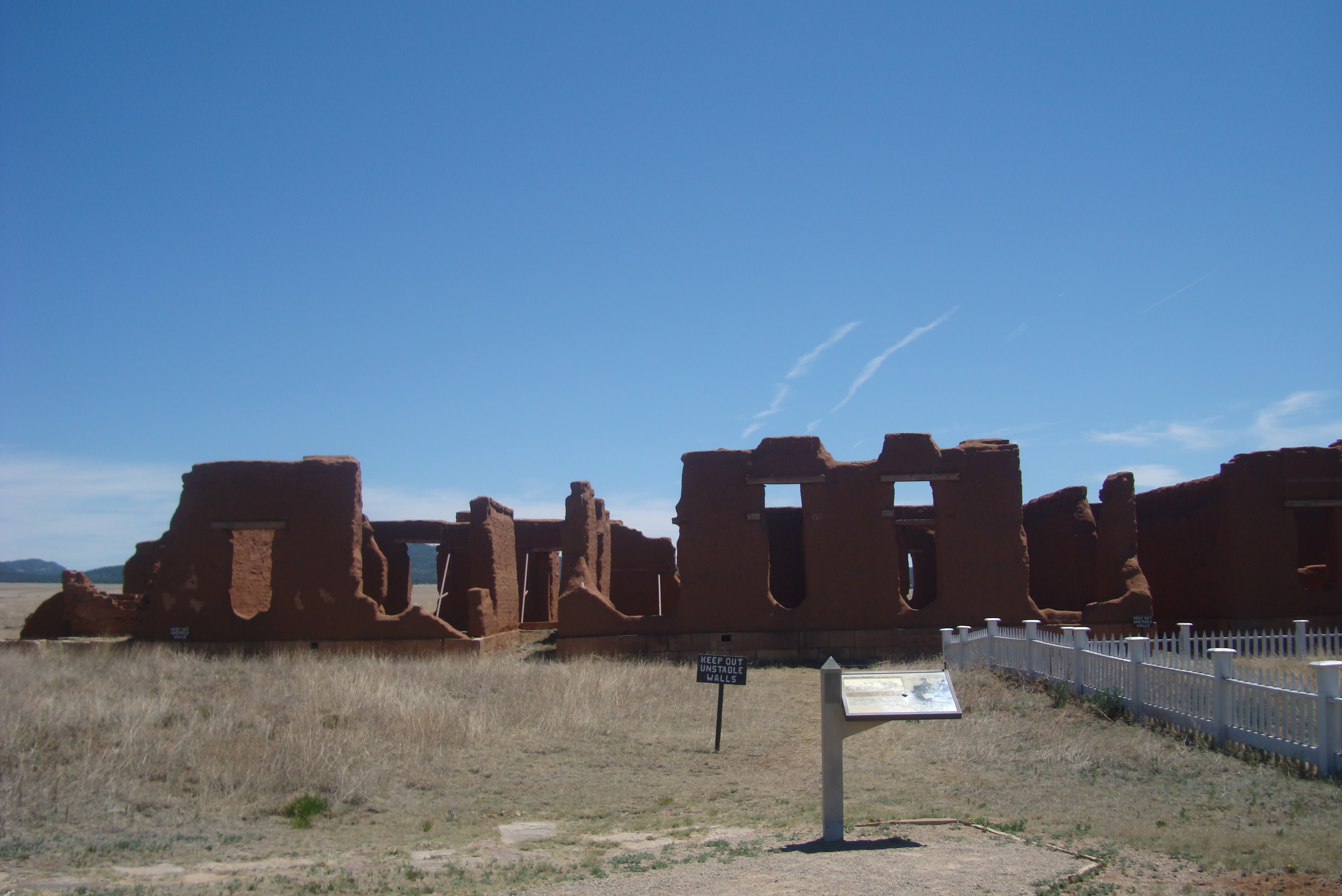
Fort Union National Monument
Santa Fe trader William Davis arrived in 1857 expecting a fortress and found instead what looked like a quiet frontier village -- neat log huts laid out on broad streets crossing at right angles, set in the pleasant valley of the Moro. That gap between expectation and reality captures something essential about Fort Union. Over four decades and three separate constructions, this post in Mora County, New Mexico, was never quite what it appeared. It was a supply depot that dwarfed its military garrison, a federal installation built on someone else's private land, and a Civil War fortification whose star-shaped earthworks defended against a Confederate invasion most people have forgotten ever threatened the Southwest.
Where the Trails Converged
In April 1851, Lt. Col. Edwin V. Sumner received orders to overhaul the defense of New Mexico Territory. His soldiers, garrisoned in civilian settlements, were distracted by alcohol and often unfit for duty. Sumner chose a site 7.7 miles north of present-day Watrous, where the Mountain and Cimarron branches of the Santa Fe Trail converged, roughly 25 miles northeast of Las Vegas, New Mexico. Construction of the first Fort Union began in August 1851. Within a decade it had become the principal military supply depot of the entire Southwest, a waypoint where trail-weary travelers could rest and refit at the post sutler's store. The ruts those wagon wheels carved into the earth remain visible today, pressed into the high-plains grass like a memory the landscape refuses to release.
Dragoons and a Star-Shaped Fort
Throughout the 1850s, mounted riflemen -- dragoons -- rode out from Fort Union to campaign against the Jicarilla Apaches, Utes, Kiowas, and Comanches who disrupted traffic on the Santa Fe Trail. In 1854, Jicarilla Apaches nearly wiped out an entire company of dragoons before being driven into the mountains west of the Rio Grande. When the Civil War began in April 1861, Col. Edward R.S. Canby ordered construction of a second Fort Union: a star-shaped earthen fortification designed to repel a Confederate invasion advancing north up the Rio Grande Valley. That invasion came in 1862. Colorado and New Mexico volunteers, joined by U.S. regulars from Fort Union, met the Confederates at Glorieta Pass, about 20 miles southeast of Santa Fe. The Southern forces were defeated and withdrew to Texas, ending Civil War activity in the Southwest and denying the Confederacy access to Colorado's mines.
The Supply Depot That Eclipsed the Garrison
Construction of the third and final fort began in 1863 under Brig. Gen. James H. Carleton. It took six years to complete and became the most extensive military installation in New Mexico Territory, encompassing not just a military post but a sprawling quartermaster depot with warehouses, corrals, workshops, offices, and living quarters. An ordnance depot rose on the site of the original first fort at the valley's western edge. The supply function soon overshadowed the military one, employing far more men -- most of them civilians -- than the garrison itself. Kit Carson served as fort commander from December 24, 1865, to April 24, 1866. The 8th Cavalry headquartered here in the early 1870s, followed by the 9th Cavalry during the Apache Wars later that decade. But by 1879, the Santa Fe Railroad had replaced the Santa Fe Trail as the principal artery of commerce, and the depot's purpose evaporated. The fort was abandoned in 1891.
Squatters in Uniform
Fort Union fought battles in courtrooms as well as on open ground. When the Army built the first fort in 1851, soldiers were unaware they had planted their post on private property -- part of the Mora Land Grant. Colonel Sumner expanded the reservation to eight square miles the following year, and in 1868, President Andrew Johnson declared a 53-square-mile timber reservation encompassing the Turkey Mountains as part of the fort. The Mora Grant claimants challenged the government squatters immediately, and by the mid-1850s the case had reached Congress. It took until 1876 for New Mexico's surveyor-general to confirm Fort Union was no doubt on the grant, but the Army refused to move or pay. The secretary of war argued the military had improved the land and should not surrender it without compensation. The stalling tactic held. The Army stayed until the fort closed in 1891 without ever paying a single penny to the legitimate owners.
What the Wind Preserves
Today Fort Union National Monument, a unit of the National Park Service, preserves the adobe ruins of the second and third forts. A self-guided trail winds past the remains of Officer's Row, the hospital, and the star-shaped earthworks. Across the valley to the west stand the ruins of the ordnance depot and the site of the original 1851 fort. A visitor center houses a museum and a film about the fort's history. The monument is open year-round, and admission is free. But the most striking artifacts require no building to contain them. The Santa Fe Trail ruts stretching away from the fort -- visible from the road and from the walking paths -- are among the most extensive surviving traces of the trail anywhere in the country, physical grooves recording the passage of thousands of wagons through a landscape that otherwise looks as vast and unbroken as it did when Sumner first surveyed the valley.
From the Air
Located at 35.907N, 105.015W in the Mora Valley of northeastern New Mexico. Fort ruins and Santa Fe Trail ruts visible on high-plains grassland about 7.7 miles north of Watrous. Recommended viewing altitude: 2,000-4,000 feet AGL. Nearest airports: Las Vegas Municipal (KLVS) approximately 25 nm southwest, Santa Fe Regional (KSAF) approximately 55 nm southwest. Sangre de Cristo Mountains rise to the west.