Fort van den Bosch
Locals call it Benteng Pendem -- the sunken fort. The name is literal. Fort van den Bosch was deliberately built lower than the surrounding terrain in Ngawi, East Java, so that from a distance it nearly disappears into the landscape. Walk past the walls and you would barely know a 165-meter-long, multi-story military fortress lay just below your feet. That was the point. The Dutch colonial engineers who designed it in the 1830s wanted a fort that could control the confluence of two major rivers without presenting an easy target, and they succeeded so well that the fort eventually sank from public memory altogether, spending decades in ruin before Indonesia's government decided to bring it back.
Prince Diponegoro's Shadow
The fort exists because of one man's rebellion. In the 1820s, Prince Diponegoro led the Java War against Dutch colonial rule, a five-year conflict that convulsed the island and forced the colonial government to rethink its military infrastructure across the interior. In the Ngawi region, local leaders joined the resistance: Regent Kerto Dirjo in Madiun, Adipati Judodiningrat and Raden Tumenggung Surodirjo in Ngawi, and Wirotani, a direct follower of Diponegoro himself. The Dutch captured Ngawi in 1825, but holding it required more than a garrison. They needed a permanent fortification that could monitor the trade and shipping routes along the Bengawan Solo and Madiun rivers. The Dutch East Indies government ordered a new fort at the exact point where those two rivers meet, a strategic chokepoint that commanded traffic in every direction.
Sunk by Design
Construction began in the 1830s and finished in 1845. The result was a fortress measuring 165 by 80 meters, set within a 15-hectare compound at the confluence of the Bengawan Solo and the Madiun River. The fort contained hundreds of rooms across multiple floors, with capacity for 250 soldiers, six cannons, and 60 cavalry. It was named for Johannes van den Bosch, the Governor-General who had implemented the Cultivation System across Java. The defining feature, though, was its position: the entire structure sat below the level of the surrounding ground. This made it nearly invisible from any approach and extremely difficult to bombard with the artillery of the era. It also gave the fort its enduring local name, Benteng Pendem, and created the strange experience of descending into a military installation rather than looking up at one.
Behind the Walls in Wartime
A century after its construction, the fort served a grimmer purpose. During the Japanese occupation of the Dutch East Indies, Fort van den Bosch was converted into a civilian internment camp for men and boys. From February 1943 to February 12, 1944, approximately 1,580 men were held here, including British and American civilians caught by the war. A Japanese officer named Nakamura commanded the camp, while local Indonesians were employed as prison guards. Some internees were confined in the fort's original prison cells; others were kept in barracks erected on the front grounds. Conditions in Japanese civilian camps across the Dutch East Indies were notoriously harsh -- overcrowding, malnutrition, and disease were common. On February 12, 1944, the internees at Fort van den Bosch were transferred to camps at Tjimahi in West Java, and the fort's role as a place of confinement ended.
A Saint Beneath the Stones
Inside the fort lies one of Ngawi's most visited graves. The tomb of Kyai Haji Muhammad Nursalim, a follower of Prince Diponegoro, sits within the fortress walls -- a resistance fighter buried inside the stronghold of the power he fought against. Local tradition holds that Nursalim was the first person to spread Islam in the Ngawi region. According to legend, the Dutch discovered that he was immune to gunfire -- no bullet could harm him -- and so they buried him alive within the fort's grounds. Whether the story is history or mythology matters less than what it reveals: even after the Dutch built their fortress and imposed their control, the memory of Javanese resistance lived on inside its walls, tended by generations of local visitors who still come to pay respects at Nursalim's tomb.
Rising from the Ground
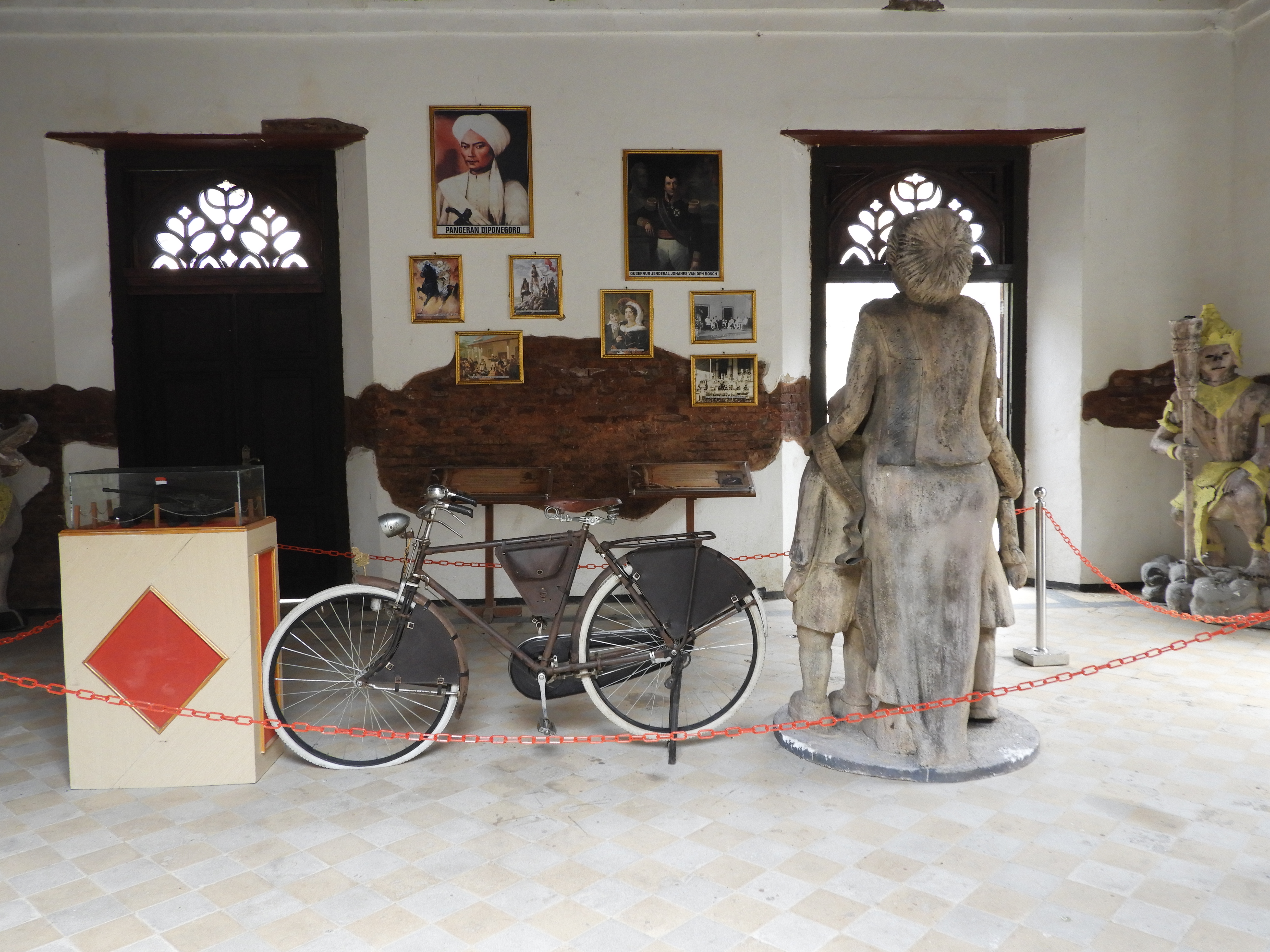
After Indonesian independence, the fort was briefly used by the Indonesian Army before being abandoned. Decades of neglect followed. The jungle crept in, walls crumbled, and the sunken fort sank further -- this time into disrepair rather than strategic concealment. For years, Benteng Pendem was a ruin that most Indonesians had never heard of. That changed in February 2019, when President Joko Widodo announced that the fort would be repaired and revitalized to near its original condition as a tourist destination. Restoration work has since begun, and the fort now houses a small museum displaying colonial-era artifacts recovered from the site. The design sketches from 1845, preserved in Dutch national archives, show a fortress of considerable ambition -- earthwork defenses, an inner reduit, barracks, and magazines all carefully planned for this remote river junction. Seeing those plans beside the restored stonework gives visitors a rare chance to watch colonial engineering being excavated from the landscape that swallowed it.
From the Air
Located at 7.39S, 111.45E at the confluence of the Bengawan Solo (Solo River) and Madiun River in Ngawi, East Java. The fort is set below ground level and may be difficult to spot from high altitude, but the river confluence is clearly visible as a major landmark. The 15-hectare compound is in the town of Ngawi. Nearest airport is Adisumarmo International Airport (ICAO: WAHQ) near Solo, approximately 90 km to the southwest. Iswahyudi Air Force Base (ICAO: WARI) near Madiun is about 30 km to the south. Best viewed at 2,000-4,000 feet AGL following the Bengawan Solo river system east from Solo.