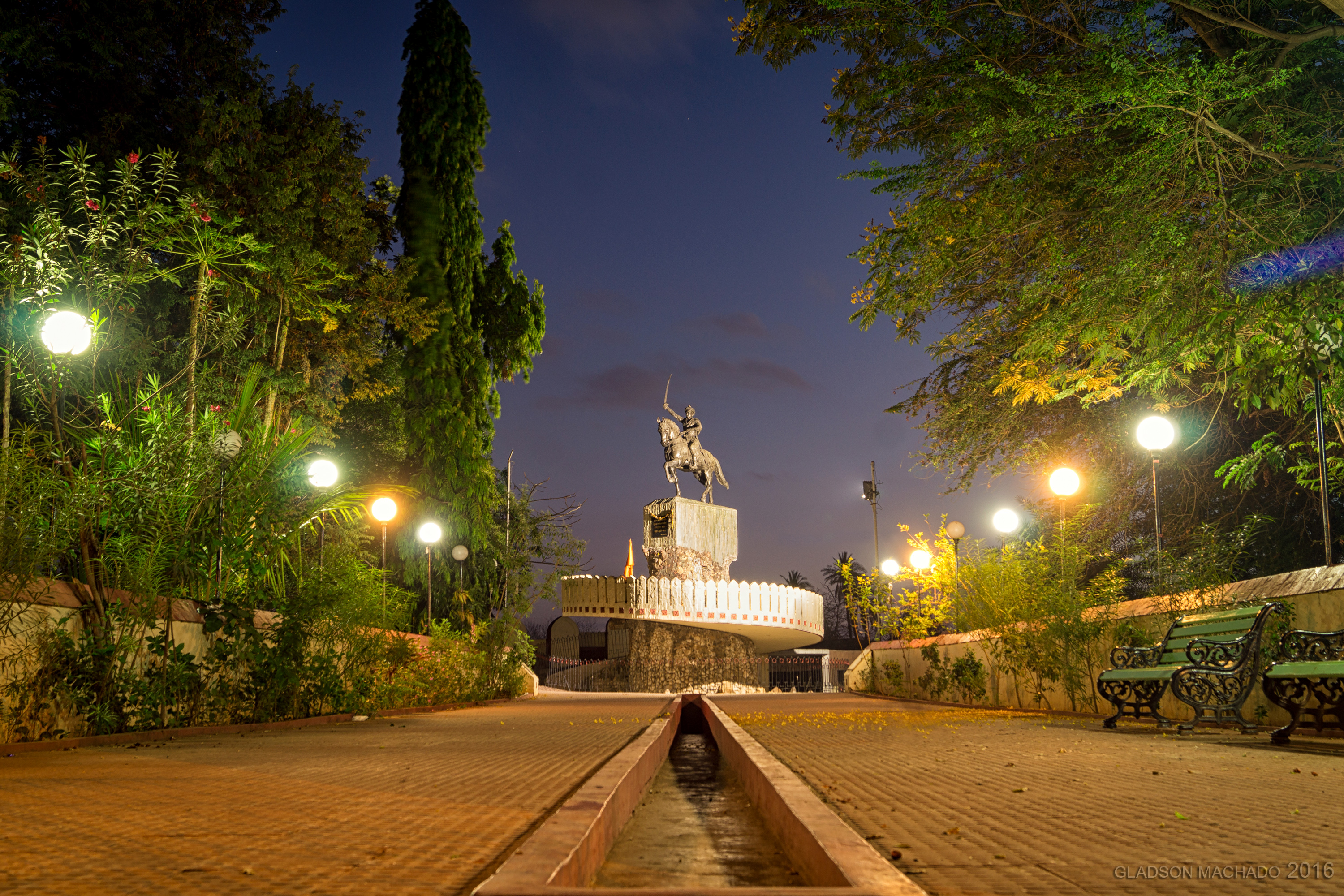
Fort Vasai
Somewhere in the Hindu temples of Maharashtra, Portuguese church bells still ring. Chimaji Appa's Maratha soldiers carried them from the churches of Vasai after their victory in 1739, installing them in the Khandoba Temple at Jejuri and the Tulja Bhavani Temple of Osmanabad. The bells remain there today -- colonial artifacts repurposed as devotional instruments, sounding across centuries of conquest and reclamation. The fort they came from, formally christened the Fort of St. Sebastian by its Portuguese builders, stands in overgrown ruin on the Konkan coast just north of Mumbai, its walls still tracing the outline of a town that was once second only to Goa in the Portuguese eastern empire.
Before the Cross and Cannon
Long before the Portuguese arrived, this stretch of coast attracted travelers from distant civilizations. The Greek merchant Cosmas Indicopleustes visited the area in the 6th century, and the Chinese pilgrim Xuanzang passed through in 640 CE. Vasai changed hands through a succession of Indian dynasties -- the Chalukyas, the Silharas of Konkan, and the Yadavas, who made it a district capital from 1184 to 1318. When the Gujarat Sultanate took control, the Portuguese explorer Barbosa described it in 1514 as "Baxay," a town with a good seaport. That seaport would prove its undoing. The Portuguese first appeared off this coast in 1509, and by 1530, Captain Antonio da Silvera had burned the city. In 1534, Sultan Bahadur Shah of Gujarat signed a treaty ceding Vasai and its dependencies -- including an island called Bombaim that would eventually become Mumbai.
A Walled City on the Arabian Sea
On 22 February 1554, the Portuguese enclosed an entire town within fortress walls. Ten bastions with names like Nossa Senhora dos Remedios and Sao Sebastiao guarded the perimeter. Two medieval gateways controlled access: the Porta do Mar, its massive teak gates studded with iron spikes and facing the sea, and the Porta da Terra opening landward. Ninety pieces of artillery lined the walls, twenty-seven cast in bronze. Twenty-one gunboats patrolled the waters, each bristling with sixteen to eighteen guns. Inside, the settlement grew wealthy. St. Francis Xavier stopped here in 1548 to convert part of the population. By 1573, the Portuguese had built nine churches across nearby Salsette Island. Baçaim, as they called it, became the administrative seat of the northern province, a territory stretching 100 kilometers along the coast. It was the most productive area under Portuguese rule in India -- and among the most vulnerable.
Plagues, Pirates, and the Price of Empire
The year 1618 brought catastrophe in waves. First plague, then a deadly cyclone on 15 May that flattened thousands of coconut trees and ripped roofs from the largest churches. Monsoon winds pushed saltwater inland, and the rains that should have followed never came. Famine set in so severely that parents sold their children to brokers rather than watch them starve -- a practice the Jesuits managed to halt through their own meager savings and donations from the wealthy. By 1634, the settlement's population was starkly stratified: 400 Portuguese families, 200 Indian Christian families, and 1,800 enslaved Indians and Africans. In 1674, six hundred Arab pirates from Muscat landed and plundered every church outside the fort walls. Meanwhile, the transfer of neighboring Bombaim to the British in 1665 -- part of Catherine of Braganza's royal dowry -- began draining Vasai's strategic importance.
The Saffron Flag
By the 1730s, the Maratha Empire was ascending. Chimaji Appa, brother of Peshwa Baji Rao I, assembled a force that Portuguese accounts numbered at 100,000 soldiers, including 25,000 cavalry and 50 elephants. The siege of Baçaim began on 17 February 1739, with the Marathas methodically cutting every supply route. On 1 May, Appa's soldiers laid ten mines against the walls near the tower of Remedios and detonated four. The breach drew fierce Portuguese fire. For three days, the fighting raged around the towers of Sao Sebastiao and Remedios, with the Portuguese defenders lighting firewood to hold attackers back. On 3 May, a Maratha mine demolished the tower of Sao Sebastiao entirely. Chimaji Appa then sent a letter warning that the garrison would be slaughtered if resistance continued. The Portuguese commander surrendered on 16 May. In a gesture of martial respect, the Maratha general permitted the garrison to depart with unfurled colors, muskets shouldered, and drums playing. On 23 May 1739, the saffron flag rose over Baçaim.
Ruins and Reels
Today the fort is a monument of national importance, protected by the Archaeological Survey of India. The ramparts still overlook Vasai Creek, nearly complete though claimed by vegetation. Watch-towers stand with their staircases intact, and enough walls survive to trace the floor plans of the Portuguese settlement. Three chapels remain recognizable, their 17th-century facades weathered but standing, one with a barrel-vaulted ceiling still in place. Carved stones line the arches -- some worn smooth, others still showing sharp chisel marks from craftsmen dead for centuries. Nature has reclaimed much of the interior: butterflies, birds, and agamid lizards share the space with visiting tourists. The fort has also become a favored Bollywood filming location, appearing in movies starring Shah Rukh Khan and serving as a backdrop for Coldplay's "Hymn for the Weekend" music video, which features Beyonce and has accumulated over 2.6 billion YouTube views. Between the carved Portuguese inscriptions and the Bollywood cameras, Vasai Fort keeps finding new audiences for its old walls.
From the Air
Located at 19.33°N, 72.81°E on the Konkan coast, just north of Mumbai. The fort sits along Vasai Creek and is visible from lower altitudes as a walled enclosure with ruined church structures. Nearest major airport is Chhatrapati Shivaji Maharaj International Airport (VABB), approximately 45 km to the south. Look for the creek and the distinctive rectangular fortification outline. Best viewed at 2,000-3,000 ft in clear conditions.