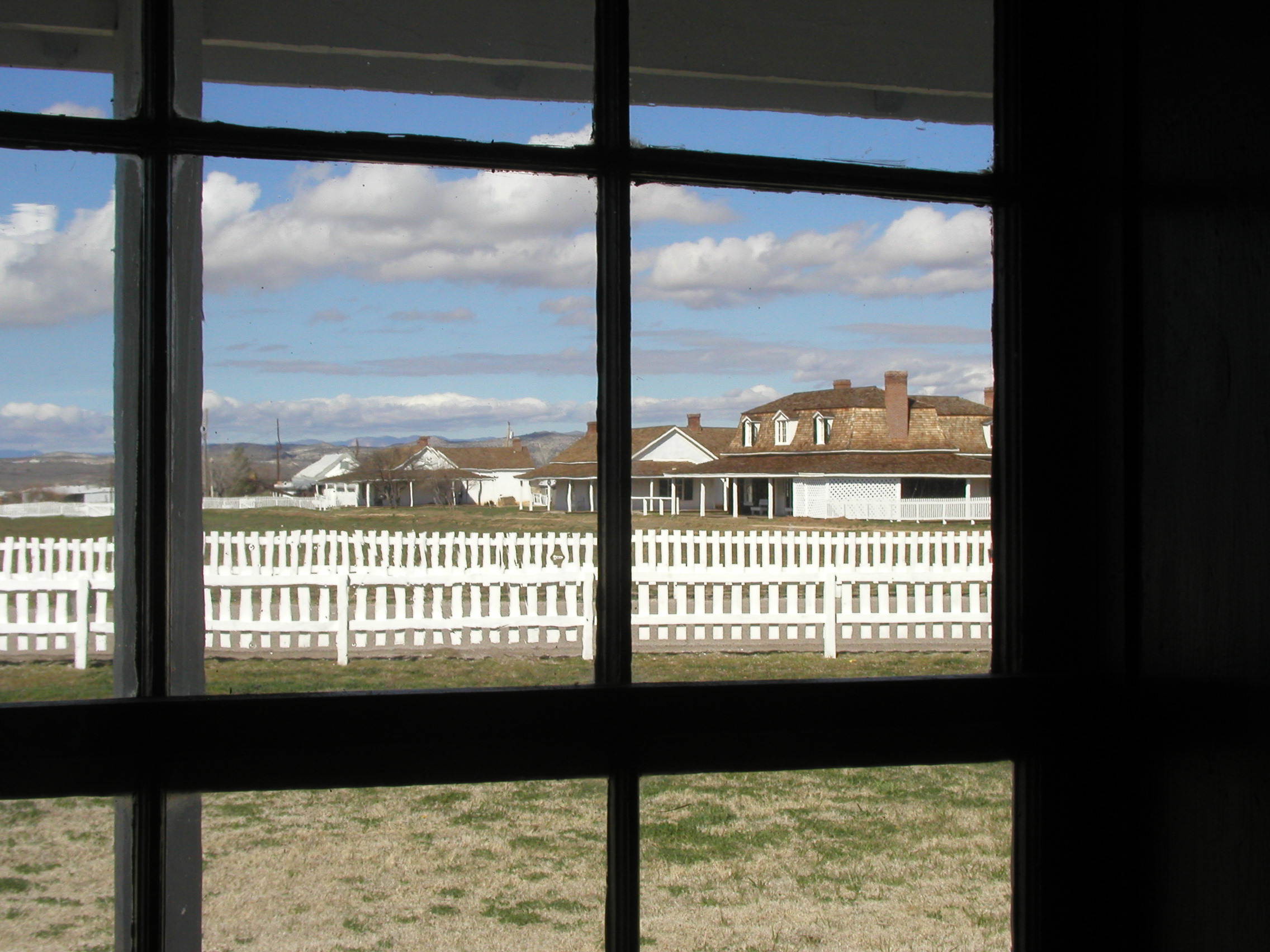
Fort Verde State Historic Park
The fort had no walls. No stockade, no palisade, no gatehouse -- just twenty-two buildings arranged on open ground in the Verde Valley, exposed to the desert wind and whatever else might come. Fort Verde was not built to withstand a siege. It was built as a staging ground for one of the most relentless military campaigns in the American Southwest: General George Crook's 1872-73 winter offensive against the Tonto Apache and Yavapai. Today, four of those original buildings survive as the best-preserved example of a military post from the Apache Wars era, their thick adobe-and-concrete walls still holding shape more than 150 years after soldiers first walked through their doors.
Farmers, Miners, and the Collapse of an Old World
The Verde Valley's troubles began with corn. Settlers arriving in the mid-19th century found fertile land along the Verde River and began farming, feeding a growing market in nearby Prescott -- then the territorial capital -- and the miners flooding Arizona's mountains. But the mining economy's rapid expansion shattered the hunting and gathering environment of the Dilzhe'e Apache and Yavapai peoples who had lived in the region for centuries. Their food sources disrupted, they raided the farmers' crops. The farmers petitioned the U.S. Army for protection. In 1865, infantry arrived and began establishing posts. Over the next six years, the military footprint shifted: a small camp five miles south of present-day Camp Verde in 1865, then Camp Lincoln a mile north, and finally the permanent installation that would become Fort Verde, built gradually between 1871 and 1873.
Crook's War Machine
General George Crook arrived in Arizona Territory in 1871 with a mandate from President Ulysses S. Grant to end the Apache Wars. Fort Verde became a critical node in his strategy. Crook established a military supply trail -- the General Crook Trail -- connecting Forts Whipple, Verde, and Apache, sealing off escape routes and enabling mobile detachments to sweep through the Tonto Basin. His winter campaign of 1872-73 was methodical and devastating. Using Apache scouts as trackers, Crook's forces kept hostile bands constantly moving, exhausting their food supplies and forcing over twenty skirmishes. By 1872, approximately 1,500 local Native Americans had been placed on a reservation, and the fort's mission shifted from offensive operations to reservation enforcement. The last major military engagement came a decade later at the Battle of Big Dry Wash in 1882. By 1891, Fort Verde was abandoned. Eight years later, it was sold at public auction.
Adobe Slabs and Concrete Memory
What makes Fort Verde remarkable among Arizona's frontier posts is its construction. Some buildings were built with pise -- large adobe slabs cast within wooden frames rather than assembled from individual adobe bricks. This technique, combined with the dry Verde Valley climate, gave the structures an unusual durability. At its peak, the fort comprised twenty-two buildings, but by 1956 only four remained: the Administration Building, the Commanding Officer's Quarters, the Bachelor Officers' Quarters, and the Doctor's and Surgeon's Quarters. That year, local citizens created a small museum in the administration building and eventually donated the surviving structures and ten acres to the State of Arizona. The park was formally established in 1970 and added to the National Register of Historic Places in 1971.
Walking the Grounds Today
The "0" Mile General Crook Trail Marker still stands near the Administration Building, marking the spot where Crook's supply trail began its run to Fort Apache. Inside the Administration Building, now the park's visitor center, exhibits display period uniforms, artifacts from military life, and history of the Indian Scouts who served alongside the Army. The Commanding Officer's Quarters and Bachelor Officers' Quarters have been preserved to reflect life in the 1880s, when the fort was at its operational height. The park sits in the town of Camp Verde, itself named after the military installation that gave the settlement its reason to exist. It is a quiet place -- fitting for a fort that never heard gunfire within its boundaries, yet played a central role in one of the most consequential military campaigns in the history of the American Southwest.
From the Air
Fort Verde State Historic Park is located at 34.565N, 111.852W in Camp Verde, Arizona, in the Verde Valley at approximately 3,160 feet elevation. The park is a small site within the town of Camp Verde. The Verde River runs nearby to the east. Look for the town along SR-260 between I-17 and Cottonwood. Nearest airports include Cottonwood Airport (P52) approximately 12 nm northwest and Sedona Airport (KSEZ) approximately 20 nm north. Camp Verde is visible where the valley widens between the Bradshaw Mountains to the west and the Mogollon Rim to the northeast. Best viewed at 4,000-6,000 feet AGL.