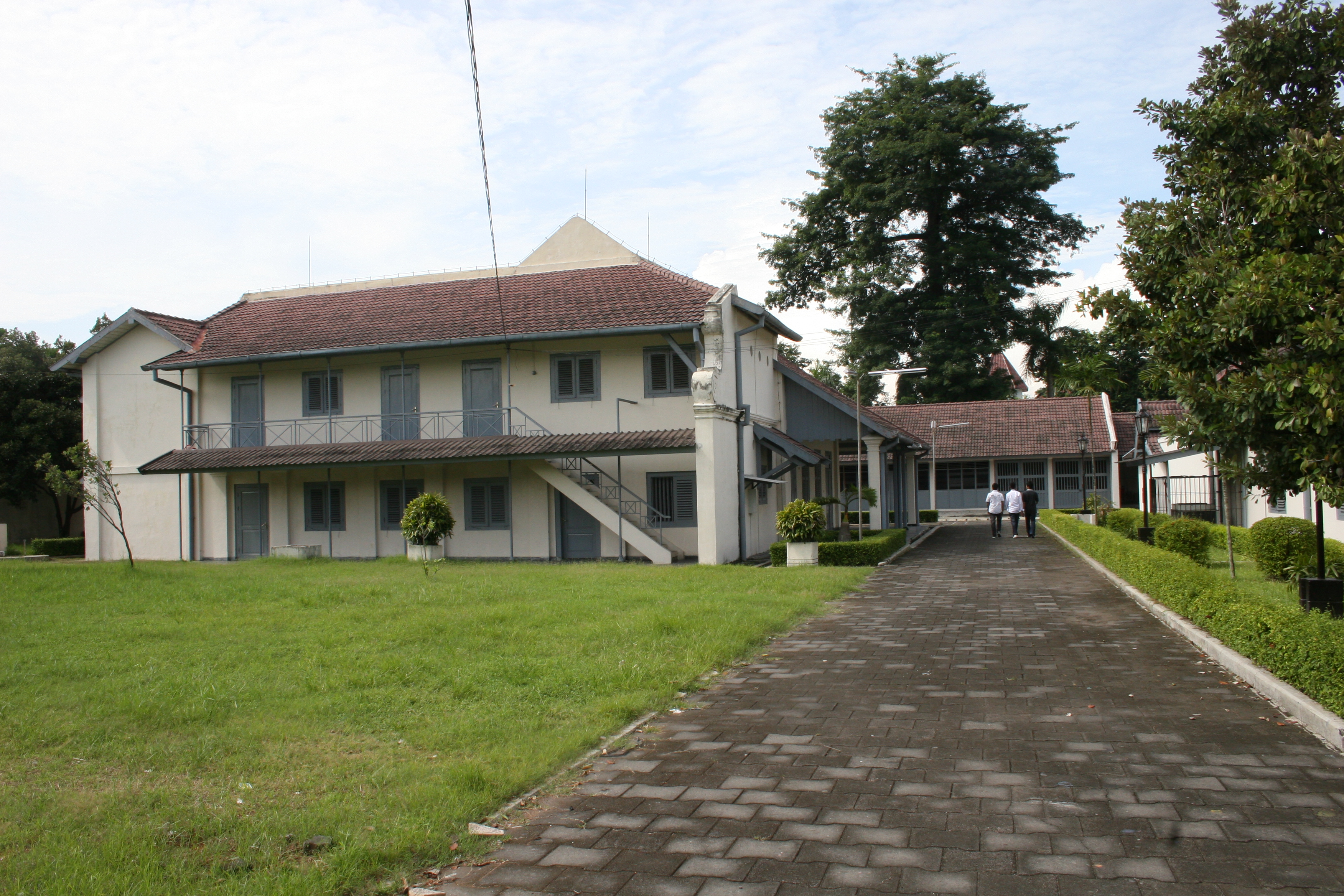
Fort Vredeburg Museum
The irony is built into the walls. In 1760, the Dutch governor of Java's north coast asked Sultan Hamengkubuwono I for permission to build a fortress in Yogyakarta -- and the sultan said yes, donating the plot of land himself. For over a century, Dutch soldiers garrisoned the fort just steps from the royal palace it was ostensibly protecting, though everyone understood the arrangement differently. Today the square fortress with its four corner bastions and reconstructed moat sits directly across from the presidential palace, Gedung Agung, and within sight of the Kraton Yogyakarta. But the dioramas inside no longer tell the story the Dutch would have chosen. Since 1992, Fort Vredeburg has been a museum of Indonesian independence.
Two Names, Two Destructions
The first fort was a simple wooden structure with four bastions, constructed on Sultan Hamengkubuwono I's donated land after the founding of the Kraton Ngayogyakarta Hadiningrat. By 1767, the Dutch architect Frans Haak had converted it into something more permanent -- stone walls, proper fortifications -- and by 1787 the completed structure was named Fort Rustenburg, Dutch for "resting fort." The name lasted eighty years. In 1867, a powerful earthquake leveled the fort. When the Dutch rebuilt it, they chose a new name: Fort Vredeburg, meaning "peace fort," a reference to the supposedly harmonious coexistence between the colonial garrison and the sultan's court just a few hundred meters away. Whether the Javanese court found the name as diplomatic as the Dutch intended is not recorded.
Independence in Miniature
The transformation from military installation to museum began in 1984, when Minister Nugroho Notosusanto reimagined the fort's purpose. Rather than a general military museum, he envisioned a space dedicated specifically to Indonesia's struggle for independence. The museum opened on November 23, 1992, with thirty diorama showcases -- far fewer than the ninety-three originally planned. By 1996, another eighteen had been added. Each diorama depicts events that took place in Yogyakarta and its surrounding region, from the capture of Pangeran Diponegoro in 1830 through Sukarno's return to Jakarta in 1949. The showcases are divided into two categories: thirty-three depicting remarkable cultural and social events, such as the founding of the Islamic reform movement Muhammadiyah and the educational initiative Taman Siswa, and fifteen focused on warfare and guerrilla resistance during the independence struggle.
Stone, Water, and Watchful Corners
Fort Vredeburg is a square fortress, each corner anchored by a bastion -- a raised watchtower that once gave Dutch sentries sightlines across the surrounding city. A moat, called a jagang in Javanese, originally encircled the complex. Parts of it have been reconstructed and are visible today, a shallow channel of water tracing the old defensive perimeter. The fort was designed as the center of Dutch governance and defense in Yogyakarta, a compact citadel meant to project authority in a city whose real power center, the Kraton, lay just to the south. The spatial relationship tells its own story: colonial military architecture planted squarely in the sultan's domain, a permanent reminder of who held the guns. Walking through the restored grounds now, with their collections of old photographs, historical objects, and replicas, the power dynamic has been inverted. The fort that once watched the palace is now a monument to the movement that made such watching obsolete.
The Sultan's Doorstep
Fort Vredeburg's location is its most revealing feature. It sits on Jalan Margo Mulyo in the heart of Yogyakarta, directly facing Gedung Agung -- the presidential palace that served as Indonesia's seat of government during the revolutionary period -- and within walking distance of the Kraton Yogyakarta. This cluster of power, Dutch fort and Javanese palace and presidential residence, concentrated within a few city blocks, made Yogyakarta the stage for some of the most consequential events of Indonesia's independence era. The museum's dioramas lean into this geography, anchoring national history to local streets. For visitors, the experience is layered: you stand inside the colonial fortress, look at scenes of resistance against colonial power, and step outside to see the sultan's palace that outlasted the fort's original purpose by centuries.
From the Air
Located at 7.80S, 110.37E in central Yogyakarta. The fort is a square compound visible near the intersection of major roads in the old city center, adjacent to Gedung Agung and close to the Kraton complex. Adisucipto International Airport (WARJ) lies approximately 8 km to the east. The city sits on a plain backed by the volcanic cone of Mount Merapi to the north.