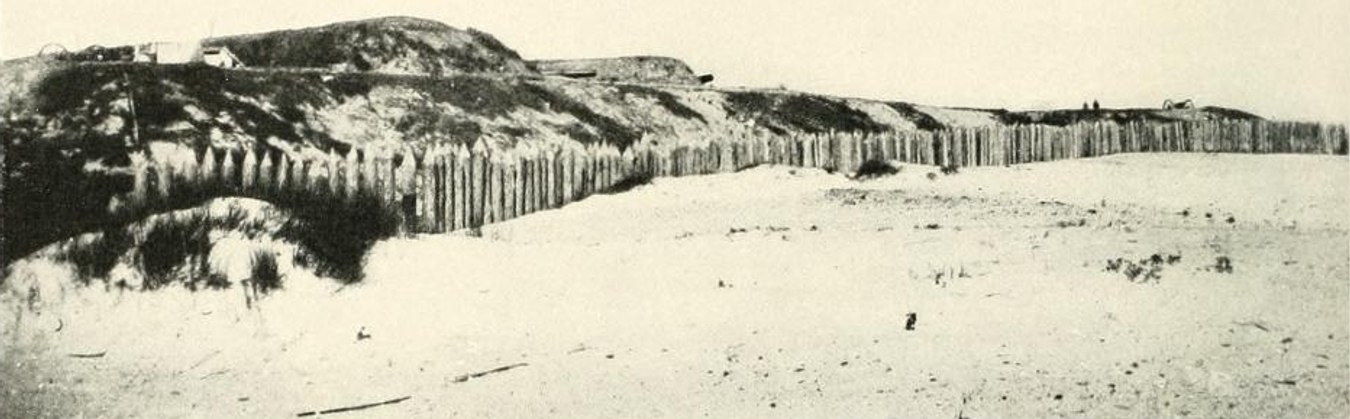
Fort Wagner
The fort no longer exists. The Atlantic Ocean swallowed it decades ago, and the stretch of Morris Island where Fort Wagner once stood is now open water off the South Carolina coast. Yet what happened on this narrow strip of sand on the evening of July 18, 1863 altered the trajectory of the Civil War and the nation itself. That night, Colonel Robert Gould Shaw led the 54th Massachusetts Infantry Regiment -- one of the first African American units raised in the North -- in a frontal assault against a Confederate fortification bristling with cannons. Shaw died on the parapet. So did 272 of his men. The fort held. But the courage displayed in that doomed charge shattered the lie that Black soldiers would not fight, and within two years more than 180,000 African Americans had enlisted in the Union Army.
Sand, Stakes, and Fourteen Cannons
Fort Wagner was not elegant, but it was brutally effective. Built in 1862 to guard the southern approach to Charleston Harbor, the fortification stretched between the Atlantic Ocean on the east and an impassable tidal marsh on the west, blocking any land advance along Morris Island. Its walls of compacted sand and earth, reinforced with palmetto logs and sandbags, rose high above the flat beach. The fort's arsenal included fourteen cannons, the largest a Columbiad capable of hurling a 128-pound shell. A water-filled trench fronted the land face, surrounded by buried land mines and sharpened palmetto stakes. Inside, bombproof shelters could protect nearly 1,000 of the garrison's 1,700 defenders against naval bombardment. The fort's design exploited the narrow geography perfectly -- any attacker had to advance across open sand directly into concentrated fire.
The Twilight Assault
The first Union attempt to storm Fort Wagner on July 11, 1863 was a disaster: 339 Union casualties against just 12 Confederate dead. A week later, after a massive naval and artillery bombardment that commanders hoped would soften the defenses, the 54th Massachusetts was given the honor of leading the second assault. At 7:45 in the evening, Shaw drew his sword and led his men forward along the narrow beach. They advanced through a storm of musket and cannon fire, reached the parapet, and fought hand to hand in the gathering darkness. Shaw fell early, his body pierced by a rifle bullet to the chest. The 54th held parts of the wall for nearly an hour before being driven back. Among the ten regiments that fought that evening, 391 men were listed as missing and presumed dead. The 54th suffered the heaviest losses of all, with 146 missing.
The Boys the Country Said Would Not Fight
Sergeant William Carney of the 54th Massachusetts, wounded twice during the assault, crawled back to Union lines still clutching the regiment's American flag. He became the first Black soldier to perform an action earning the Medal of Honor, though the award was not issued until 1900. Josiah T. Walls, another soldier from the battle, went on to serve as a United States Congressman from Florida. These were men the country had debated whether to arm at all. The 54th was controversial even in the abolitionist North, where many who opposed slavery still considered African Americans inferior. The regiment's valor at Fort Wagner demolished that argument in blood and smoke. By the war's end, African Americans made up ten percent of all Union forces. The sacrifice at Morris Island did not open the fort, but it opened a door that could never again be shut.
The Siege and the Silence
After the failed assaults, Union forces settled into a grinding siege. For nearly two months, artillery pounded the fort while engineers dug approach trenches through the sand. By early September, the bombardment had breached the walls and wrecked the bombproof shelters. On September 6, 1863, the garrison commander, Colonel Keitt, wrote desperately to his superiors: 'The garrison must be taken away immediately after dark, or it will be destroyed or captured.' That night, the Confederates evacuated. With Fort Wagner and nearby Fort Gregg lost, Morris Island fell to Union control. Charleston's port was effectively sealed. By year's end, Secretary of the Navy Gideon Welles could report that 'the commerce of Charleston has ceased.' The long, costly siege had shut down a vital lifeline of the Confederacy.
Claimed by the Sea
The Atlantic eventually did what Union guns could not do quickly -- it erased Fort Wagner entirely. Coastal erosion consumed Morris Island's northern tip, and the fort's original site now lies beneath the waves. Many of the bodies of the fallen were never recovered, lost to the shifting sea and sand. The 1989 film Glory brought the story of the 54th Massachusetts and Colonel Shaw back into public consciousness, and the American Battlefield Trust has since preserved portions of the remaining Morris Island landscape where gun emplacements and military installations once stood. There is no monument at the fort itself, because there is no fort. Only the water, moving ceaselessly over ground that once mattered more than anyone standing on it could have known.
From the Air
Fort Wagner's original location on the northern tip of Morris Island is now submerged, at approximately 32.719N, 79.885W in the waters off Charleston Harbor's southern approach. Morris Island itself is visible as a long, narrow barrier island south of the harbor entrance. The island is uninhabited and accessible only by boat. Charleston International Airport (KCHS) is approximately 12 nm to the northwest. Charleston Executive Airport (KJZI) is about 8 nm west. Best viewed at 1,500-2,500 feet AGL. Fort Sumter is visible to the north at the harbor mouth, providing geographic context for the Civil War-era defensive system.