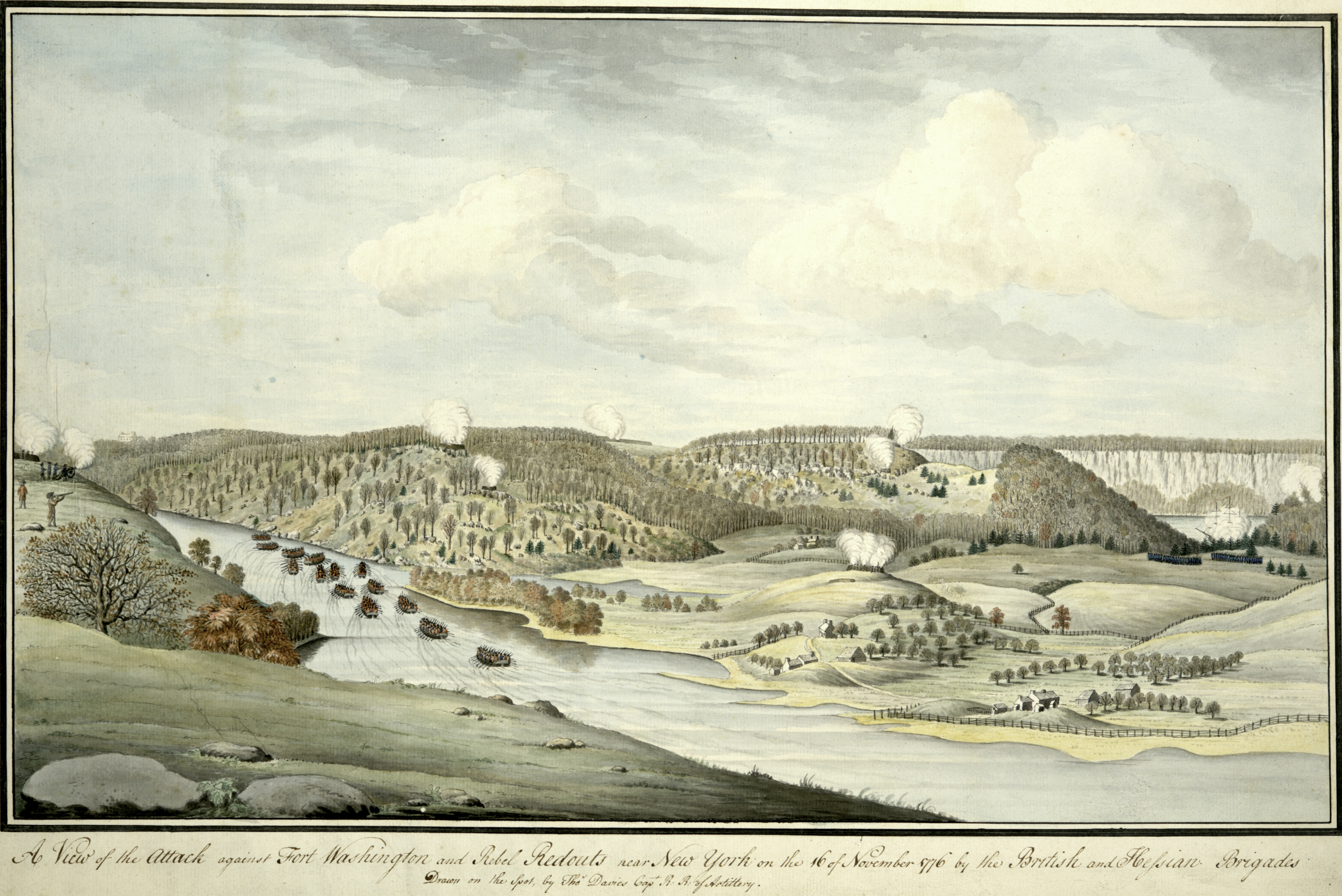
Fort Washington (Manhattan)
Colonel Robert Magaw was given the chance to surrender. He refused, sending word to the British that he would defend Fort Washington 'to the last extremity.' It was a brave statement, but bravery was not enough. Unknown to Magaw, one of his own officers had already walked into the British camp with complete plans of the fort's defenses. On November 16, 1776, at the highest point on Manhattan Island, the Continental Army suffered one of its worst defeats of the entire war - and the prisoners who survived the battle faced a winter that would kill most of them anyway.
The Highest Ground
Fort Washington occupied a commanding position at the northern end of Manhattan, built on a rocky promontory of schist that rises to the island's highest natural elevation. George Washington ordered the fort's construction because he believed - or at least hoped - that a fortified position here, paired with Fort Lee across the Hudson on the New Jersey Palisades, could prevent British warships from sailing upriver and severing the colonies. The two forts were linked by chevaux-de-frise, underwater barriers of iron-spiked logs designed to damage any ship that tried to pass. But Washington harbored deep doubts about whether New York could be defended at all, given the Continental Army's limited resources and the overwhelming superiority of the Royal Navy.
Betrayal and Assault
The fort's doom was sealed two weeks before the attack. On November 2, 1776, William Demont, one of Magaw's officers, deserted to the British and delivered detailed plans of the American fortifications and troop positions to General William Howe. Armed with this intelligence, Howe assembled a force of approximately 8,000 men, including Hessian soldiers under Lieutenant General Wilhelm von Knyphausen, and launched a coordinated assault on November 16. The attack came from multiple directions simultaneously. Despite fierce resistance in some sectors, the Americans were overwhelmed. Magaw surrendered the garrison, and 2,838 Continental soldiers became prisoners of war. British and Hessian casualties numbered 132 killed and 374 wounded - a fraction of the American losses. The fort was renamed Fort Knyphausen in honor of the Hessian commander.
Margaret Corbin and the Prisoners' Fate
Among the defenders was Margaret Corbin, a Pennsylvania-born colonist whose husband John Corbin served in the First Company of the Pennsylvania Artillery. When her husband was killed at his cannon, Margaret took his place, cleaning, loading, and firing the weapon until she herself was severely wounded. She survived but never regained the use of her left arm. Corbin is recognized as the first woman to fight as a soldier in the American Army, and she is believed to be one of the inspirations for the legendary figure of Molly Pitcher. The captured American soldiers fared far worse than Corbin. Marched through the streets of New York City to the jeering of the city's large Loyalist population, most were confined to British prison ships anchored in the harbor. Over 2,000 of the captured men died that winter of disease, cold, and starvation in the holds of those ships. Approximately 800 survived to be released in a prisoner exchange the following year.
Stones in a Park
The site of Fort Washington is now Bennett Park, a small public space on Fort Washington Avenue between West 183rd and 185th Streets in Washington Heights. Stones set into the ground trace the outlines of the fort's walls. A nearby tablet marks the schist outcropping as the highest natural point on Manhattan Island - the geological feature that made the location strategically valuable in 1776. Bennett Park sits just three blocks north of the George Washington Bridge, which now spans the same stretch of river the Continental Army tried to control with sunken timbers and cannon fire. Below the bluff, along the Hudson's edge beneath the Henry Hudson Parkway, Fort Washington Park extends to a small point of land called Jeffrey's Hook, where the Little Red Lighthouse has stood since 1921 - a modest beacon on the same riverbank where the ambitions of the American Revolution once nearly drowned.
From the Air
Located at 40.853N, 73.938W in the Washington Heights neighborhood of northern Manhattan. The site is at Manhattan's highest natural point, now Bennett Park, three blocks north of the George Washington Bridge. The GW Bridge is the primary visual landmark. Fort Washington Park runs along the Hudson River below the bluff, and the Little Red Lighthouse is visible at the water's edge near Jeffrey's Hook. Closest airports: KTEB (Teterboro, 6 nm NW), KLGA (LaGuardia, 6 nm E), KEWR (Newark Liberty, 13 nm SW). Best viewed at 1,000-2,000 ft AGL.