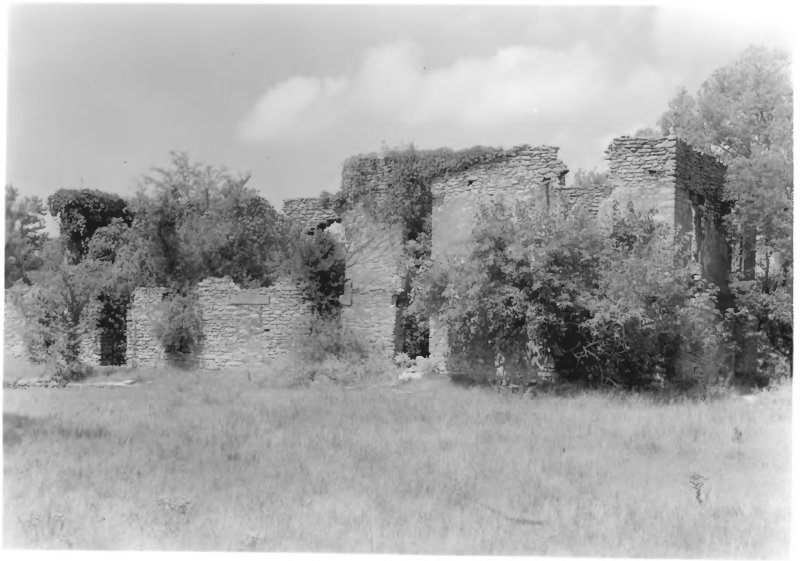
Fort Washita
The Chickasaws paid $530,000 for the right to settle on land they were afraid to occupy. Removed from their southeastern homelands in 1837, they had been assigned territory in the western reaches of Choctaw country, but the Comanche, Kiowa, and Wichita raiding parties that swept across the plains made the region feel less like a promised homeland and more like an exposed frontier. The nearest federal garrison, Fort Towson, sat eighty miles to the east -- far too distant to offer meaningful protection. Something had to change, and in 1842, General Zachary Taylor chose a patch of high ground a mile and a half east of the Washita River to build the fort that would bear the river's name.
Shield on the Prairie
Fort Washita rose from rolling prairie near the confluence of the Washita and Red Rivers, at a time when the Red River marked the southern boundary between Indian Territory and the young Republic of Texas. Companies A and F of the Second Dragoons did most of the construction, beginning with temporary log barracks in 1842. The Cross Timbers, a dense belt of nearly impassable trees and brush running north to south about nineteen miles west, formed a natural barrier between the plains tribes to the west and the relocated nations settling to the east. Within this fragile buffer zone, Fort Washita became the anchor of federal protection, eventually spanning over seven square miles and containing more than ninety buildings and structures. Limestone replaced logs as the fort matured: the south barracks went up in 1849, the west barracks in 1856, and by 1858 the complex included a hospital, surgeon's quarters, corral, stables, blacksmith shop, and farrier facilities.
Crossroads of War and Westward Expansion
When the Mexican-American War erupted in May 1846, Fort Washita transformed from a quiet frontier garrison of 150 troops into a bustling staging point housing nearly 2,000 soldiers. Traffic surged along the Texas Road heading south. The Chickasaws seized this moment of proximity to federal power, gathering at nearby Boiling Springs in 1846 to adopt their first constitution and again in 1848 to establish a government separate from the Choctaws. During the California Gold Rush, Fort Washita became a critical rendezvous point for emigrants choosing the southern route to avoid cholera, snow, and the hazards of northern trails. Parties would consolidate at the fort, elect officers, and make final preparations before crossing the Red River into Texas and angling southwest toward El Paso. The fort's prominence grew so great that in 1853, the headquarters of the Seventh Military Department transferred there.
Officers Who Became Generals
Fort Washita's roster reads like a Civil War preview. Zachary Taylor, who selected the site, became the twelfth President of the United States. Randolph B. Marcy and George McClellan both served there before rising to Union prominence. Major Daniel Ruggles commanded the post from 1849 to 1851 and was so well-liked that the nearby settlement was named Rugglesville in his honor; he later became a Confederate general. When news of Fort Sumter reached the garrison in April 1861, Lieutenant William Emory led his federal forces on a harrowing march to Fort Leavenworth, Kansas, with 4,000 Texas militia pursuing one day behind. The Confederates seized Fort Washita immediately afterward. Both the Choctaw and Chickasaw nations allied with the Confederacy, and the fort served as an important supply depot throughout the war, though it never saw direct combat.
Ruins, Revival, and Homecoming
Confederate troops burned what remained of Fort Washita at war's end in 1865, and the United States military never returned. The ruins passed into private hands, slowly crumbling over the decades. In 1927, history professor William Brown Morrison visited and found the remains "rapidly disintegrating and disappearing" but still "very extensive and very interesting." When the Oklahoma Historical Society purchased the grounds from the Colbert family in 1962, they documented eighty-six structures, fifty foundations, and just two buildings still standing. The site was declared a National Historic Landmark in 1965. Tragedy struck in 2010 when the reconstructed South Barracks was destroyed by fire. In 2017, stewardship came full circle when the Chickasaw Nation purchased Fort Washita, and in August 2023, the site was placed into federal trust -- returning to the people it was originally built to protect.
From the Air
Fort Washita sits at 34.10N, 96.55W, on rolling prairie northwest of Durant, Oklahoma. Look for the restored ruins just north of the Washita River's confluence with the Red River. Nearest airport: Eaker Field (KDUA) in Durant, about 12 miles southeast. Best viewed at 2,000-3,000 feet AGL. The limestone ruins and open grounds are visible against the surrounding grasslands.