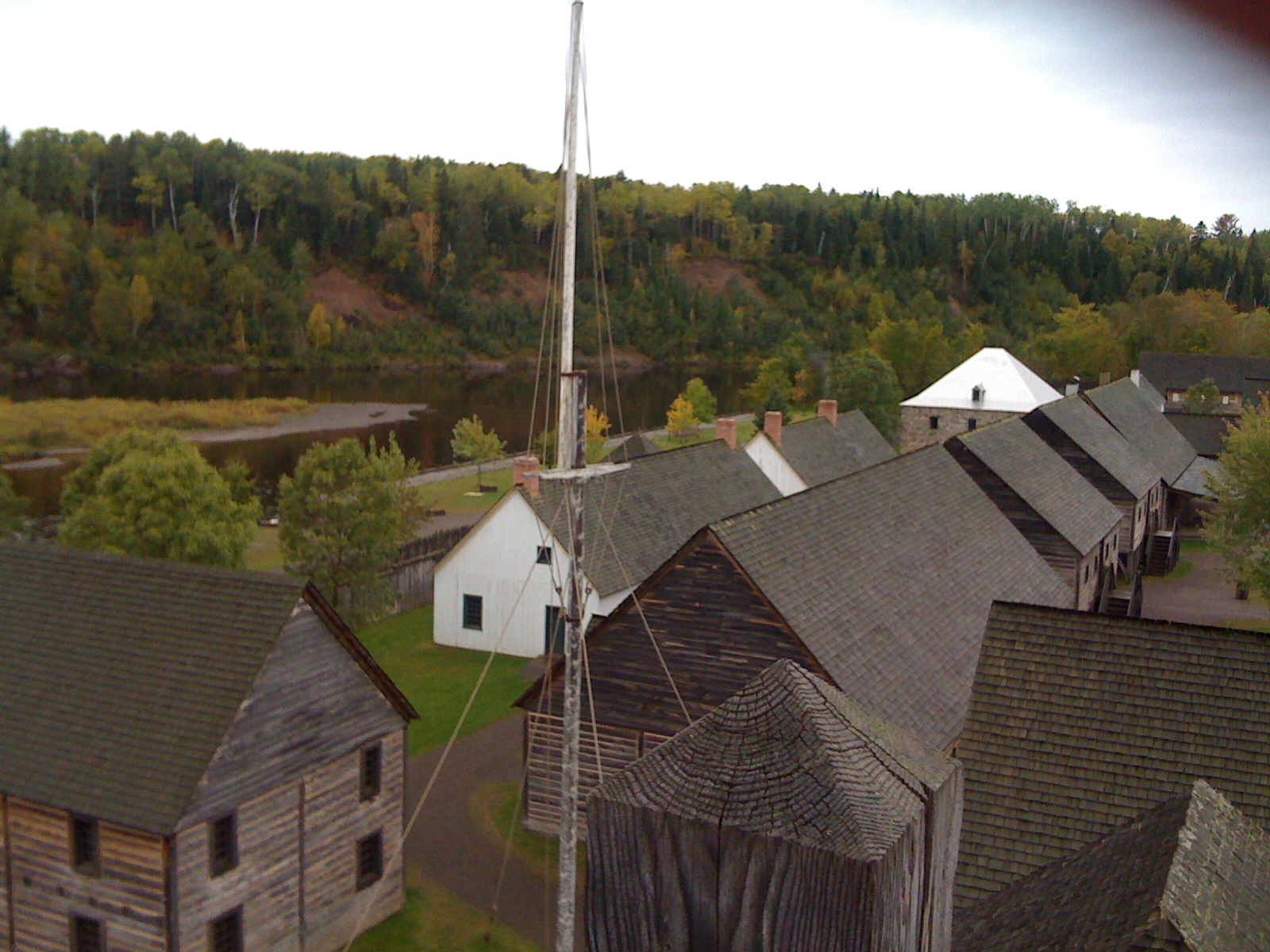
Fort William Historical Park
Every summer, the smell of birch bark and wood smoke drifts across the Kaministiquia River at Point de Meuron, just as it did two centuries ago. Fort William Historical Park in Thunder Bay, Ontario, is not a museum in any ordinary sense. It is a living reconstruction of the inland headquarters of the North West Company, frozen in the year 1816 - the moment when this sprawling depot stood at the center of a continental fur trade network that stretched from Montreal to the Pacific. Forty-two buildings fill the site: warehouses, workshops, a council house, an Ojibwa encampment, and a working farm. Costumed interpreters speak in character as Scottish partners, French Canadian voyageurs, and Ojibwa traders. A blacksmith hammers iron at a forge built to 19th-century specifications. A canoe builder bends birch bark using tools and techniques that have changed little in three hundred years.
A Border Drawn Through Commerce
The story of Fort William begins with a line on a map. The North West Company had operated its summer gathering point at Grand Portage, on the western shore of Lake Superior, for decades. But after the American Revolutionary War, the Jay Treaty of 1796 placed Grand Portage firmly inside the United States. British and Canadian fur traders faced a choice: pay American taxes or move. They moved north, establishing a new depot on the Canadian side of the border at the mouth of the Kaministiquia River. The post they built was no modest trading house. Fort William became the largest fur trade post in the interior of North America, a seasonal city where hundreds of voyageurs, traders, clerks, and Indigenous partners converged each July for the annual rendezvous - the great exchange of furs from the western interior for manufactured goods from Montreal.
The Great Rendezvous
The rendezvous was the heartbeat of the North West Company's operations. Every summer, brigades of voyageurs paddled massive birch bark canoes thousands of kilometers to reach Fort William. The winterers brought pelts from posts scattered across the continent. The Montreal men brought trade goods shipped from Europe. For several weeks, the fort transformed into a crossroads of cultures and commerce. Scottish merchants negotiated in the Great Hall. French Canadian voyageurs unloaded and repacked cargo. Ojibwa hunters and their families camped along the river, trading furs and local knowledge that made the entire enterprise possible. Today, Fort William Historical Park revives this gathering each summer with its own Great Rendezvous, drawing historical reenactors from across Canada and the United States who camp, trade, and compete in period contests on the same riverbanks.
Bloodlines of a New People
The fur trade created more than wealth. It created families. The North West Company's senior traders - the so-called winter partners who lived year-round at remote posts - frequently married into the leading families of Indigenous nations. These alliances were strategic as well as personal, binding trading partnerships through kinship. Two tiers of society emerged within the fort's walls. The children of traders and chiefs' daughters often received formal English educations alongside their mothers' Indigenous cultural knowledge, and many went on to hold positions in Canadian government and commerce. The children of lower-ranking workers and Indigenous women tended to remain in the fur trade economy, and their descendants became the Metis - a distinct people whose mixed heritage and unique culture trace directly back to posts like Fort William.
Hands That Keep the Old Ways
Walk through the fort today and you will hear the ring of a hammer on an anvil, the rasp of a cooper shaping barrel staves, and the quiet scrape of a knife against birch bark. Fort William maintains a working community of skilled tradesmen who practice their crafts using early 19th-century methods and tools. The blacksmith, tinsmith, carpenter, and cooper all produce functional goods in the manner of their predecessors. The canoe builder is particularly notable - birch bark canoe construction is a rare and exacting craft, and Fort William's builders have supplied canoes to other cultural institutions across Canada, including the Canadian Museum of Civilization. These artisans are not performing. They are practicing disciplines that require years of apprenticeship, working with materials that behave the same way they did in 1816.
Empires Rise and Fall on Rivers
Fort William's prominence was brief in historical terms. In 1816, Lord Selkirk seized the post during the Pemmican War. By 1821, the North West Company had been absorbed by the Hudson's Bay Company, and Fort William's role as a continental hub was finished. The original buildings were dismantled in 1902. The Thunder Bay Historical Society placed a plaque at the old site, which had long since been built over by the growing city. The reconstructed park, which opened on July 3, 1973, sits a few kilometers upstream at Point de Meuron - itself a place of layered history, having once hosted a Hudson's Bay Company post. In 2008, the fort added an amphitheatre capable of hosting audiences of up to 50,000, making it one of Canada's largest purpose-built outdoor entertainment venues. The contrast captures something essential about this place: a 19th-century fur trade post that has become a gathering point once again, drawing people to the same riverbanks for reasons that have changed but echo the old ones.
From the Air
Located at 48.34N, 89.36W on the banks of the Kaministiquia River in Thunder Bay, Ontario. The fort's 42-building compound and amphitheatre are visible from lower altitudes along the river's south bank, approximately 2 km west of Highway 61. Nearest airport: Thunder Bay International Airport (CYQT), approximately 8 km northeast. Elevation roughly 200 m (650 ft) MSL. The Kaministiquia River and its confluence with Lake Superior provide strong visual references. The Sleeping Giant formation on the Sibley Peninsula is a dramatic landmark visible to the east across Thunder Bay harbour.