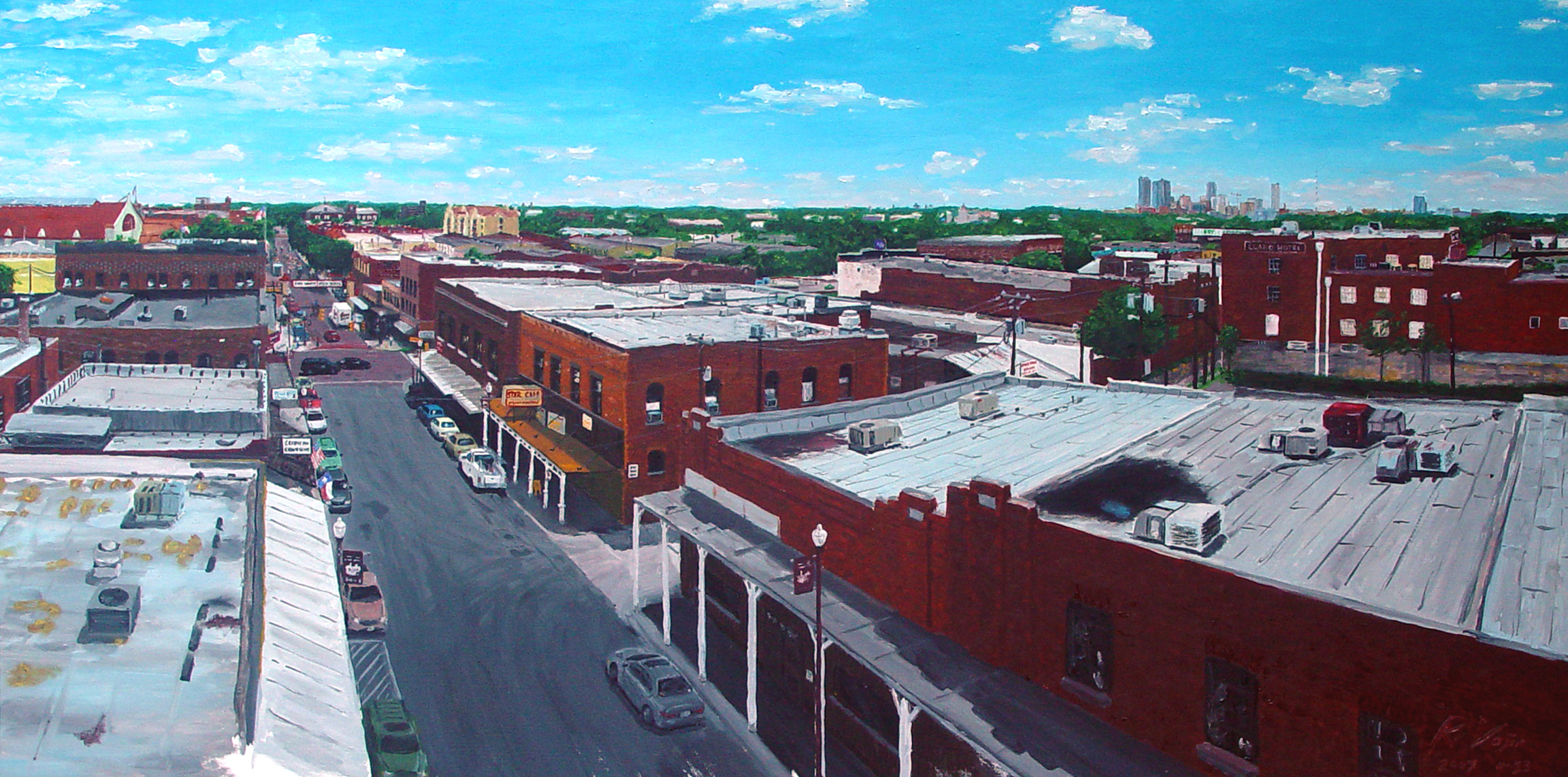
Fort Worth Stockyards
Every morning and every afternoon, a small herd of Texas longhorns ambles down Exchange Avenue in Fort Worth's Stockyards district, trailed by mounted drovers in period dress. Tourists line the brick sidewalks to photograph the spectacle, most of them unaware that this daily cattle drive is not an invention of the tourism board. It is a continuation -- stylized, yes, but rooted in a tradition that stretches back to the late 19th century, when frontiersman Charles 'Buffalo' Jones herded buffalo calves through the streets of Garden City, Kansas. What began as a practical necessity became Fort Worth's defining ritual, and the Stockyards remain the place where the city earns its unofficial motto: 'Where the West Begins.'
Railroads and Riches
The railroads arrived in 1876 and transformed Fort Worth from a frontier outpost into a livestock juggernaut. By 1890, the Fort Worth Union Stockyards had opened for business on 206 acres of pens, chutes, and holding yards north of the central business district. Boston capitalist Greenleif W. Simpson, along with a half-dozen associates from Boston and Chicago, incorporated the Fort Worth Stock Yards Company on March 23, 1893, purchasing the existing Union Stock Yards and the Fort Worth Packing Company. They courted the Swift and Armour meatpacking companies to establish packing houses on site. The strategy worked. By 1907, the Stockyards were moving a million cattle per year. Fort Worth had become one of the most important livestock centers in the United States, a status it held for decades until the 1950s, when regional auctions closer to the ranches began siphoning business away.
The Bones of Cowtown
Listed on the National Register of Historic Places in 1976, the Fort Worth Stockyards Historic District preserves 46 contributing buildings and one contributing structure from its heyday. The Livestock Exchange Building still anchors the district, its heavy masonry and terra cotta ornament standing as a monument to the money that once flowed through its halls. The Thannisch Block Building houses the Stockyards Hotel, where guests sleep in rooms named after famous outlaws and cattle barons. The entrance sign, the Armour & Swift Plaza, and the Cowtown Coliseum are all designated Texas State Antiquities Landmarks. The architectural mix is a distinctive blend of Mission Revival and Spanish Revival styles -- ornate enough to announce that Fort Worth's cattle trade was serious business, sturdy enough to survive a century of Texas weather.
Saloons and Saddle Shops
Today the Stockyards hum with a different kind of commerce. The White Elephant Saloon pours drinks on the same street where cattlemen once closed million-dollar deals with a handshake. M.L. Leddy's, the celebrated boot-making company, has occupied a storefront in the heart of the district for decades, hand-crafting custom boots that can take months to produce. The Maverick Fine Western Wear and Saloon invites customers to 'belly up to the bar, relax and have a cold beer while in the Stockyards -- just like they did in the days of the big cattle drives.' A vintage railroad, the Grapevine Vintage Railroad, still runs from the Stockyards station. Fort Worth's sesquicentennial in 1999 was marked by a full reenactment of a 19th-century cattle drive through the streets, a nod to the district's insistence that its identity is not a costume but a continuation.
Where the West Begins
Fort Worth has always been the rougher, more western counterpart to its eastern neighbor Dallas, and the Stockyards are the physical proof of that distinction. While Dallas built skyscrapers and banking headquarters, Fort Worth built cattle pens and packing houses. The rivalry is older than either city's skyline. The Stockyards embody something that Dallas never claimed: a direct, tangible connection to the open-range cattle culture that defined the American West. The daily cattle drives are not just entertainment -- they are an assertion of identity, a declaration that the frontier is not entirely gone. As late as the early 2020s, the Fort Worth Herd was actively hiring new drovers to lead the longhorns, posting job listings that read like dispatches from another century. In a city of 900,000 people with freeways and Fortune 500 companies, cattle still have the right of way.
From the Air
Located at 32.790°N, 97.346°W, just north of downtown Fort Worth. The Stockyards district is identifiable from the air by its distinctive grid of low-rise historic buildings and large open areas where cattle pens once stood, adjacent to railroad tracks. Best viewed from 2,000-4,000 ft AGL. Nearest airports: KFTW (Fort Worth Meacham International, 3 nm N), KAFW (Fort Worth Alliance Airport, 12 nm N), KDFW (Dallas/Fort Worth International, 15 nm NE). The Trinity River curves just south of the district.