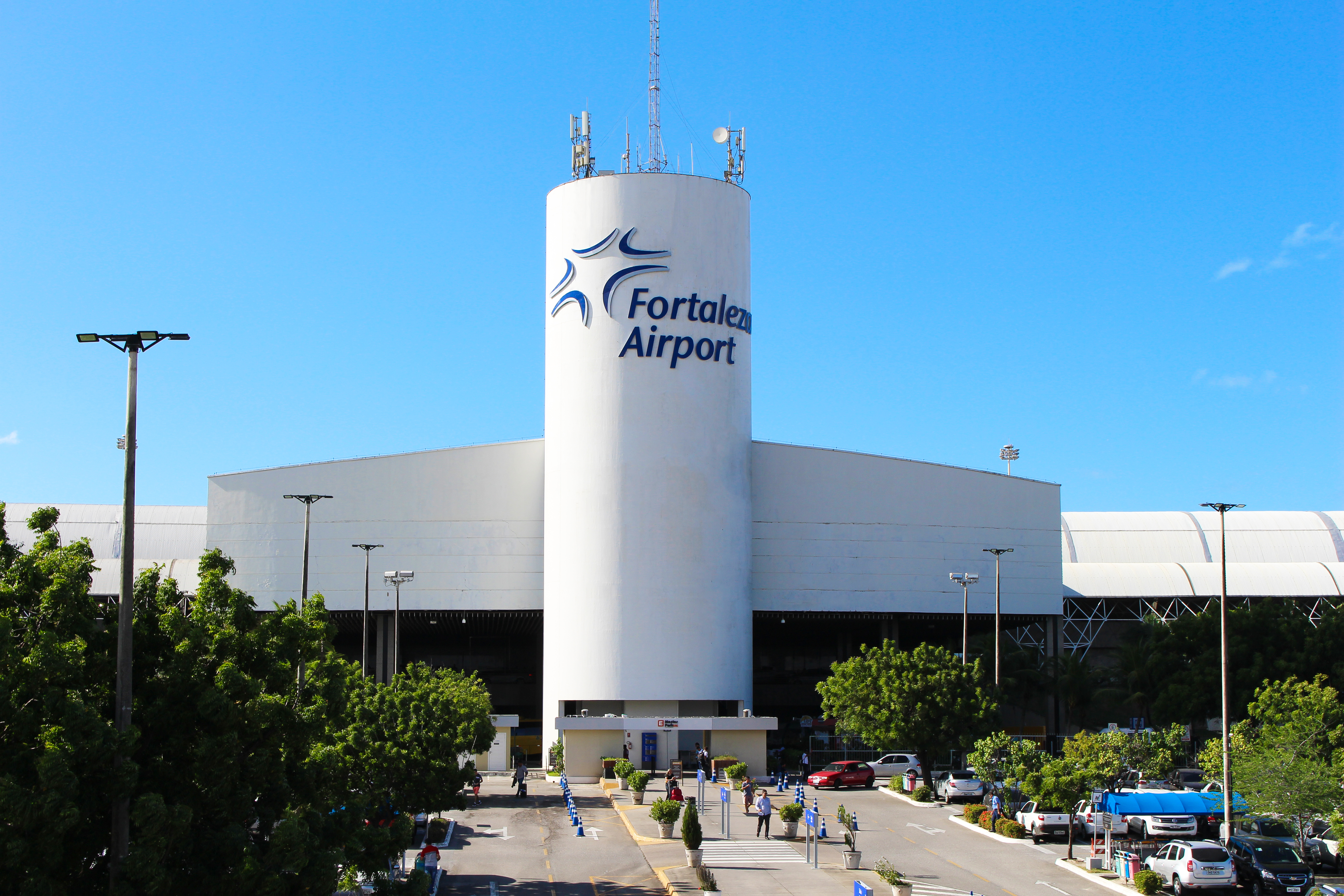
Fortaleza Airport
Euclides Pinto Martins died in 1924 at thirty-two years old, barely two years after proving that New York and Rio de Janeiro could be connected by air. The airport outside Fortaleza carries his name, and every jet that lifts off its runway traces a line he helped imagine into being. The asphalt here has been known by other titles and run by other hands, but since 1952 it has belonged, in memory at least, to a young Ceará aviator who flew far from the red-tiled rooftops of his home state before his time ran out.
From Dirt Strip to Wartime Lifeline
The story of the airport begins on a runway cut from Ceará scrubland in the 1930s, used for years by the Ceará Flying School. Then the Second World War arrived, and the strategic bulge of Brazil suddenly mattered enormously. Fortaleza sits closer to Africa than almost any other major city in the Americas, making its airfield a natural stepping stone for Allied aircraft ferrying men, cargo, and news across the South Atlantic. For a few charged years, American engines warmed up on these taxiways before the long hop eastward. The field was still called Cocorote then, a name drawn from the surrounding landscape. It would hold that title until May 13, 1952, when the Brazilian government rechristened it for Pinto Martins, giving the pioneer aviator a permanent address in the city he'd left behind.
A Gateway Grown by Football
For decades, Pinto Martins served the northeast as a regional node. The international upgrade came only in 1997, and the real transformation arrived with the 2014 FIFA World Cup. Fortaleza was one of Brazil's twelve host cities, and Infraero, the federal airport authority, announced a 525-million-real modernization in 2009 to prepare for the world's arrival. Aprons widened. The terminal stretched. Boarding bridges multiplied from seven to sixteen. By the time Germany faced Ghana here in the group stage and Brazil beat Colombia in the quarterfinals at nearby Arena Castelão, travelers passed through a facility that looked almost nothing like the Cocorote field of a generation earlier. Capacity climbed to over eleven million passengers a year, making Fortaleza the third-busiest airport in Brazil's northeast.
The German Takeover
On March 16, 2017, something unusual happened in Brazilian aviation history: Fortaleza's airport was auctioned to Fraport AG, the same German consortium that runs Frankfurt. The price was 425 million reais for a thirty-year concession, and from January 2, 2018, Fraport has been the sole operator. The transition reshaped the airport's personality. A new two-story extension opened in 2019, a sixty-position check-in hall followed, and the full renovation finished in April 2020, just as the pandemic was emptying the concourses Fraport had spent years expanding. The airport today covers 531 hectares with a single runway, and the old 1966 terminal on the north side has found a second life serving private jets and air taxis.
A Closer Brazil to the World
Fortaleza's geography gives it an advantage that larger Brazilian hubs cannot match: Lisbon is just 5,608 kilometers away, closer than any other point in Brazil. LATAM, TAP, Iberia, and Air France have all built seasonal or year-round routes that exploit this proximity, turning Pinto Martins into an unlikely transatlantic gateway. Northbound travelers can fly directly to Miami and, on select Iberia aircraft, to Madrid. Regional connections fan out to Buenos Aires, Bogota, and Praia in Cape Verde. For a city long thought of as the end of a domestic route, the airport has become something more ambitious: a place where the red earth of the Brazilian northeast meets the wider Atlantic world in the span of a single boarding call.
The Man in the Name
Most passengers rushing through the concourse never think about who Pinto Martins was. Born in Camocim on the Ceará coast in 1892, he joined a small fraternity of early Brazilian aviators willing to risk their lives proving that commercial aviation was possible in a country whose sheer size made other forms of transport agonizing. His 1922 flight linking New York with Rio de Janeiro was a multi-stage odyssey undertaken in fragile aircraft over territory with almost no emergency landing options. He died two years later at thirty-two. The law that named the airport for him in 1952 made a specific exception to naming rules in his honor, keeping his name even when a later decree might have changed it. It is an unusually careful act of remembrance for a man whose work made this place possible.
From the Air
Fortaleza-Pinto Martins International Airport (SBFZ / FOR) sits at 3.78 degrees south, 38.53 degrees west, six kilometers south of downtown Fortaleza on Brazil's northeast coast. Field elevation is roughly 25 meters above sea level, with a single runway of about 2,755 meters. Best viewing altitude for the airport and surrounding city is 3,000-5,000 feet above ground on approach from the Atlantic, with the coastline and the white dunes of Praia do Futuro visible to the northeast. Trade winds from the east are nearly constant year-round. Nearby fields include Jericoacoara (SBJE) to the west and Natal-Augusto Severo (SBSG) to the northeast.