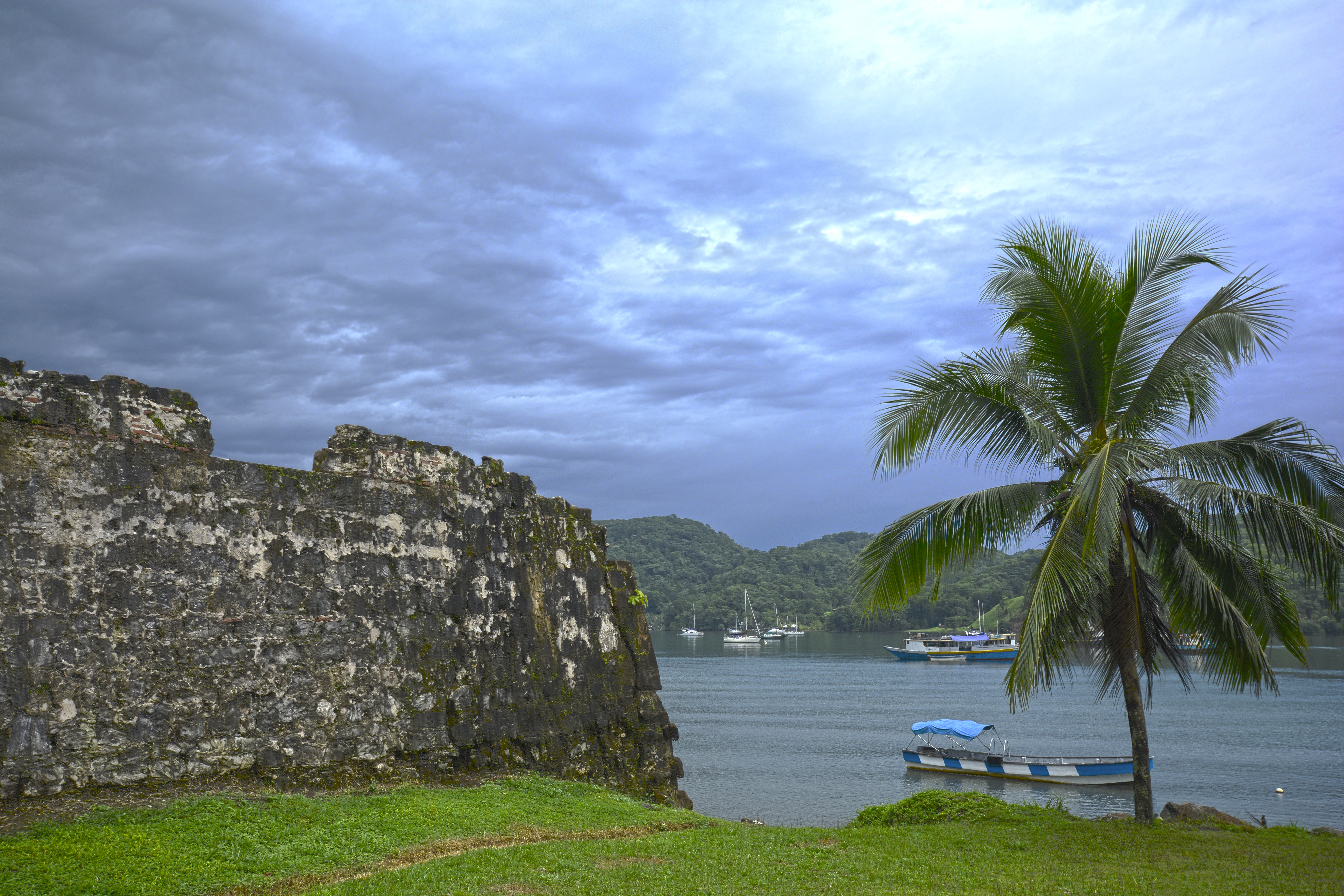
Fortifications on the Caribbean Side of Panama: Portobelo-San Lorenzo
The cannons are still there. Spiked by attackers to prevent reuse, their iron barrels rust in the Caribbean salt air while the wooden carriages that once held them have long since rotted away. Scattered across the bays and headlands of Panama's Colon Province, the fortifications at Portobelo and San Lorenzo represent two centuries of Spanish military engineering -- built, destroyed, rebuilt, and destroyed again in a cycle driven by one overwhelming fact: the wealth of an empire flowed through here. In 1980, UNESCO inscribed both sites as a World Heritage Site, calling them "magnificent examples of 17th- and 18th-century military architecture" that formed part of the defense system the Spanish Crown built to protect transatlantic trade.
Two Locks on the Treasure Road
Portobelo and San Lorenzo sit approximately 80 kilometers apart on Panama's Caribbean coast, and together they controlled the two routes by which Spanish treasure crossed the isthmus. Portobelo's fortifications guarded the harbor where silver from Peru, carried overland by mule train along the Camino Real from Panama City, was loaded onto galleons of the Spanish Plate Fleet. San Lorenzo, perched at the mouth of the Chagres River, protected the alternative water-and-land route: goods traveled upriver by boat and then overland via the town of Cruces. The Spanish built Portobelo as a replacement for the earlier Caribbean terminal at Nombre de Dios, which had proven too vulnerable to attack and too exposed to seasonal rains that made overland transport nearly impossible.
Medieval Walls, Neoclassical Ambitions
The earliest fortifications at Portobelo, constructed between 1596 and 1599, followed medieval Spanish military designs drawn up by the Italian-born engineer Bautista Antonelli. These initial structures featured thick stone walls, narrow embrasures, and compact layouts suited to resisting infantry assault and cannon bombardment from ships. By the 18th century, the architectural language had shifted. Engineers Salas and Hernandez, working between 1753 and 1760, rebuilt the Santiago, San Jeronimo, and San Fernando forts with neoclassical features -- wider fields of fire, more sophisticated battery placements, and integrated strongholds at multiple elevations. San Fernando alone incorporated a lower battery, an upper battery, and a hilltop stronghold, creating layered defenses that could engage enemies at the waterline and on the surrounding heights simultaneously.
An Inventory of Defiance
The full roster of fortifications around Portobelo Bay reads like a catalog of persistent paranoia -- justified, given how often the port was attacked. The Santiago complex included the Castle of Santiago de la Gloria, the Old Santiago Fortress, the ruins of the Castillo del Hierro (the Iron Castle), the La Trinchera site, and the Buenaventura Battery. Across the harbor, the San Fernando fortifications layered lower and upper batteries beneath a hilltop stronghold, with the San Jeronimo Battery Fort covering the inner approaches. On the Chagres River, 80 kilometers to the west, San Lorenzo Castle -- originally named San Lorenzo el Real del Chagre -- commanded the river mouth from a high bluff. The custom house at Portobelo, damaged in an attack in 1744, has been rebuilt and now serves as a museum. Between the two sites, the Spanish erected, lost, and rebuilt these defenses across nearly 200 years of colonial warfare.
Heritage in Danger
UNESCO's 1980 inscription recognized the fortifications under two criteria: as masterpieces of human creative genius and as outstanding examples of a type of building that illustrates a significant stage in history. But recognition has not meant safety. In 2012, the Global Heritage Fund flagged the sites, and they were added to UNESCO's List of World Heritage in Danger. Tropical climate, coastal erosion, vegetation encroachment, and insufficient conservation funding have all taken their toll. Panama's legal framework provides protection through Law 14/1982, updated by Law 58/2003, with underwater archaeological remains covered under Law 32/2003. The fortifications and approximately 36,000 hectares of surrounding tropical rainforest are also protected as part of Portobelo National Park. The challenge, as with so many heritage sites, is converting legal protection into physical preservation before the Caribbean reclaims what the Spanish built.
From the Air
The Portobelo fortifications are centered at 9.554N, 79.656W on a deep natural harbor along Panama's Caribbean coast. From 3,000-5,000 feet AGL, the bay's narrow entrance and the fort ruins along both shorelines are clearly visible, with San Fernando on the western shore and Santiago on the eastern. San Lorenzo Castle is located approximately 80 km to the west at the mouth of the Chagres River (9.32N, 80.02W). Colon's France Field/Enrique Adolfo Jimenez Airport (MPEJ) is the nearest airfield, approximately 25 km west of Portobelo. The area is characterized by tropical maritime weather with frequent afternoon convection, low ceilings in the morning, and heavy rainfall throughout much of the year.