Fortified Position of Liege: A Ring of Forts That Held Twice and Fell Twice
On the night of 15 August 1914, lightning lit the sky above Fort de Loncin on the western edge of Liege. Inside the central magazine, beneath layer upon layer of concrete that had not bonded properly when it was poured a quarter-century earlier, a German 42cm shell found its way through. The explosion that followed dismembered the fort and killed roughly 350 men where they stood. Their bones are still inside the rubble. Loncin has never been rebuilt; it remains a military cemetery, a memorial, and the most honest monument the Fortified Position of Liege has. Everything that followed - the rebuilding in the 1930s, Eben-Emael, the fall in May 1940 - is in some sense a long footnote to that one night.
Brialmont's Twelve
When Belgium accepted in 1887 that the next war would come down the Meuse, it gave the job of fortifying its eastern frontier to one man: Henri Alexis Brialmont, a Belgian general who had already built the National Redoubt at Antwerp. He drew up a ring of twelve forts - six large, six small - placed in a 46-kilometre arc roughly 7 kilometres out from Liege. Each had two trace plans, triangular or trapezoidal depending on the ground, and each was to be the first fort in the world built entirely of concrete. Construction began on 28 July 1888 and finished in October 1891. Around Liege, workers excavated 1.48 million cubic metres of earth and poured 601,140 cubic metres of concrete at a final cost of 71.6 million francs.
The Flaws Nobody Tested
Brialmont designed his forts to withstand the heaviest artillery of the 1880s: 21cm guns firing shells that the new German 42cm howitzers outmatched by a factor of fifteen in destructive energy. They were never modernized. By 1914 the German siege train was throwing 28cm and 42cm shells generating fifteen times that energy. The concrete itself had a hidden weakness: it could not be poured at night for lack of lighting, so each day's pour sat overnight before the next began, and the layers never fully bonded. When Loncin took its decisive hit, the shockwave found those seams and the fort came apart in slabs. The men inside also paid for choices made on paper. Latrines, kitchens, the morgue and the showers had all been placed in the counterscarp - the rear ditch facing Liege - because in 1888 mechanical ventilation barely existed and the planners wanted natural airflow. Heavy shellfire made the counterscarp untenable. The garrisons were driven back into the central massif, which had sanitation for a fraction of their number. Powder gas, dust and the stench of unmanaged human waste made the air unbreathable; several forts surrendered not from broken guns but from broken air.
Holding Long Enough
Despite everything, the Liege forts did their job in 1914. Their delay - roughly a week before the last fort fell - bought time for the Belgian and French armies to mobilize and threw the German timetable for the invasion of France off rhythm. That delay matters. It is also a memory that survivors and their families carried for the rest of their lives. The forts held while the air went bad and the concrete cracked, while the wounded crowded into rooms designed for fifty. By the time Loncin exploded, the fortress ring had earned its place in Belgian memory not as engineering triumph but as endurance under impossible odds.
Rebuilding with Lessons Learned
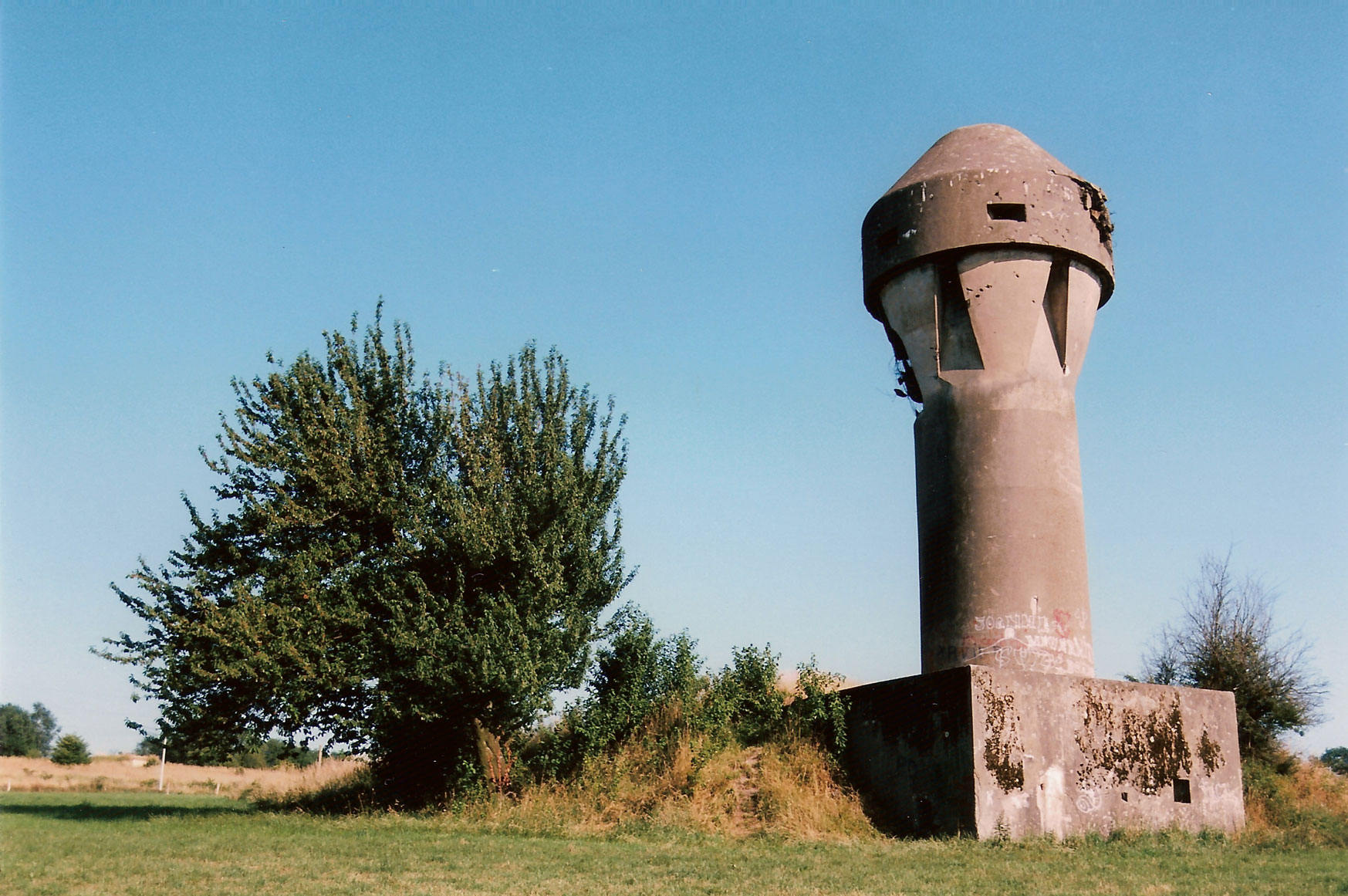
After the war, a commission spent years asking how to do better. The 1927 report recommended a new line of fortifications east of the Meuse, closer to Germany. Budget crises delayed everything except Fort Eben-Emael; work on Battice, Aubin-Neufchateau and Tancremont only began in 1933. The result was the Position Fortifiee de Liege - five layers in all. Position avancees were 66 small bunkers right on the border. PFL I was the four new forts plus 178 supporting bunkers. PFL II was the old Brialmont ring, modernized: longer-range 15cm guns replaced the 21cm howitzers, forced ventilation finally arrived, sanitation and accommodations were redesigned, and disguised air-intake towers that looked like water tanks doubled as observation posts. PFL III and IV covered the Meuse crossings and the western bank. Loncin alone could not be repaired and was left as it stood.
May 1940
The plan was for Eben-Emael to be the keystone. Instead, on 10 May, eighty-five German gliderborne troops disabled it in a single morning, and the other PFL I forts found themselves facing the German Army without their northern anchor. Battice and Aubin-Neufchateau surrendered on 22 May; Tancremont was bypassed. The old Brialmont forts of PFL II were assaulted from 12 May after Belgian field forces withdrew. Flemalle fell on 16 May after air attack. On 18 May the same German infantry battalion that had taken Eben-Emael assaulted Fort de Barchon with a 420mm howitzer in support. Barchon, Fleron and Pontisse all surrendered the same day. The remaining forts were bypassed and surrendered on 28 May as part of the general Belgian capitulation. Tancremont held out one extra day, the last to give up. Each of those surrenders represents Belgian conscripts and reservists, mostly young men, who fought the war they had been told to expect and found a different one waiting.
What You Can See Today
Seven of the Brialmont forts are open to the public: Loncin, Lantin, Flemalle, Hollogne, Pontisse, Barchon and Embourg. Loncin remains the most affecting - a quiet military cemetery built into ruin, with the names of the men still inside the broken concrete inscribed at the entrance. Lantin, never re-armed between the wars, looks essentially as it did when finished in 1888. Tancremont is notably intact, with much of its 1930s equipment still in place. Eben-Emael is preserved as a museum. Walk any of them and you can read the lessons in the architecture: thicker concrete, better air, longer guns - and the recognition, finally, that the men in the rooms mattered as much as the guns in the cupolas.
From the Air
The Fortified Position of Liege spans both banks of the Meuse around the city of Liege at approximately 50.63N, 5.57E, with the outer PFL I line including Fort Eben-Emael (50.797N, 5.681E) running north toward Maastricht. From the air, look for the wide Meuse valley curving through the Pays de Herve hills, and the small wooded mounds 7km out from Liege that mark Brialmont's ring. Nearest airports: Liege (EBLG) at the heart of the position, Maastricht-Aachen (EHBK) to the north, Brussels (EBBR) 90km west, Cologne-Bonn (EDDK) 100km east.